How to Maximize Behavioral Health Reimbursements in 2026

What if the claim isn’t where your reimbursement problem begins? A payment can stall or shrink because eligibility wasn’t confirmed, authorization details were missed, documentation didn’t support the service, or a denial wasn’t followed through. If slow, partial, or missing payer payments are hard to explain, focusing only on claim submission leaves too much of the billing cycle in the dark. To maximize behavioral health reimbursements, practices need visibility from the first insurance check through final payment posting.
You don’t need to fix every process at once. Find the gaps with the greatest effect, address them in a practical order, and measure whether the changes improve collections.
This guide shows you how to trace revenue leakage across the behavioral health billing cycle and prioritize fixes across verification, authorization, claims, and denial follow-up. You’ll learn how to use payment and workflow data to identify where claims stall, which patterns need attention, and whether a change is working. The goal is a more controlled reimbursement process, not more busywork for your team.
Key Takeaways
- Separate billed charges, allowed amounts, payer payments, adjustments, and patient responsibility to pinpoint where expected revenue changes.
- Use a pre-appointment sequence: confirm enrollment, verify benefits, check authorization, and reconcile scheduled services. Eligibility is a point-in-time check, not a payment guarantee.
- Connect documentation, code selection, modifiers, provider details, and payer edits to claim accuracy. Consult current payer policies and authoritative coding guidance before making corrections.
- To maximize behavioral health reimbursements, define consistent measures for net collections, AR aging, denial patterns, and unresolved claims, then segment results to expose patterns.
- Build a sustained plan by establishing a baseline, choosing one priority, assigning ownership, and reviewing results to determine whether workflow changes or broader RCM oversight may help.
What it means to maximize behavioral health reimbursements
Reimbursement optimization isn’t about billing more or expecting a payer to raise its rates. It means reliably collecting the accurate, contractually allowable payment for covered services, then accounting for the remaining balance correctly. Improving collections means recovering more of what a practice is entitled to, not simply submitting more claims.
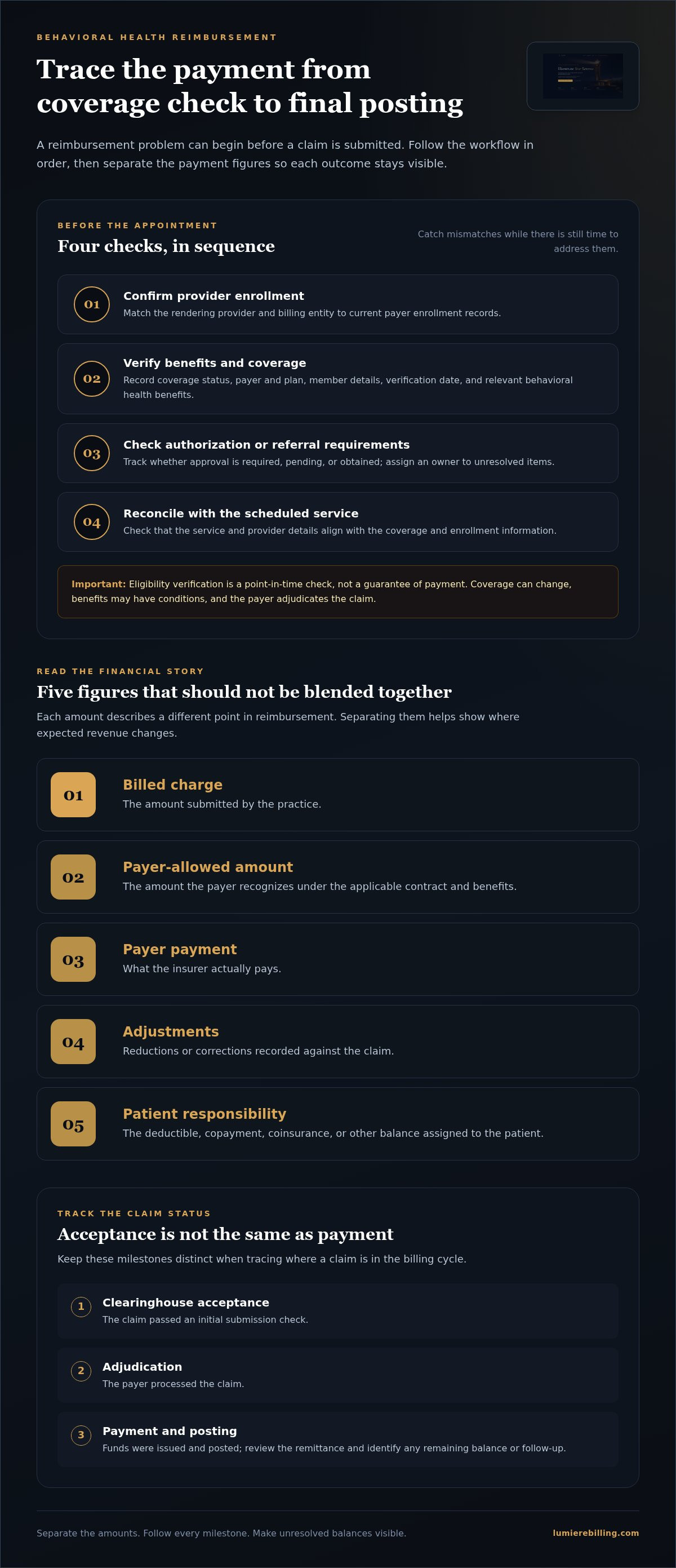
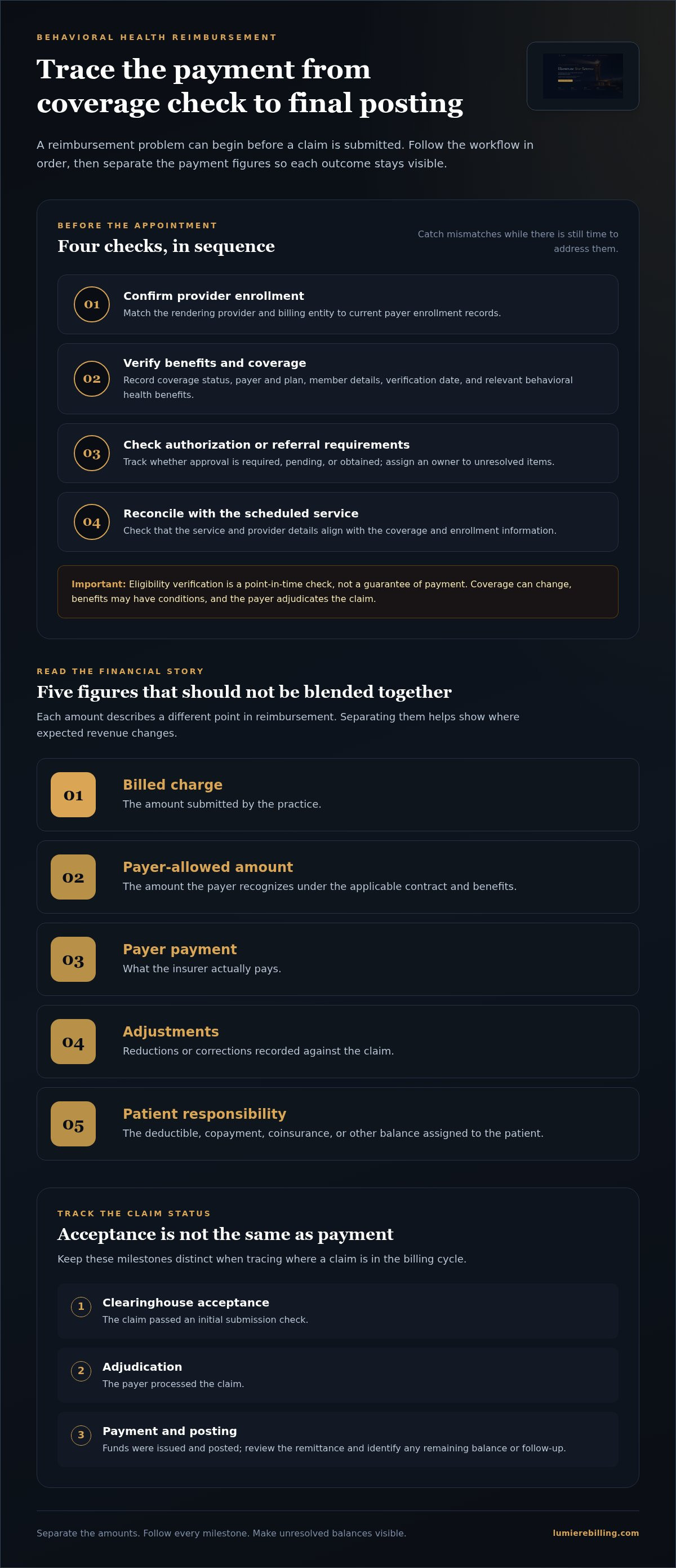
Look beyond the billed charge. The billed charge is the amount submitted by the practice; the payer-allowed amount is what the payer recognizes under the applicable contract and benefits. The payer payment is what the insurer actually pays. Adjustments record reductions or corrections, while patient responsibility is the deductible, copayment, coinsurance, or other balance assigned to the patient. Each amount tells a different part of the story.
The claim journey starts before a service is delivered. Enrollment, eligibility, and authorization checks establish important details. Documentation and accurate claim data support submission; payer adjudication determines how the claim is processed; and payment posting records the result and identifies any remaining balance or follow-up. A break at one stage can obscure what happened next. Behavioral health practices operating under different funding arrangements should also distinguish those structures. For example, the Certified Community Behavioral Health Clinic (CCBHC) model has a distinct reimbursement context involving Medicaid and SAMHSA grants.
Which reimbursement measures should a behavioral health practice distinguish?
Start by comparing collections with expected allowed amounts for the same set of services. Use a consistent definition of what counts as collected and which adjustments are excluded. Then separate the claim milestones: clearinghouse acceptance means a claim passed an initial submission check; adjudication means the payer processed it; payment means funds were issued and posted. Track adjustments and patient balances separately so they don’t disappear inside a single “paid” total.
For useful comparisons, group results consistently by payer, provider, service, and time period. Otherwise, a shift in payer mix or service volume can look like a reimbursement change when it isn’t.
Where can reimbursement be lost before payment?
A small intake error can carry through the claim. Outdated insurance details may lead to an incorrect eligibility check; a missed authorization requirement can interrupt processing; and inaccurate provider or claim information can trigger a rejection or denial. Even after adjudication, an unreviewed remittance or an unassigned patient balance can leave the outcome unresolved.
Trace each claim from enrollment and coverage checks through authorization, submission, payer response, and remittance posting. This shows whether revenue is delayed, adjusted, denied, or simply waiting for follow-up. For a broader view of how these stages fit together, see the behavioral health revenue cycle management guide.
Strengthen behavioral health reimbursement before the appointment
Pre-service checks work best as a defined sequence, not a set of disconnected tasks. Confirm that the rendering and billing providers are enrolled with the payer, verify the patient’s benefits, identify authorization or referral requirements, then reconcile that information against the service on the schedule. This order helps staff catch mismatches while there’s still time to address them.
Eligibility verification is a point-in-time check, not a guarantee that a claim will be paid. Coverage can change, benefits may have conditions, and the payer still adjudicates the claim based on the service and information submitted. Treat verification as evidence to record and act on, not as a promise of payment.
How do enrollment and provider records affect reimbursement?
Before care, compare the scheduled rendering provider and billing entity with current payer enrollment records. Check names, identifiers, tax details, practice locations, and effective dates against the records used for claims. A provider roster or demographic mismatch can prevent a claim from processing as expected, even when coverage is active. For more detail on maintaining those records, see the behavioral health provider roster guide.
What should insurance verification capture before care?
Give intake, scheduling, and billing teams a consistent record to work from. Capture:
- Coverage status, payer, plan, member details, and the date verification was completed.
- Relevant behavioral health benefits, including applicable cost-sharing information.
- Any identified authorization or referral requirement, its status, and the next follow-up owner.
- The scheduled service and provider details used to check coverage and enrollment.
Keep authorization tracking focused on control: note whether it’s required, whether it’s pending or obtained, and whether the approval details align with the scheduled care. Assign unresolved items to an owner before the appointment when possible. If a service, provider, or schedule changes, make the handoff visible so staff can reassess the relevant details instead of relying on an outdated check.
A clear handoff prevents intake findings from stopping at the front desk. Scheduling should know what remains unresolved; billing should be able to see the verification date, authorization status, and relevant plan details. HFMA’s revenue cycle management resources provide broader context for practices refining these workflows. Lumiere Billing provides specialized behavioral health revenue cycle management, from insurance verification through payment posting.
Improve claim accuracy and follow-through without chasing volume
More claims won’t solve a process that sends inaccurate information or leaves payer responses unattended. A focused review connects the clinical record to the claim: documentation must support the service performed, code selection, and any modifiers, while provider details and payer edits must align with the submitted claim. A mismatch can lead to rejection, denial, or an incorrect payment outcome.
How can a clean-claim review protect reimbursement?
Before submission, check that required fields are complete and consistent. Confirm the payer and member details, billing and rendering providers, service date, codes, modifiers, and authorization information against the record. Then verify that the documentation supports the services and codes reported. This is a control point, not a universal checklist. Payer-specific requirements and authoritative coding guidance can differ, so consult current sources before correcting a claim.
Corrections and appeals must reflect the documentation and applicable payer rules. Don’t change a code or add information simply to obtain payment. If a claim is rejected for a correctable data issue, address that issue. If it’s denied after adjudication, review the explanation and determine whether a correction, appeal, or other action is supported.
How should practices follow up on unpaid and denied claims?
Separate claims still awaiting adjudication from denials that need a response. They require different next steps. A work queue makes the distinction visible and helps staff focus on risk and action instead of processing claims by volume alone.
- Prioritize: Flag approaching timely-filing deadlines first, then weigh claim value and denial reason.
- Assign: Record the payer response, responsible owner, next action, and required follow-up date.
- Resolve: Track whether the claim was corrected, appealed, paid, adjusted, or remains open.
For example, a claim awaiting a payer response may need a status follow-up, while a denial for missing information needs a documented correction or appeal decision. Keep both visible until the result is posted and the remaining balance is understood. This prevents “submitted” from being mistaken for “resolved.”
Review denial reasons across claims, not just one at a time. Repeated provider-data issues may point to an enrollment or claim setup problem; recurring documentation or coding issues may signal a review or training need. Use the pattern to address the process, then monitor whether it recurs. The behavioral health billing errors guide offers more ways to identify preventable breaks. To maximize behavioral health reimbursements, pair accurate submission with disciplined follow-through, and verify that each correction is supported before resubmitting.
Measure reimbursement performance and prioritize the next fix
A compact dashboard can turn reimbursement activity into decisions. Track net collections, accounts receivable (AR) aging, denial patterns, and unresolved claims, but define each measure before comparing results. For example, specify which payments and adjustments count in net collections and what period the calculation covers. Without consistent definitions, a changing number may reflect a reporting difference rather than a workflow improvement.
Start with your own baseline. Segment results by payer, provider, service, and period where useful, so differences in payer mix or service volume don’t distort the picture. Then review claim status alongside AR aging. Older balances may indicate slow adjudication, unworked claims, or stalled follow-up. Review denial reasons, corrected-claim outcomes, and write-offs under consistent categories. Reconcile ERA and EOB details against posted payments to see whether adjudication was recorded accurately and the remaining balance was handled.
How should a practice choose which revenue issue to fix first?
Rank potential fixes by how often the issue occurs, its potential impact, any approaching filing deadlines, and whether the practice can address the cause. Assign each priority an owner, a specific next action, and a review date. A metric can point to a problem, but validate the underlying claim data before treating it as proof of a cause or a promised result.
| Possible finding | Investigative question | Next operational action |
|---|---|---|
| AR aging is rising for one payer | Are claims awaiting adjudication, or are follow-ups missing? | Review claim status and assign overdue follow-up. |
| A denial reason repeats | Does the pattern trace to documentation, coding, provider data, or payer edits? | Validate examples, then address the recurring process issue. |
| Posted payments differ from remittance details | Were payer payments, adjustments, and balances recorded correctly? | Reconcile the ERA or EOB and correct posting discrepancies. |
| Unresolved claims near filing deadlines | What response or correction is still outstanding, and who owns it? | Prioritize the next supported action and document the outcome. |
Use this review cycle to maximize behavioral health reimbursements through evidence-led adjustments, not assumptions. If your team needs a clearer view of revenue gaps across verification, claims, denials, and payment posting, a free billing audit can help identify where to focus next.
Turn reimbursement findings into a sustained behavioral health billing plan
A dashboard only creates value when findings lead to owned, reviewed changes. Keep the improvement plan focused: establish a baseline, select one priority, assign responsibility, then review whether the process and its results changed. Starting with one issue makes it easier to see what was addressed and what still needs attention.
What should a reimbursement improvement plan include?
For each priority, document the issue, the evidence behind it, the responsible owner, the corrective action, and a review date. For example, if a recurring denial appears tied to missing claim information, identify where that information should be captured, update the relevant handoff, and review a later set of claims to see whether the new step is being followed. Set a review cadence your team can sustain, and keep payer-specific rules and documentation standards current as you implement the change.
Internal workflow changes may be enough when the cause is clear, ownership is established, and staff can consistently complete and monitor the corrective step. Broader revenue-cycle oversight may help when issues recur across multiple stages, follow-up is fragmented, or the practice lacks a clear view from intake through payment posting. The deciding factor is visibility and execution, not how many tasks are added to the list.
How can specialized revenue-cycle support help?
Lumiere Billing focuses exclusively on behavioral health revenue-cycle management, connecting insurance verification, prior authorization, claims, denial prevention, payment posting, and analytics. Coordinated oversight connects intake findings to claim readiness, keeps payer responses visible, and uses payment data to identify where workflows need attention. This joined-up view supports a more durable plan than treating each stalled claim as an isolated event.
To maximize behavioral health reimbursements, keep the cycle active: measure, correct, and review. If you’ve identified gaps but need help understanding where they begin, request a free billing audit to bring reimbursement and workflow issues into focus.
Make your next reimbursement improvement measurable
Stronger reimbursement starts with a clear view of the full claim journey. Confirm front-end details, connect documentation to accurate claims, and follow each response through payment posting. Then use a consistent baseline to identify one priority, assign an owner, and review whether the workflow changed.
That’s a practical way to maximize behavioral health reimbursements without mistaking higher claim volume for better collections. Focused adjustments can address a specific gap; recurring issues across verification, authorization, claims, denials, and payment posting may call for broader revenue-cycle oversight.
Lumiere Billing specializes exclusively in behavioral health revenue-cycle management, with support spanning insurance verification through payment posting. A free billing audit can help surface reimbursement and workflow gaps so your team can see where to focus next. Request a free billing audit and take a clear first step toward a more controlled billing process.
With the right issue in focus and a plan to measure progress, your practice can move forward with greater clarity and confidence.
Frequently Asked Questions
How can a behavioral health practice maximize insurance reimbursements?
To maximize behavioral health reimbursements, manage the full claim journey rather than focusing only on submission. Confirm provider enrollment, verify benefits, identify authorization requirements, and reconcile scheduled services before care. Then ensure documentation supports the codes and details submitted, follow payer responses through adjudication, and post payments and adjustments accurately. Track results against a consistent baseline to identify recurring gaps and prioritize a practical correction.
Does insurance verification guarantee that a behavioral health claim will be paid?
No. Verification reflects coverage information available at the time of the check; it doesn’t guarantee that a specific service will be covered or that a claim will be paid. Benefits, authorization requirements, provider enrollment, documentation, and claim details can all affect adjudication. Record the verification date and findings, flag unresolved requirements for follow-up, and compare the final payer response with the information gathered before the appointment.
How do prior authorization issues affect behavioral health reimbursement?
An authorization problem can delay processing or contribute to a denial if a payer requires approval for the service and the claim doesn’t align with its authorization records. Track whether authorization is required, its status, relevant approved service details, and who owns follow-up. Reconcile scheduled care with those details, and investigate payer-specific requirements before correcting or appealing a claim. Keep authorization tracking connected to scheduling and billing workflows.
Which metrics should behavioral health practices track to improve collections?
Use a compact dashboard with net collections, accounts receivable aging, denial reasons, and unresolved claims. Define each measure consistently, including which payments and adjustments count, then compare results with your own baseline. Segment by payer, provider, service, and period where useful. Review claim statuses to distinguish delayed adjudication from missed follow-up, and reconcile remittance advice or explanation of benefits details with posted payments to identify discrepancies.
Can better documentation increase behavioral health reimbursement?
Accurate, complete documentation can support correct code selection and help show that submitted claims reflect the services provided. It won’t guarantee payment or change a payer’s contracted rate, but gaps or inconsistencies may contribute to denials, adjustments, or requests for more information. Check documentation against current payer policies and authoritative coding guidance. Any correction must reflect the record and the service actually delivered, not simply an effort to secure payment.
What should a practice do when an insurance claim is denied?
Review the denial reason and associated remittance details, then separate a correctable claim error from a dispute that may warrant an appeal. Compare the claim with the documentation, authorization information, provider records, and current payer requirements. Record the filing deadline, assign an owner, and track the next action through resolution. If the same denial reason recurs, look for a workflow cause rather than treating each claim as an isolated event.
When should a behavioral health practice consider a billing audit?
Consider an audit when payment differences are difficult to explain, denial patterns persist, claims remain unresolved, or staff can’t clearly see where the billing workflow breaks down. A focused review can surface issues across verification, authorization, claim submission, follow-up, and payment posting. Lumiere Billing specializes exclusively in behavioral health revenue-cycle management and offers a free billing audit as a starting point for identifying reimbursement and workflow gaps.
Frequently Asked Questions
Start by comparing collections with expected allowed amounts for the same set of services. Use a consistent definition of what counts as collected and which adjustments are excluded. Then separate the claim milestones: clearinghouse acceptance means a claim passed an initial submission check; adjudication means the payer processed it; payment means funds were issued and posted. Track adjustments and patient balances separately so they don’t disappear inside a single “paid” total. For useful comparisons, group results consistently by payer, provider, service, and time period. Otherwise, a shift in payer mix or service volume can look like a reimbursement change when it isn’t.
A small intake error can carry through the claim. Outdated insurance details may lead to an incorrect eligibility check; a missed authorization requirement can interrupt processing; and inaccurate provider or claim information can trigger a rejection or denial. Even after adjudication, an unreviewed remittance or an unassigned patient balance can leave the outcome unresolved. Trace each claim from enrollment and coverage checks through authorization, submission, payer response, and remittance posting. This shows whether revenue is delayed, adjusted, denied, or simply waiting for follow-up. For a broader view of how these stages fit together, see the behavioral health revenue cycle management guide. Pre-service checks work best as a defined sequence, not a set of disconnected tasks. Confirm that the rendering and billing providers are enrolled with the payer, verify the patient’s benefits, identify authorization or referral requirements, then reconcile that information against the service on the schedule. This order helps staff catch mismatches while there’s still time to address them. Eligibility verification is a point-in-time check, not a guarantee that a claim will be paid. Coverage can change, benefits may have conditions, and the payer still adjudicates the claim based on the service and information submitted. Treat verification as evidence to record and act on, not as a promise of payment.
Before care, compare the scheduled rendering provider and billing entity with current payer enrollment records. Check names, identifiers, tax details, practice locations, and effective dates against the records used for claims. A provider roster or demographic mismatch can prevent a claim from processing as expected, even when coverage is active. For more detail on maintaining those records, see the behavioral health provider roster guide.
Give intake, scheduling, and billing teams a consistent record to work from. Capture: Keep authorization tracking focused on control: note whether it’s required, whether it’s pending or obtained, and whether the approval details align with the scheduled care. Assign unresolved items to an owner before the appointment when possible. If a service, provider, or schedule changes, make the handoff visible so staff can reassess the relevant details instead of relying on an outdated check. A clear handoff prevents intake findings from stopping at the front desk. Scheduling should know what remains unresolved; billing should be able to see the verification date, authorization status, and relevant plan details. HFMA’s revenue cycle management resources provide broader context for practices refining these workflows. Lumiere Billing provides specialized behavioral health revenue cycle management, from insurance verification through payment posting. More claims won’t solve a process that sends inaccurate information or leaves payer responses unattended. A focused review connects the clinical record to the claim: documentation must support the service performed, code selection, and any modifiers, while provider details and payer edits must align with the submitted claim. A mismatch can lead to rejection, denial, or an incorrect payment outcome.
Before submission, check that required fields are complete and consistent. Confirm the payer and member details, billing and rendering providers, service date, codes, modifiers, and authorization information against the record. Then verify that the documentation supports the services and codes reported. This is a control point, not a universal checklist. Payer-specific requirements and authoritative coding guidance can differ, so consult current sources before correcting a claim. Corrections and appeals must reflect the documentation and applicable payer rules. Don’t change a code or add information simply to obtain payment. If a claim is rejected for a correctable data issue, address that issue. If it’s denied after adjudication, review the explanation and determine whether a correction, appeal, or other action is supported.
Separate claims still awaiting adjudication from denials that need a response. They require different next steps. A work queue makes the distinction visible and helps staff focus on risk and action instead of processing claims by volume alone. For example, a claim awaiting a payer response may need a status follow-up, while a denial for missing information needs a documented correction or appeal decision. Keep both visible until the result is posted and the remaining balance is understood. This prevents “submitted” from being mistaken for “resolved.” Review denial reasons across claims, not just one at a time. Repeated provider-data issues may point to an enrollment or claim setup problem; recurring documentation or coding issues may signal a review or training need. Use the pattern to address the process, then monitor whether it recurs. The behavioral health billing errors guide offers more ways to identify preventable breaks. To maximize behavioral health reimbursements, pair accurate submission with disciplined follow-through, and verify that each correction is supported before resubmitting. A compact dashboard can turn reimbursement activity into decisions. Track net collections, accounts receivable (AR) aging, denial patterns, and unresolved claims, but define each measure before comparing results. For example, specify which payments and adjustments count in net collections and what period the calculation covers. Without consistent definitions, a changing number may reflect a reporting difference rather than a workflow improvement. Start with your own baseline. Segment results by payer, provider, service, and period where useful, so differences in payer mix or service volume don’t distort the picture. Then review claim status alongside AR aging. Older balances may indicate slow adjudication, unworked claims, or stalled follow-up. Review denial reasons, corrected-claim outcomes, and write-offs under consistent categories. Reconcile ERA and EOB details against posted payments to see whether adjudication was recorded accurately and the remaining balance was handled.
Rank potential fixes by how often the issue occurs, its potential impact, any approaching filing deadlines, and whether the practice can address the cause. Assign each priority an owner, a specific next action, and a review date. A metric can point to a problem, but validate the underlying claim data before treating it as proof of a cause or a promised result. Use this review cycle to maximize behavioral health reimbursements through evidence-led adjustments, not assumptions. If your team needs a clearer view of revenue gaps across verification, claims, denials, and payment posting, a free billing audit can help identify where to focus next. A dashboard only creates value when findings lead to owned, reviewed changes. Keep the improvement plan focused: establish a baseline, select one priority, assign responsibility, then review whether the process and its results changed. Starting with one issue makes it easier to see what was addressed and what still needs attention.
For each priority, document the issue, the evidence behind it, the responsible owner, the corrective action, and a review date. For example, if a recurring denial appears tied to missing claim information, identify where that information should be captured, update the relevant handoff, and review a later set of claims to see whether the new step is being followed. Set a review cadence your team can sustain, and keep payer-specific rules and documentation standards current as you implement the change. Internal workflow changes may be enough when the cause is clear, ownership is established, and staff can consistently complete and monitor the corrective step. Broader revenue-cycle oversight may help when issues recur across multiple stages, follow-up is fragmented, or the practice lacks a clear view from intake through payment posting. The deciding factor is visibility and execution, not how many tasks are added to the list.
Lumiere Billing focuses exclusively on behavioral health revenue-cycle management, connecting insurance verification, prior authorization, claims, denial prevention, payment posting, and analytics. Coordinated oversight connects intake findings to claim readiness, keeps payer responses visible, and uses payment data to identify where workflows need attention. This joined-up view supports a more durable plan than treating each stalled claim as an isolated event. To maximize behavioral health reimbursements, keep the cycle active: measure, correct, and review. If you’ve identified gaps but need help understanding where they begin, request a free billing audit to bring reimbursement and workflow issues into focus. Stronger reimbursement starts with a clear view of the full claim journey. Confirm front-end details, connect documentation to accurate claims, and follow each response through payment posting. Then use a consistent baseline to identify one priority, assign an owner, and review whether the workflow changed. That’s a practical way to maximize behavioral health reimbursements without mistaking higher claim volume for better collections. Focused adjustments can address a specific gap; recurring issues across verification, authorization, claims, denials, and payment posting may call for broader revenue-cycle oversight. Lumiere Billing specializes exclusively in behavioral health revenue-cycle management, with support spanning insurance verification through payment posting. A free billing audit can help surface reimbursement and workflow gaps so your team can see where to focus next. Request a free billing audit and take a clear first step toward a more controlled billing process. With the right issue in focus and a plan to measure progress, your practice can move forward with greater clarity and confidence.
To maximize behavioral health reimbursements, manage the full claim journey rather than focusing only on submission. Confirm provider enrollment, verify benefits, identify authorization requirements, and reconcile scheduled services before care. Then ensure documentation supports the codes and details submitted, follow payer responses through adjudication, and post payments and adjustments accurately. Track results against a consistent baseline to identify recurring gaps and prioritize a practical correction.
No. Verification reflects coverage information available at the time of the check; it doesn’t guarantee that a specific service will be covered or that a claim will be paid. Benefits, authorization requirements, provider enrollment, documentation, and claim details can all affect adjudication. Record the verification date and findings, flag unresolved requirements for follow-up, and compare the final payer response with the information gathered before the appointment.
An authorization problem can delay processing or contribute to a denial if a payer requires approval for the service and the claim doesn’t align with its authorization records. Track whether authorization is required, its status, relevant approved service details, and who owns follow-up. Reconcile scheduled care with those details, and investigate payer-specific requirements before correcting or appealing a claim. Keep authorization tracking connected to scheduling and billing workflows.
Use a compact dashboard with net collections, accounts receivable aging, denial reasons, and unresolved claims. Define each measure consistently, including which payments and adjustments count, then compare results with your own baseline. Segment by payer, provider, service, and period where useful. Review claim statuses to distinguish delayed adjudication from missed follow-up, and reconcile remittance advice or explanation of benefits details with posted payments to identify discrepancies.
Accurate, complete documentation can support correct code selection and help show that submitted claims reflect the services provided. It won’t guarantee payment or change a payer’s contracted rate, but gaps or inconsistencies may contribute to denials, adjustments, or requests for more information. Check documentation against current payer policies and authoritative coding guidance. Any correction must reflect the record and the service actually delivered, not simply an effort to secure payment.
Review the denial reason and associated remittance details, then separate a correctable claim error from a dispute that may warrant an appeal. Compare the claim with the documentation, authorization information, provider records, and current payer requirements. Record the filing deadline, assign an owner, and track the next action through resolution. If the same denial reason recurs, look for a workflow cause rather than treating each claim as an isolated event.
Consider an audit when payment differences are difficult to explain, denial patterns persist, claims remain unresolved, or staff can’t clearly see where the billing workflow breaks down. A focused review can surface issues across verification, authorization, claim submission, follow-up, and payment posting. Lumiere Billing specializes exclusively in behavioral health revenue-cycle management and offers a free billing audit as a starting point for identifying reimbursement and workflow gaps.
Free billing audit
Find out what your billing is really costing you
We'll review your claims, denials and collections and show you exactly where revenue is leaking. Free, no obligation, no contract.
Schedule a Free Billing Audit