ABA Modifier Billing Errors: The Specialist’s Guide to Preventing Revenue Leakage in 2026
A single two-letter modifier is often the only mechanical component standing between a fully reimbursed clinical hour and a total technical denial. You've likely perfected your CPT coding and unit tracking, yet claims still bounce back with cryptic reason codes that defy logic. It’s exhausting to watch your hard-earned revenue vanish into the "silent denial" void because a payer's internal rules shifted without warning. We understand that these ABA modifier billing errors aren't just administrative hiccups; they're systemic leaks that threaten your practice's financial health.
This specialist’s guide will help you master the complex logic required to eliminate these technical failures and secure the full value of your clinical work. We will provide a clear framework for assigning modifiers based on provider credentials and navigate the specific 2026 requirements for telehealth and supervision. By the end of this article, you'll have the tools to improve your clean claim rate and stop spending your valuable time on endless re-submissions. It is time to bring these hidden issues into focus and restore integrity to your revenue cycle.
Key Takeaways
- Understand how to precisely align HM, HN, and HO modifiers with provider credentials to eliminate technical denials at the source.
- Master the 2026 requirements for telehealth modifiers and Modifier 59 to ensure clinical context is preserved during claim transmission.
- Stop the financial drain caused by ABA modifier billing errors by implementing the critical sequencing rules required for the CMS-1500 form.
- Calculate the hidden administrative costs of claim re-work and discover why proactive oversight is your best defense against revenue leakage.
- Implement a rigorous audit framework that bridges the gap between clinical delivery and billing execution for total financial visibility.
The Mechanical Logic of ABA Billing Modifiers
In the specialized field of Applied Behavior Analysis (ABA), CPT codes only tell half the story. Modifiers act as the two-digit technical keys that provide the essential context required for payment. They don't change the definition of the procedure; instead, they define the "who" and "where" behind the service. Without them, a claim is a skeleton without muscle. ABA billing is uniquely dependent on these codes because the rendering provider's credentials, whether an RBT or a BCBA, fundamentally change the claim's validity and help prevent ABA modifier billing errors.
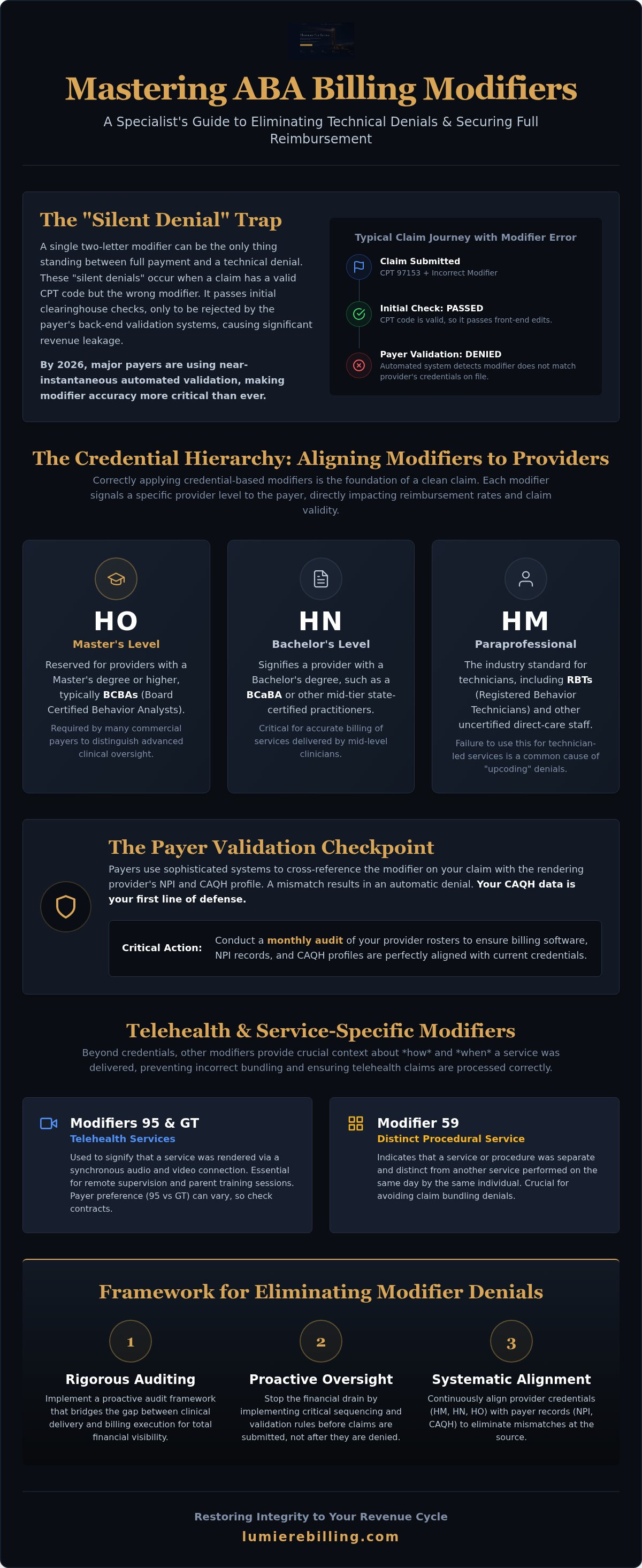
Many practices suffer from the "Silent Denial" phenomenon. This occurs when ABA modifier billing errors bypass initial front-end clearinghouse edits because the CPT code itself is valid. However, they trigger manual reviews or automated credential-to-modifier validation on the payer's back end. In 2026, major commercial payers have moved toward near-instantaneous automated validation. If your modifier doesn't match the rendering provider's NPI on file, the system rejects the claim before a human ever sees it.
Why Modifiers Determine Your Reimbursement Rate
The "Credential Hierarchy" is the engine of your practice's revenue. Modifiers like HO (Master’s level) or HM (Paraprofessional) dictate the contracted rate for each unit. Using the wrong tag isn't just a mistake. It's a financial liability. If you use a higher-level modifier for an RBT-led session, you risk overpayment. Payers will eventually identify this during a post-payment audit, leading to aggressive recoupment that can destabilize your cash flow. Precision here is non-negotiable for healthy ABA revenue cycle management.
The Interplay Between CPT 97153 and Modifier Logic
CPT 97153 is the workhorse of most ABA practices, but it's also a magnet for technical friction. Because this code is technician-led, it almost always requires a modifier to specify the level of supervision or the presence of a BCBA. Payers use these tags to distinguish between "direct" units and "supervised" units billed on the same day. Your clinical documentation must mirror this logic exactly. If a claim carries a modifier indicating BCBA presence, but the session note only mentions the RBT, the claim will fail. This alignment is the mechanical integrity your practice needs to survive 2026 payer scrutiny.
Credential-Based Modifiers: HM, HN, and HO Requirements
In 2026, the technical identity of your claim is defined by the modifier attached to the service. These two-character codes act as a signal to the payer, confirming that the rendering provider possesses the specific credentials required for the contracted rate. Misalignment here is the primary driver of ABA modifier billing errors. While most practitioners are familiar with RBT and BCBA distinctions, the specific modifier requirements often vary by payer contract and state mandate. Using the wrong credential tag doesn't just delay payment; it triggers automated red flags for credentialing non-compliance.
- HO Modifier: This is reserved for Master’s level providers, typically BCBAs. Many commercial contracts require this modifier to distinguish advanced clinical oversight from direct technician services.
- HN Modifier: Often overlooked, the HN modifier signifies a Bachelor’s level provider. This is critical for mid-tier providers, such as BCaBAs or practitioners with specific state-level certifications that fall between a technician and a Master's level clinician.
- HM Modifier: This is the industry standard for Paraprofessionals. It covers RBTs and uncertified technicians. Failing to use HM when a technician renders the service is a frequent cause of "upcoding" denials.
Aligning NPI Numbers with Modifier Selection
A technical failure occurs when a claim uses an HO modifier but the rendering NPI is registered as a technician in the payer's database. Payers now use sophisticated cross-referencing tools to validate these claims instantly. If your CAQH profile isn't updated to reflect a provider's recent certification or degree, the system will reject the claim regardless of the clinical work performed. Accuracy in your CAQH data is the first line of defense against these automated rejections. We recommend a monthly audit of your provider rosters to ensure your billing software reflects current credentials. To identify existing mismatches in your system, a Free Billing Audit can bring these hidden leaks into focus.
State-Specific Modifier Variations for 2026
The landscape becomes more complex when moving from commercial insurance to Medicaid. Many state programs bypass standard HCPCS modifiers in favor of "U-modifiers," such as U1 or U2, to denote specific levels of care or provider types. Maintaining a comprehensive "Payer Matrix" is essential for tracking these variations across your different contracts. The CMS ABA Services Oversight Toolkit highlights the increasing pressure on states to monitor program integrity and reduce ABA modifier billing errors through stricter reporting. State-specific licensure laws often override standard CPT modifier definitions, creating a fragmented landscape that requires constant vigilance. Precision in this matrix ensures that your claims move through the system without the friction of manual review.
Telehealth and Service-Specific Modifiers (95, GT, and 59)
The 2026 landscape for remote ABA services has stabilized, yet technical friction remains high. Modifiers 95 and GT are no longer temporary measures; they are permanent fixtures in the code set for remote supervision of 97155. While Modifier 95 signals synchronous audio-visual communication for most commercial payers, many state Medicaid programs still mandate the GT modifier. Misapplying these results in immediate "Service Not Covered" denials. Beyond telehealth, service-specific modifiers like 52 and 59 provide the mechanical detail necessary to justify payment for non-standard sessions. If a session is terminated early and fails to meet the 8-minute rule threshold for a 15-minute unit, Modifier 52 (Reduced Services) must be applied to maintain compliance. Similarly, location modifiers are now strictly enforced to ensure the Place of Service (POS) code on the claim matches the clinical setting, whether in a school, home, or clinic.
Mastering Remote Supervision Modifiers
In a typical 2026 clinical scenario, an RBT provides on-site direct therapy (97153) while a BCBA provides remote supervision (97155). This concurrent billing requires a precise interplay between POS codes and modifiers. The RBT’s claim line reflects the physical location, such as POS 12 (Home), while the BCBA’s line must include the telehealth modifier and often POS 02 or 10, depending on the payer's specific rules for "patient at home" vs. "patient not at home." The most frequent cause of ABA modifier billing errors in this context is the failure to update the modifier when a modality changes mid-month. If a BCBA switches from in-person to remote supervision due to a schedule change, the billing system must reflect that shift immediately to avoid a mismatch with the session notes.
The Danger of Misusing Modifier 59
Modifier 59 (Distinct Procedural Service) is a surgical tool designed to bypass National Correct Coding Initiative (NCCI) edits when billing multiple services on the same day. For example, if you conduct a parent training session (97156) and a follow-up assessment (97151) on the same date, Modifier 59 tells the payer these were separate and distinct events. However, many practices use this modifier as a "skeleton key" to unbundle services that are naturally inclusive. Over-utilization of Modifier 59 is a primary trigger for "Red Flag" audits by payer Special Investigative Units (SIUs). These units look for patterns where 97151 and 97156 are billed simultaneously without clinical justification. To protect your practice, you must understand the behavioral health billing errors to avoid, ensuring that Modifier 59 is only used when the documentation clearly supports the independence of each procedure. This level of oversight prevents ABA modifier billing errors from turning into full-scale recoupment efforts.
The Cost of Modifier Mismatches: Auditing for Common Errors
The true cost of ABA modifier billing errors is often hidden beneath the surface of your accounts receivable. When a claim is denied for a technical mismatch, the damage extends beyond the delayed reimbursement. You must account for the administrative "re-work" cost, which typically ranges from $25 to $40 per claim in labor alone. This includes the time spent identifying the error, cross-referencing clinical notes, and resubmitting the claim. Over a month, these minor friction points aggregate into thousands of dollars in lost operational efficiency and wasted clinical hours.
One of the most common yet overlooked triggers for these technical failures is "Modifier Sequencing." On the CMS-1500 form, the primary modifier, the one that dictates the reimbursement rate, must occupy the first slot. If an HO modifier is placed in the second or third position behind a telehealth tag, the payer's system may default to a lower rate or issue a CO-4 denial. This specific code signifies an "Inconsistent Modifier" and usually indicates that the modifier used doesn't align with the rendering provider's NPI or the service rendered. Fixing this at the source requires a rigorous alignment of your billing templates with your provider roster.
Modifier Sequencing and Technical Claim Scrubbing
Modern behavioral health platforms can be programmed to act as a first line of defense. You can configure "scrubbers" to catch credential-modifier mismatches before the claim ever leaves your office. For instance, practitioners can automate modifier assignment based on the service note's signatory. If an RBT signs a note but the billing template defaults to an HO modifier, the scrubber should halt the submission. The "Order of Operations" is critical here. Always place the credential-based modifier (HO, HN, HM) in the first position, followed by service-specific tags like 95 or 59. This hierarchy ensures the payer's software recognizes the highest-value attribute of the claim first.
Identifying Revenue Leakage in Modifier Denials
Revenue leakage isn't always about denials; sometimes it's about "silent underpayment." If your practice mistakenly bills an HM modifier for a BCBA’s direct time, you are effectively leaving approximately 30% of your potential revenue on the table. This is why running a "Denial by Modifier" report is essential for visibility. In 2026, industry data suggests that modifier-related errors account for nearly 12% of all ABA claim rejections. To stop these leaks and restore your practice's financial health, you need a partner who can bring these hidden issues into focus. Request a Free Billing Audit to identify exactly where your practice is losing value.
To maintain mechanical integrity, implement this 4-step internal audit framework for modifier accuracy:
- Validate: Perform a monthly cross-check of your provider roster against CAQH profiles.
- Verify: Review a random sample of 20 claims per major payer to check for correct sequencing on the CMS-1500.
- Analyze: Run monthly reports specifically for CO-4 and CO-59 denial codes to identify patterns.
- Adjust: Update billing templates immediately when a payer changes their specific "U-modifier" or telehealth requirements.
Eliminating Modifier Denials with Proactive RCM Oversight
Generalist billing firms often treat ABA billing as a high-volume data entry exercise. This approach is a fundamental failure of oversight. It ignores the mechanical complexity of the modifier matrix and leaves your practice vulnerable to shifting payer logic. Lumiere Billing operates as a proactive extension of your team, acting as a vigilant protector of your financial health. We don't just process claims; we audit the clinical-to-billing alignment to ensure every unit is backed by the correct technical key. By integrating deeply into your daily workflow, we identify the subtle friction points that trigger ABA modifier billing errors before they ever reach the payer’s portal.
This shift from reactive appeals to proactive prevention defines a healthy revenue cycle in 2026. Instead of chasing "silent denials" months after a service is rendered, our oversight ensures that credentials, locations, and modalities are synchronized on day one. We bring hidden issues into focus, allowing your practice to secure the full value of every clinical hour without the administrative drag of constant re-submissions. When the technical foundation is sound, your revenue becomes predictable rather than precarious.
The Advantage of Specialized Behavioral Health RCM
The difference between a "clean claim" and a "paid claim" often rests on an obsessive focus on ABA nuances. Generalist firms frequently miss the subtle shift in payer-specific modifier rules, such as a sudden change in telehealth requirements or a new state-mandated U-modifier. We reject the generalist identity. Our team possesses a level of domain expertise that borders on the obsessive, utilizing advanced analytics to identify systemic ABA modifier billing errors that others overlook. We look for the patterns in your data that suggest underpayment or credentialing mismatches. To test the integrity of your current systems, we invite you to experience the clarity of Lumiere’s Free Billing Audit. It is a low-friction way to identify where revenue is leaking and how to repair the system.
Scaling Your Practice with Confidence
Scaling an ABA practice requires a foundation of financial stability. When your billing is precise, clinical directors can stop worrying about back-office friction and start focusing on patient outcomes. Our practice advisory services help multi-location groups optimize their EHR workflows, ensuring that clinical templates and session notes are perfectly aligned with current 2026 modifier logic. This level of mechanical integrity allows you to grow with confidence, knowing that your revenue cycle is managed by experts who value precision over volume. Don't let technical errors dictate your practice's future. It's time to Optimize your ABA revenue cycle with Lumiere Billing and reclaim the value of your clinical work.
Restoring Mechanical Integrity to Your Practice Revenue
Mastering the hierarchy of credential-based modifiers and the specific nuances of 2026 telehealth tags is no longer an optional administrative task. It is the baseline for financial survival. Precision in modifier sequencing and clinical documentation alignment ensures that every clinical hour is valued correctly by payers. Resolving ABA modifier billing errors requires more than just reactive fixes; it demands a system built on total visibility and mechanical accuracy. When you align your provider credentials with the correct technical keys, you stop the silent leakage that drains your practice's resources.
As your practice scales, don't let technical friction stall your progress. Lumiere Billing specializes exclusively in Behavioral Health RCM, bringing deep expertise in ABA-specific unit tracking and reconciliation. We act as a vigilant protector of your financial health, providing proactive denial prevention and revenue optimization. It's time to bring your hidden billing issues into focus and reclaim the full value of your clinical work. Secure your revenue with a Free Billing Audit from Lumiere Billing. You focus on the life-changing outcomes of your clients. We'll ensure the systems supporting your work remain unbreakable.
Frequently Asked Questions
What are the most common modifiers used in ABA therapy billing for 2026?
HM (Paraprofessional), HN (Bachelor's), HO (Master's), 95 (Telehealth), and 59 (Distinct Service) are the primary tools for 2026. These tags provide the mechanical context for the rendering provider's credentials and the service location. Some payers also require "U-modifiers" like U1 or U2 for Medicaid contracts. Using these correctly prevents technical friction and ensures the claim reflects the actual clinical scenario delivered to the patient.
Can I bill 97153 and 97155 at the same time with the same modifier?
No, you typically can't use identical modifiers for concurrent billing because they represent different rendering providers. While 97153 is technician-led and uses an HM modifier, 97155 is supervisor-led and often requires an HO modifier. Using the same tag for both lines would imply identical credentials for different roles, which triggers an audit for ABA modifier billing errors. Each line must uniquely identify the credential level of the person performing that specific service.
What is the difference between the HM, HN, and HO modifiers?
These modifiers represent a hierarchy of educational attainment and certification. HM is designated for paraprofessionals like RBTs. HN is for Bachelor's level providers, such as BCaBAs or specific state-certified practitioners. HO is reserved for Master's level clinicians, primarily BCBAs. Payers use this hierarchy to determine the reimbursement rate for each unit. Misapplying these codes is a major cause of revenue leakage and potential recoupment during post-payment audits.
Why is my claim being denied for a "modifier mismatch" even if the code is correct?
A modifier mismatch denial (CO-4) usually indicates that the modifier on the claim doesn't align with the NPI's registered credentials. In 2026, payers automate the cross-referencing of your CAQH profile with the modifiers used on the CMS-1500 form. If you bill an HO modifier but the rendering provider is only credentialed as an RBT in the payer's database, the claim will fail. Maintaining an accurate provider roster is essential for approval.
Do I need a modifier for ABA telehealth services in 2026?
Yes, you must use a telehealth modifier, typically 95 or GT, for all remote ABA services in 2026. While 95 is the commercial standard for synchronous audio-visual sessions, some Medicaid programs still require the GT tag. This must be paired with the correct Place of Service (POS) code, such as 02 or 10. Failing to include these details results in technical rejections and obscures the modality of the clinical service provided.
How does modifier sequencing affect claim approval rates?
Sequencing is critical because the first modifier slot on the claim form dictates the primary processing logic for the payer. The credential-based modifier (HO, HN, HM) should occupy the first position to establish the reimbursement rate. Service-specific modifiers, like 95 for telehealth, follow in subsequent slots. If you reverse this order, the payer's system might default to a lower rate or reject the claim entirely for inconsistent data formatting.
What happens if I use the wrong modifier on an ABA claim?
Using the wrong modifier leads to either an immediate technical denial or a "silent underpayment" where you receive less than the contracted rate. If you accidentally upcode by using a higher-level modifier, you face significant risk during post-payment audits. Payers will identify ABA modifier billing errors and demand recoupment of the overpaid funds. It's a source of administrative re-work costs and destabilizes your practice's cash flow over time.
Can I use Modifier 59 for all concurrent ABA services?
No, Modifier 59 should only be used when services are truly distinct and not naturally inclusive of one another. Overusing this tag as a "skeleton key" to bypass NCCI edits is a major red flag for Special Investigative Units (SIUs). You must have clinical documentation that justifies why the services were separate. Don't use it for all concurrent sessions without specific justification; this can lead to aggressive audits and potential fraud allegations.
Frequently Asked Questions
HM (Paraprofessional), HN (Bachelor's), HO (Master's), 95 (Telehealth), and 59 (Distinct Service) are the primary tools for 2026. These tags provide the mechanical context for the rendering provider's credentials and the service location. Some payers also require "U-modifiers" like U1 or U2 for Medicaid contracts. Using these correctly prevents technical friction and ensures the claim reflects the actual clinical scenario delivered to the patient.
No, you typically can't use identical modifiers for concurrent billing because they represent different rendering providers. While 97153 is technician-led and uses an HM modifier, 97155 is supervisor-led and often requires an HO modifier. Using the same tag for both lines would imply identical credentials for different roles, which triggers an audit for ABA modifier billing errors. Each line must uniquely identify the credential level of the person performing that specific service.
These modifiers represent a hierarchy of educational attainment and certification. HM is designated for paraprofessionals like RBTs. HN is for Bachelor's level providers, such as BCaBAs or specific state-certified practitioners. HO is reserved for Master's level clinicians, primarily BCBAs. Payers use this hierarchy to determine the reimbursement rate for each unit. Misapplying these codes is a major cause of revenue leakage and potential recoupment during post-payment audits.
A modifier mismatch denial (CO-4) usually indicates that the modifier on the claim doesn't align with the NPI's registered credentials. In 2026, payers automate the cross-referencing of your CAQH profile with the modifiers used on the CMS-1500 form. If you bill an HO modifier but the rendering provider is only credentialed as an RBT in the payer's database, the claim will fail. Maintaining an accurate provider roster is essential for approval.
Yes, you must use a telehealth modifier, typically 95 or GT, for all remote ABA services in 2026. While 95 is the commercial standard for synchronous audio-visual sessions, some Medicaid programs still require the GT tag. This must be paired with the correct Place of Service (POS) code, such as 02 or 10. Failing to include these details results in technical rejections and obscures the modality of the clinical service provided.
Sequencing is critical because the first modifier slot on the claim form dictates the primary processing logic for the payer. The credential-based modifier (HO, HN, HM) should occupy the first position to establish the reimbursement rate. Service-specific modifiers, like 95 for telehealth, follow in subsequent slots. If you reverse this order, the payer's system might default to a lower rate or reject the claim entirely for inconsistent data formatting.
Using the wrong modifier leads to either an immediate technical denial or a "silent underpayment" where you receive less than the contracted rate. If you accidentally upcode by using a higher-level modifier, you face significant risk during post-payment audits. Payers will identify ABA modifier billing errors and demand recoupment of the overpaid funds. It's a source of administrative re-work costs and destabilizes your practice's cash flow over time.
No, Modifier 59 should only be used when services are truly distinct and not naturally inclusive of one another. Overusing this tag as a "skeleton key" to bypass NCCI edits is a major red flag for Special Investigative Units (SIUs). You must have clinical documentation that justifies why the services were separate. Don't use it for all concurrent sessions without specific justification; this can lead to aggressive audits and potential fraud allegations.