Practice Growth Strategies for Behavioral Health Practices in 2026

More appointments aren’t always the next step toward growth. If clinicians are stretched or administrative workflows are falling behind, adding demand can strain care and cash flow instead of strengthening the practice. Effective practice growth strategies behavioral health practices can sustain start by identifying what’s limiting capacity now.
It’s understandable to feel pressure to expand when patients are waiting for access. But growth works best when appointment volume, team capacity, operational processes, and financial visibility move together. Without a clear picture of how they connect, it’s difficult to know whether to recruit, improve workflows, or address billing bottlenecks first.
This guide will help you pinpoint your practice’s most important constraint before investing in expansion. You’ll find practical ways to increase access without overlooking clinical and administrative capacity, and learn how billing visibility can support better-informed decisions. The goal is a growth plan built to last, not simply a fuller schedule.
Key Takeaways
- Use a readiness check to find whether clinician capacity, administrative workflows, patient access, or financial processes are limiting growth.
- Match service-line expansion to demonstrated demand and operational readiness before adding complexity.
- Compare organic expansion and acquisition by their control, pace, staffing needs, integration demands, and financial visibility.
- Put practice growth strategies behavioral health into action with a measured sequence: diagnose, prioritize, assign ownership, pilot, and review.
- Track billing workflows from verification through payment posting to inform expansion decisions.
Behavioral Health Practice Growth Strategies Start With Finding the Bottleneck
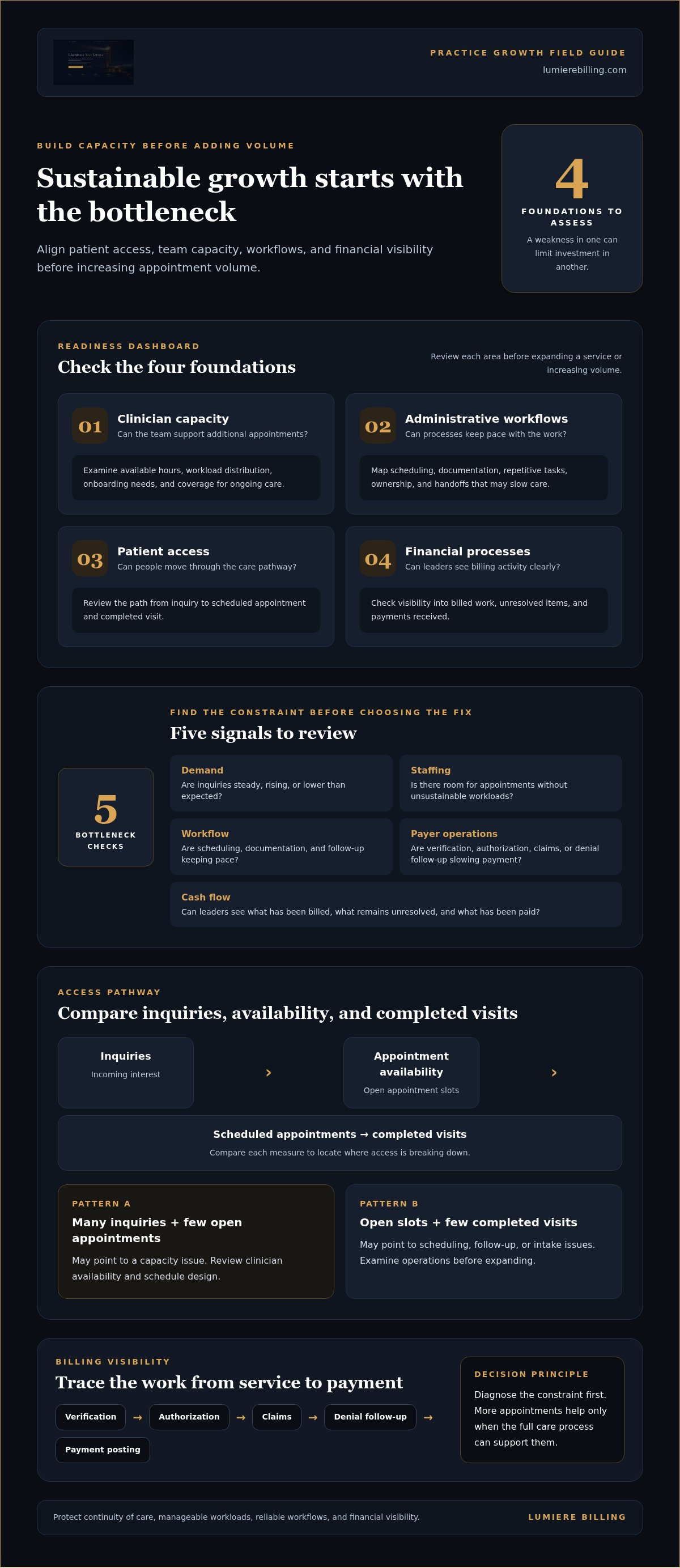
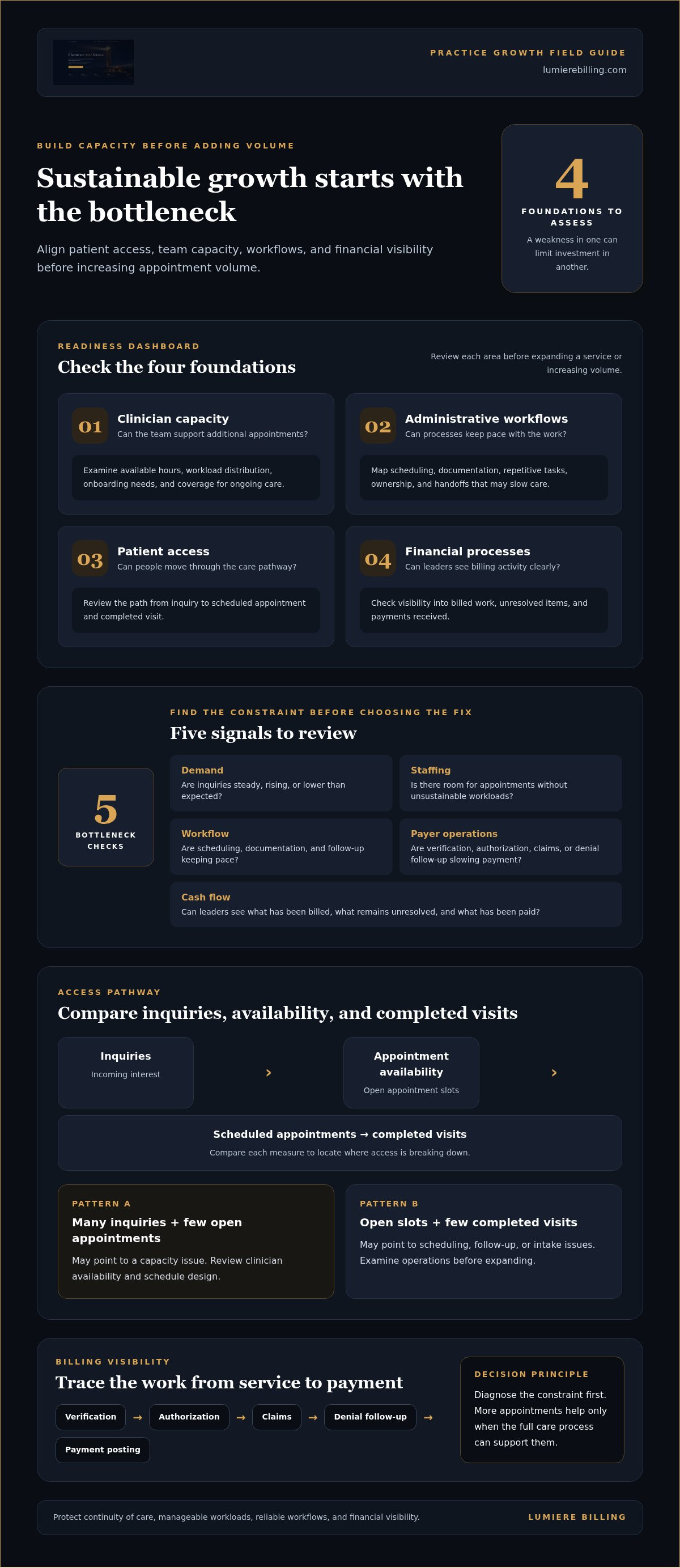
Adding appointments is not the same as building capacity. A fuller schedule may increase access in the short term, but sustainable growth also depends on whether clinicians can deliver care, administrative workflows can support the added activity, and finances are visible enough to guide decisions. Effective practice growth strategies behavioral health leaders can sustain begin with diagnosis, not expansion.
Growth has several connected dimensions: patients can access appropriate appointments, clinicians have manageable workloads, financial processes support resilience, and care can continue consistently as the practice changes. Because behavioral health includes services addressing mental, emotional, and related well-being, capacity planning needs to reflect the practice’s care model, not just the number of open appointment slots.
Sustainable practice growth aligns patient access, team capacity, and financial visibility before increasing volume.
Use this checklist to identify where to look first:
- Demand: Are inquiries steady, rising, or lower than expected?
- Staffing: Do clinicians have room for additional appointments without creating unsustainable workloads?
- Workflow: Are scheduling, documentation, and follow-up keeping pace?
- Payer operations: Are verification, authorization, claims, or denial follow-up slowing the path from service to payment?
- Cash flow: Can leaders see what has been billed, what remains unresolved, and what has been paid?
How to identify what is limiting practice growth
Compare incoming inquiries with appointment availability, wait times, and completed visits. Each measure reveals a different part of the access pathway. Many inquiries paired with few open appointments may point to a capacity issue. Open slots alongside few completed visits may instead signal a scheduling, follow-up, or intake problem. The distinction matters: recruiting clinicians won’t fix a process that prevents people from reaching available care.
Next, trace the work behind an appointment. Check whether administrative delays, such as unresolved insurance verification or authorization tasks, are holding up scheduling or creating rework. Compare those delays with clinician availability. If clinicians are fully booked, staffing or schedule design may be the constraint. If appointment capacity exists but patients aren’t completing the process, examine operations before deciding to expand.
Why growth should not mean more visits at any cost
Volume without capacity alignment can expose weak points. More scheduled visits may increase pressure on clinicians, complicate follow-up, or leave administrative tasks unfinished. Those effects can disrupt continuity and shape the patient experience. Additional appointments are useful only when the practice can support the full care process, from access and scheduling through ongoing service and the operational work that follows.
Before changing schedules or adding a service, identify what the practice needs to protect: continuity of care, manageable clinician workloads, reliable workflows, or financial visibility. A clear priority helps leaders choose a targeted next move rather than pursue several disconnected tactics. Billing workflow visibility can clarify operational questions, while clinical leaders remain responsible for decisions about care and clinician capacity.
Build the Behavioral Health Practice Foundations That Can Support Growth
Once the primary constraint is clear, assess whether the practice has the operating foundations to address it. Readiness rests on four connected areas: clinician capacity, administrative workflows, patient access, and financial processes. A weakness in one can limit the value of investment in another. Hiring clinicians, for example, won’t expand access if scheduling and insurance workflows can’t support their caseloads.
Review each area before adding a service line or increasing appointment volume. Look for evidence of patient interest, clinician availability, the administrative steps a new service requires, and a way to track its financial performance. The KFF report on school-based mental health services offers context on access and workforce needs in one care setting. For any practice, the practical lesson is to match expansion plans to the people and processes needed to deliver care.
- Clinician capacity: Examine available hours, workload distribution, onboarding needs, and coverage for ongoing care.
- Administrative workflows: Map scheduling, documentation, and repetitive tasks that could slow new or existing services.
- Patient access: Review how people move from inquiry to scheduled appointment and completed visit.
- Financial processes: Check whether billing activity and outstanding work are visible enough to inform planning.
Prepare staffing and workflows for additional patient volume
Before hiring, assess how current schedules are used and where workload is concentrated. A new clinician needs a clear onboarding path, workable scheduling practices, and administrative support for the tasks surrounding care. Identify repetitive work that creates avoidable friction, then document who owns each step and how handoffs happen. Clear workflows help the team maintain consistency as roles and caseloads change.
Retention also depends on the operating environment. If clinicians absorb recurring administrative tasks because ownership is unclear, adding staff may not resolve the underlying strain. Define responsibilities, orient new team members to established processes, and review workload distribution as capacity changes. These foundations make expansion more deliberate, not simply faster.
Strengthen financial and administrative readiness
Trace the revenue cycle from insurance verification and prior authorization through claim submission, payment posting, and follow-up. Note where information or responsibility passes between people and where unresolved items accumulate. A behavioral health revenue cycle management guide can help clarify how these workflows connect.
Unresolved billing friction can make it harder to see what resources are available for growth. Reliable revenue-cycle visibility gives practice leaders a clearer basis for capacity planning. Analytics, practice advisory, or a billing audit can help surface workflow questions to investigate before expansion. For more information about this support, explore Lumiere Billing’s behavioral health billing support.
Organic Expansion or Acquisition: Compare Behavioral Health Growth Paths
Once a practice understands its operational readiness, it can compare two broad paths: grow from within or acquire an established practice. Neither route is automatically safer or more effective. Each creates different demands on leadership, staffing, workflows, and financial oversight. The right choice depends on what the practice is trying to achieve and whether it can manage the work that follows.
Use this comparison to frame the decision. These are common trade-offs, not guarantees. A carefully planned acquisition can still require substantial integration, while organic expansion can move quickly if the practice already has the people and processes to support it.
| Factor | Organic expansion | Acquisition |
|---|---|---|
| Control | Owners shape changes directly and build systems to fit the practice. | Leaders must align existing practices while deciding what to retain or change. |
| Pace | Capacity typically develops in stages through hiring, scheduling, or selected services. | Can bring an established operation into the organization, but integration work begins after the transaction. |
| Integration demands | New roles and workflows can be introduced incrementally. | Records, payer processes, staffing practices, and revenue-cycle workflows may need coordination. |
| Staffing | Recruitment, onboarding, and workload planning shape the pace of growth. | Staff continuity and differences in roles or processes require attention. |
| Financial visibility | Leaders can monitor changes as the practice adds capacity. | Leaders need a clear view of existing operations and post-integration performance. |
When organic growth may fit a practice’s goals
Organic growth may suit owners who want to retain direct control and develop systems over time. A practice might adjust scheduling, recruit for a defined capacity gap, or introduce a service after confirming relevant patient demand. Each step still needs an operational plan covering recruitment, onboarding, administrative workload, and how the practice will review whether the change is working.
Stage the work. For example, clarify who will handle scheduling and billing tasks for a new service before opening appointments. This ties expansion to demonstrated need and the practice’s ability to support it, rather than assuming that adding services will automatically improve performance. These are central considerations in practice growth strategies behavioral health leaders weigh.
What to assess before acquiring or integrating a practice
A purchase rationale is not an integration plan. Alongside strategic fit, consider culture, staffing continuity, records, payer workflows, and how revenue-cycle responsibilities will connect. Identify which processes need to remain consistent for patients and which require alignment across teams. Map handoffs for verification, authorization, claims, payment posting, and follow-up so operational gaps don’t remain hidden after the transaction.
An acquisition may add an established team or patient base, but it also brings work that organic growth doesn’t: combining people, information, and operating practices. Build a transition plan with clear owners and checkpoints before assuming existing workflows will transfer smoothly. For legal, valuation, or tax questions, consult qualified professionals. Operational planning can inform those discussions, but it doesn’t replace specialized advice.
Turn Behavioral Health Growth Strategies Into a Measurable Action Plan
A growth plan becomes useful when it names the constraint, defines the next move, and gives someone responsibility for reviewing the result. Instead of launching several initiatives at once, turn the priority into a sequence the team can track. This makes practice growth strategies behavioral health leaders can adapt to real operating conditions, not just broad ambitions.
Use five steps to move from diagnosis to informed action:
- Diagnose: State the specific obstacle the practice wants to address, such as delays between inquiry and appointment or recurring billing handoff problems.
- Prioritize: Choose one issue based on its impact on access, team workload, workflow reliability, or financial visibility.
- Assign ownership: Name the person responsible for coordinating the change and the people who need to contribute.
- Pilot: Test the adjustment in a defined part of the workflow, team, or service before applying it more broadly.
- Review: Compare observations with the starting point, gather team feedback, and decide whether to adjust, continue, or stop.
Keep leading indicators distinct from financial outcomes. Leading indicators show whether operations are moving as intended, such as appointment availability, time from inquiry to scheduling, or completion of a verification or authorization step. Financial outcomes show what happened later, such as claims submitted, denials requiring follow-up, or payments posted. Looking at both helps leaders distinguish an early workflow change from its eventual financial effect.
Choose measures that reflect the practice’s growth goal
Match each measure to the priority. For access, track inquiries, appointment availability, and completed visits using consistent definitions. For staffing capacity, review schedule utilization and workload distribution. For workflow reliability, monitor whether key handoffs are completed. For collections, follow billing activity through payment posting and follow-up. Assign an owner to each measure and set a review cadence that fits the pace of the change.
Consistency matters more than a complicated dashboard. If the team changes how it defines a completed appointment or resolved billing task midway through a review period, comparisons become harder to interpret. Record the measure, its definition, the data source, and who updates it. Review results at predictable intervals, but don’t treat an arbitrary benchmark as proof of success.
Pilot one change before scaling it across the practice
A pilot should have a clear objective, an accountable owner, a review date, and agreed criteria for adjusting the process. For example, test a revised scheduling handoff with one team, then compare workflow completion and staff feedback with the original process. Review operational observations alongside financial information, since early access changes may appear before their billing effects are visible.
Document what worked, what caused friction, and what needs revision before extending the process to other teams or locations. If billing visibility is part of the challenge, learn about Lumiere Billing’s behavioral health support as leaders assess their next steps.
Use Behavioral Health Billing Operations to Support Sustainable Practice Growth
Billing workflows can reveal where operational capacity is delayed or obscured. Insurance verification and prior authorization affect the information available before care; claims submission, denial follow-up, and payment posting show what happens after services are delivered. If a handoff stalls, leaders may have less clarity about pending work and financial activity when evaluating staffing or expansion.
Specialized revenue cycle management (RCM) organizes and monitors billing processes to support that evaluation. It doesn’t replace clinical judgment or guarantee revenue growth. Practice leaders remain responsible for decisions about care, staffing, and expansion. RCM support makes underlying workflows more visible, so decisions can draw on operational context rather than assumptions alone.
Review the revenue cycle as a connected sequence:
- Verification: Are benefits and coverage details addressed before the relevant appointment?
- Authorization: Are required authorization steps assigned and tracked?
- Claims: Are claims submitted with a clear process for identifying items that need attention?
- Denials: Is responsibility for review, correction, and follow-up clear?
- Payment posting: Can the practice see when payments are recorded and which items remain unresolved?
Where specialized revenue-cycle support fits into a growth plan
Behavioral health RCM support can coordinate work across verification, prior authorization, claims submission, denial prevention, and payment posting. This connected view helps leaders investigate whether delays stem from a specific handoff, unclear ownership, or recurring workflow friction. Lumiere Billing provides revenue cycle management for behavioral health practices, with billing support that helps organize these operational steps while leaders assess capacity and priorities.
Look at patterns, not just isolated tasks. For example, recurring authorization delays may call for closer review of how requests are assigned and tracked. Unresolved claims may prompt questions about submission and follow-up processes. These signals help direct investigation; they don’t, by themselves, establish whether the practice should hire, add a service, or change its care model.
What a billing audit can help practice leaders examine
A billing audit can review workflows and highlight process friction for further investigation. Leaders can use the findings to ask practical questions: Who owns each step? Where do handoffs break down? Which items need follow-up, and how is that work tracked? A review of behavioral health billing errors to avoid can also help frame common process checks.
The purpose is clearer operational understanding, not a promised recovery amount, denial reduction, or growth result. Treat findings as input for practice leaders, who can weigh them alongside clinical needs, staffing capacity, and the practice’s goals.
For a focused review of billing workflows, learn about Lumiere Billing’s free billing audit.
Make Your Next Growth Decision With Greater Clarity
Growth doesn’t need to begin with a sweeping change. Choose one decision the practice is approaching, then identify what information would make that decision clearer. A focused review can help leadership distinguish an operational question from a clinical or staffing decision and set a practical next step.
For behavioral health practices, specialized revenue cycle management brings billing activity into view from insurance verification through payment posting. That operational perspective supports leadership’s planning; it doesn’t replace clinical judgment or guarantee a particular growth outcome. Strong practice growth strategies behavioral health practices can sustain depend on decisions grounded in what the practice can see and manage.
Lumiere Billing’s free billing audit helps practices examine billing workflows and identify questions for follow-up. Request a free billing audit from Lumiere Billing to inform your next capacity or expansion decision. Start with one clear question and build from there.
Frequently Asked Questions
What are the most effective growth strategies for a behavioral health practice?
The most effective practice growth strategies behavioral health leaders choose are tied to a specific patient or operational need. For example, a practice could review whether referral inquiries from a particular source become scheduled visits, then improve the information or intake steps for that pathway. Other options include strengthening payer enrollment for clinicians or clarifying service information so prospective patients understand what the practice provides. Track whether the chosen change improves the intended outcome before adding another initiative.
How can a behavioral health practice grow without overwhelming its clinicians?
Protect clinician capacity by accounting for the work surrounding appointments, not just time spent in sessions. Set schedules that leave room for documentation, care coordination, and other responsibilities, then review whether those tasks are being completed within the team’s normal workflow. Watch for signs such as growing documentation backlogs or repeated schedule changes. If they appear, adjust processes or workload distribution before opening more appointments.
Is it better to grow a behavioral health practice organically or acquire another practice?
Neither option is inherently better; the fit depends on the practice’s goals, leadership bandwidth, and ability to manage change. Organic growth can suit owners who want to build gradually and retain close control. Acquisition may align with goals that require integrating an existing team or operation, but it also brings transition work. Consider how much time leaders can devote to change management, alongside the strategic rationale for either path.
How can a behavioral health practice attract more patients?
Make it easier for prospective patients and referral sources to understand the practice’s services and next steps. Keep online service descriptions, clinician profiles, insurance information, and intake instructions clear and consistent. Build relationships with relevant referral partners and make the referral process straightforward. Review inquiry patterns to learn which sources connect with the patients the practice is equipped to serve, then focus outreach accordingly.
What KPIs should a behavioral health practice track while growing?
Choose a small set of measures tied to the practice’s current objective. Useful examples include inquiry-to-intake conversion, appointment cancellation patterns, clinician schedule utilization, claim acceptance trends, and the age of unpaid accounts. Define each measure consistently, specify its data source, and assign someone to review it. Interpret financial measures alongside patient access and workload indicators so one improving number doesn’t conceal strain elsewhere.
When should a behavioral health practice outsource revenue cycle management?
Consider outside RCM support when billing work repeatedly competes with essential administrative responsibilities or the practice struggles to maintain consistent follow-up. Examples include unresolved claims accumulating, denials lacking clear ownership, or leaders having limited visibility into billing status. First identify which tasks are creating the strain and what oversight the practice needs. A behavioral health-focused partner can support billing operations while practice leadership retains responsibility for clinical and staffing decisions.
How does billing support practice growth?
Billing support can give leaders a clearer view of administrative work that affects planning. For example, reviewing patterns in delayed claims or unresolved follow-up may help distinguish a process issue from a broader capacity concern. That information can inform questions about staffing, payer workflows, and expansion timing. Revenue cycle management supports decision-making; it can’t guarantee more patients, higher collections, or a particular growth outcome.
Frequently Asked Questions
The most effective practice growth strategies behavioral health leaders choose are tied to a specific patient or operational need. For example, a practice could review whether referral inquiries from a particular source become scheduled visits, then improve the information or intake steps for that pathway. Other options include strengthening payer enrollment for clinicians or clarifying service information so prospective patients understand what the practice provides. Track whether the chosen change improves the intended outcome before adding another initiative.
Protect clinician capacity by accounting for the work surrounding appointments, not just time spent in sessions. Set schedules that leave room for documentation, care coordination, and other responsibilities, then review whether those tasks are being completed within the team’s normal workflow. Watch for signs such as growing documentation backlogs or repeated schedule changes. If they appear, adjust processes or workload distribution before opening more appointments.
Neither option is inherently better; the fit depends on the practice’s goals, leadership bandwidth, and ability to manage change. Organic growth can suit owners who want to build gradually and retain close control. Acquisition may align with goals that require integrating an existing team or operation, but it also brings transition work. Consider how much time leaders can devote to change management, alongside the strategic rationale for either path.
Make it easier for prospective patients and referral sources to understand the practice’s services and next steps. Keep online service descriptions, clinician profiles, insurance information, and intake instructions clear and consistent. Build relationships with relevant referral partners and make the referral process straightforward. Review inquiry patterns to learn which sources connect with the patients the practice is equipped to serve, then focus outreach accordingly.
Choose a small set of measures tied to the practice’s current objective. Useful examples include inquiry-to-intake conversion, appointment cancellation patterns, clinician schedule utilization, claim acceptance trends, and the age of unpaid accounts. Define each measure consistently, specify its data source, and assign someone to review it. Interpret financial measures alongside patient access and workload indicators so one improving number doesn’t conceal strain elsewhere.
Consider outside RCM support when billing work repeatedly competes with essential administrative responsibilities or the practice struggles to maintain consistent follow-up. Examples include unresolved claims accumulating, denials lacking clear ownership, or leaders having limited visibility into billing status. First identify which tasks are creating the strain and what oversight the practice needs. A behavioral health-focused partner can support billing operations while practice leadership retains responsibility for clinical and staffing decisions.
Billing support can give leaders a clearer view of administrative work that affects planning. For example, reviewing patterns in delayed claims or unresolved follow-up may help distinguish a process issue from a broader capacity concern. That information can inform questions about staffing, payer workflows, and expansion timing. Revenue cycle management supports decision-making; it can’t guarantee more patients, higher collections, or a particular growth outcome.
Free billing audit
Find out what your billing is really costing you
We'll review your claims, denials and collections and show you exactly where revenue is leaking. Free, no obligation, no contract.
Schedule a Free Billing Audit