How to Read an EOB and Understand Your Share of the Bill

An EOB explains how your insurer processed a health care claim; it isn’t a bill. To understand how to read an explanation of benefits (EOB), compare the provider’s billed amount with the allowed amount, then review what the plan paid and what it assigned to you. Your share may include a deductible, copayment, coinsurance, or a non-covered charge.
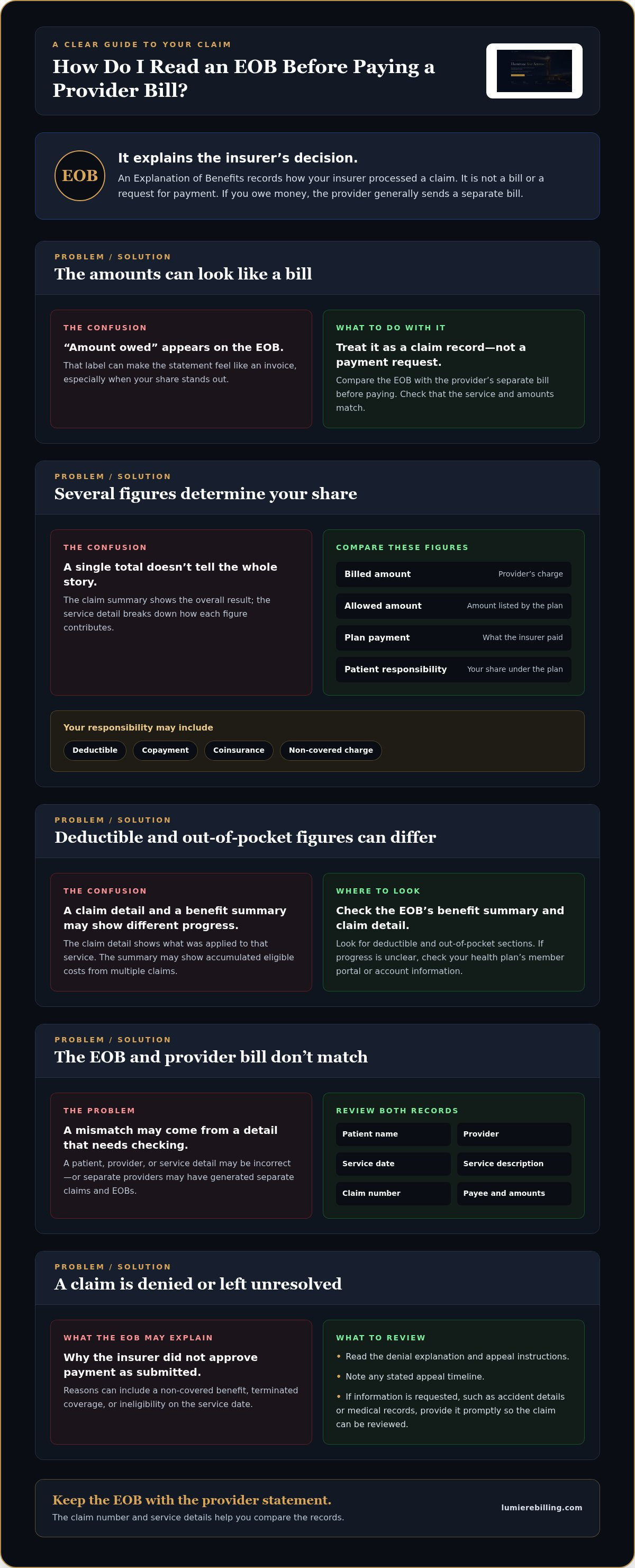
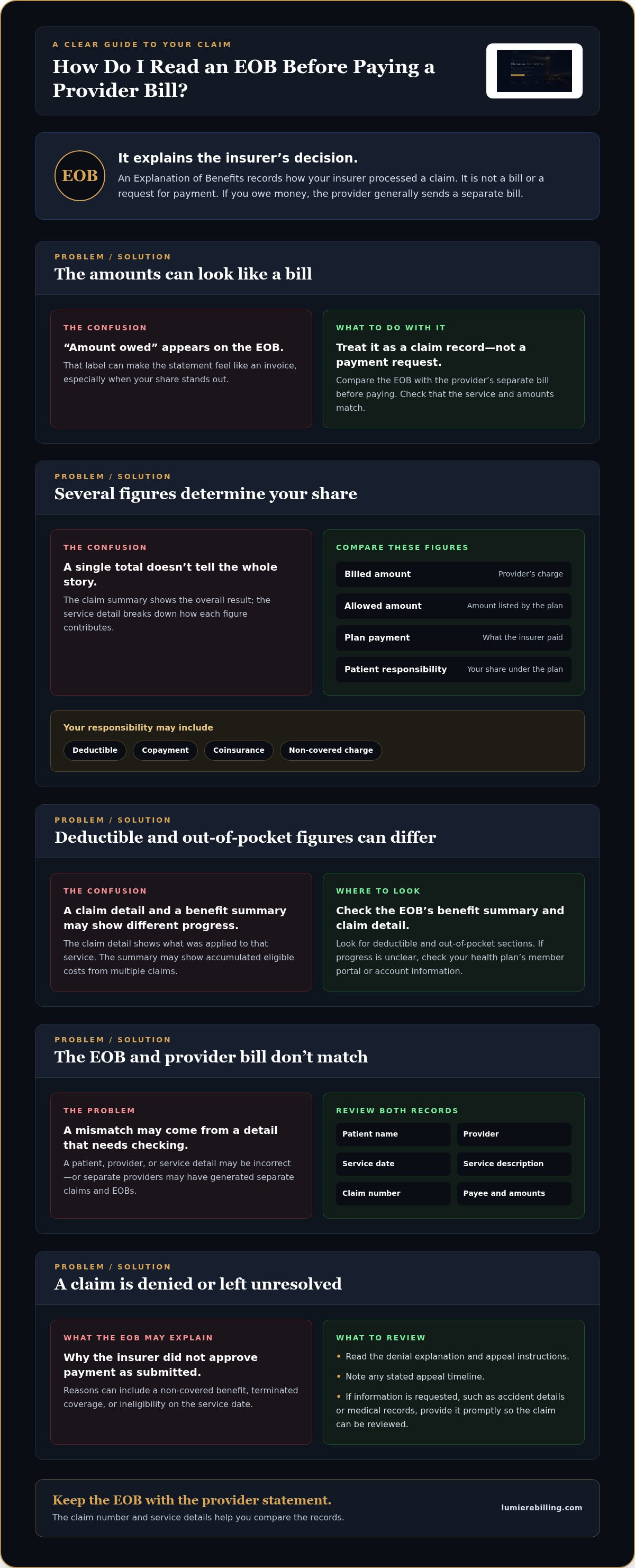
The figures can look like a bill, especially when the amount assigned to you stands out. But an EOB records the insurer’s decision; it does not request payment. If you owe money, the provider generally sends a separate bill. Compare it with the EOB before paying.
This guide explains what each amount means, how the allowed amount affects your share, and where to find deductible and out-of-pocket details. You’ll also learn what to review if the EOB and provider bill don’t match, so you can understand the claim outcome before deciding what to do next.
Key Takeaways
- An EOB explains how your insurer processed a claim; it isn’t a bill. Compare it with the provider’s bill before paying.
- Review the billed amount, allowed amount, plan payment, and patient responsibility to see how the claim was calculated.
- Look for deductible and out-of-pocket details in the EOB’s benefit summary or member portal to track your plan-year progress.
- Check the patient, provider, service date, and service description for accuracy, and follow up if details or amounts don’t match.
- If a claim is denied, read the explanation and appeal instructions carefully so you understand the reason and any applicable deadline.
How EOBs are generated after claims are processed
An EOB follows an insurer’s review of a claim for care, treatment, or a prescription. Read it as a record of that decision, including the service details, plan payment, and amount assigned to you.
Claim Details and Patient Responsibility
This section identifies the services on the claim and the amount assigned to you. Check the patient and provider names, service date, description, and claim number against your records. These details tie the insurer’s decision to a specific visit or prescription. Treatment involving multiple providers may generate separate claims and EOBs, so one statement may not cover every service.
Claims Summaries and Deductible Status
A claims summary brings together the processed claim’s charges, plan payment, and your responsibility, sometimes with deductible information. The detail section breaks down the figures by service. Check whether an amount applies to your deductible, the amount you pay for covered care before your plan begins paying. The summary shows the overall result; the detail explains each service’s contribution.
Insurance Payments and Amounts Owed
“Insurance paid” is the amount the insurer paid toward the processed claim. “Patient responsibility” is the portion assigned to you under the plan, while “amount owed” is the balance stated on the EOB. These labels distinguish the plan’s payment from your share, but the EOB itself isn’t a bill. Compare the stated amount with the provider’s later bill before paying.
The process starts when a provider submits a claim after care, treatment, or a prescription. The insurer processes it, applies the plan’s coverage and cost-sharing terms, and sends an EOB. You may receive it by mail or through the insurer’s member portal. For certain managed care services, such as physician office visits, a primary care physician’s medical group may process the claim instead, and the health plan may not send an EOB for those specific encounters.
Direct primary care can affect whether this process occurs. If a practice does not submit a claim to your insurer, you may not receive an EOB for that service. If insurance is billed, review the resulting EOB alongside the provider statement. Lumiere Billing helps patients navigate these medical billing records to understand their financial obligations clearly.
A denial means the insurer did not approve payment as submitted. Common reasons include a non-covered benefit, terminated coverage, or ineligibility on the service date. Read the denial explanation and appeal instructions on the EOB, including any stated timeline. If the insurer requests information, such as accident details or medical records, provide it promptly so the claim can be reviewed. For help with certain surprise billing concerns, people in the United States can call the No Surprises Help Desk at 1-800-985-3059, according to the Centers for Medicare & Medicaid Services.
How can I find out more about my deductibles and out-of-pocket maximums?
Start with the EOB’s benefit summary and look for deductible and out-of-pocket sections. An EOB may show how much of your medical costs count toward your annual deductible, and some plans show your progress toward meeting it. The out-of-pocket maximum section may show your plan’s limit and your progress toward it. These figures help explain how the claim affects your remaining cost-sharing.
Compare the claim’s deductible amount with the deductible status in the summary. The claim detail shows what was applied to that service; the summary may show accumulated progress. Don’t treat the figures as interchangeable: one describes a claim, while the other may reflect eligible costs from multiple claims. If the EOB doesn’t clearly show progress, review your health plan’s member portal or account information.
Check the patient and plan details before interpreting the totals. Confirm the patient’s name, health plan, provider, service date, claim number, and payee. A mismatch can make an otherwise clear deductible figure misleading. Treatment involving multiple providers may produce separate EOBs, each showing only part of the care and cost-sharing.
An EOB typically lists the service or prescription, total charges, allowed charges, plan payment, non-covered amounts, and your responsibility. Read the coverage decision alongside the deductible figure. An amount applied to your deductible affects your progress differently from a non-covered charge. The EOB may also show copayment or coinsurance details to explain your share of the claim.
Coordination of benefits can change how a claim is processed when another plan or coverage may apply. If the insurer requests updated information, respond promptly. The request may ask for accident details, medical records noting pre-existing conditions, or other information needed to review the claim. An insurer may request this information annually. Missing details can leave the decision unresolved and make the payment and deductible figures harder to interpret.
Use the EOB’s glossary to clarify plan-specific terms. If you disagree with a coverage or payment decision, look for appeal instructions. The EOB may explain your appeal rights, submission steps, and timelines. Read the directions carefully, because the deadline and process matter when you challenge how the plan handled a claim. Keep the EOB with the provider statement so the claim number and service details are easy to find.
What’s an explanation of benefits?
An explanation of benefits, or EOB, describes how a health insurance company processed a claim. It records the insurer’s coverage decision and how the claim was handled, but it isn’t a bill.
In the United States, call the insurer’s member services number on your ID card for help understanding an EOB. For questions about a service or charge, the provider’s billing department can explain its records.
An EOB Compared With a Bill
An EOB is the insurer’s statement about a claim; a provider bill requests payment. This distinction matters because an EOB may show your responsibility without asking you to pay. The provider sends a separate bill if a balance remains. Understanding how to read an explanation of benefits (EOB) helps you interpret the insurer’s claim record before responding to a bill from a doctor, clinic, or hospital.
An EOB typically identifies the patient, health plan, provider, service date, claim number, and payee. It may list service descriptions, total charges, allowed charges, plan payments, non-covered amounts, and your responsibility. These details connect the coverage decision to a specific visit, prescription, or hospital service. Confirm the names and dates against your records, especially if multiple providers treated you.
Comparing EOBs With Provider Bills
Compare an EOB with the provider bill to spot differences before paying. Match the service date, provider, and patient-responsibility figure. Then account for payments you’ve already made, payments posted after processing, or bills sent before the claim was processed. If the figures still differ, trace each amount to its source rather than assuming the bill reflects the insurer’s final decision.
If the records don’t match, contact the provider’s billing department and identify the disputed line. Request an itemized bill showing the services and codes billed, then compare those entries with the EOB’s service descriptions. If the provider can’t explain the difference, contact the insurer with the claim number and ask how it processed the service. Keep notes of the response with your claim paperwork.
A hospital visit may involve separate claims from the facility and physician. Each provider’s claim can have its own EOB and bill, even when both relate to the same visit. Match each statement to the EOB that names that provider. This avoids treating one processed claim as a complete account of every service received.
When learning how to read an explanation of benefits (EOB), use the claim number as a key reference. Keep the EOB until you receive and pay the related provider bill. If you disagree with the insurer’s coverage decision, review the appeal instructions and timeline on the EOB. For an unfamiliar service or code, use the itemized bill to clarify what the provider submitted.
Billed amounts, allowed amounts, and network savings
An EOB’s charge figures show how a provider’s billed amount becomes a plan payment and your share. Read the billed, allowed, and paid amounts together; no single figure explains the final responsibility.
The billed amount is what the doctor or facility charged for a service. The allowed amount is what the insurer recognizes under the plan’s terms. For an in-network provider, the difference between these figures is generally written off rather than paid by you or the insurer. That adjustment is a network saving, not an additional bill.
The difference between the billed and allowed totals is not automatically your share for an in-network service.
Service lines show how the totals were calculated. This line-by-line view helps identify which doctor’s or facility’s services contributed to the claim total.
Network status affects how the difference between billed and allowed amounts is handled. For an in-network provider, that difference is written off. For a Blue Shield of California non-preferred provider, you may owe the difference between the billed and allowed amounts, in addition to any applicable deductible, copayment, or coinsurance. Check the provider’s network status and the EOB’s responsibility section before treating the adjustment as a discount.
Look for the plan payment, deductible, copayment or coinsurance, and non-covered amounts in the claim detail. These items can make your responsibility differ from the billed-to-allowed adjustment. A sample EOB uses remark code PDC when the billed amount exceeds the maximum payment allowed by insurance, with payment based on the allowed amount. Read the code description on the EOB, not just the letters.
An amount shown as owed may include a payment you already made, and direct payments to the provider may not have been subtracted. Compare the EOB’s responsibility figure with the provider’s current statement and your receipts. If the amount differs, ask the billing department how it applied prior payments. This final comparison separates the insurer’s calculation from the balance the provider says remains due.
Purpose and meaning of an explanation of benefits
An EOB does more than record one claim. It shows how the health plan applied coverage to care. Read its figures as a financial trail: the provider submitted services, the insurer made a decision, and the statement records the result. This record can help you track health care costs, understand plan coverage, and identify billing questions that need follow-up.
EOBs become more useful when you review multiple claims. Compare statements for separate visits, prescriptions, or providers, and note how your responsibility changes. A deductible amount may count toward your annual progress, while coinsurance may appear after the plan applies its rules. An EOB connects an individual service to your broader health care spending, rather than leaving each charge isolated.
Use the claim record to spot possible billing errors. Check that the patient, provider, service date, and description match what happened. Then compare the insurer’s processed service with the provider’s bill. For example, review any EOB service you don’t recognize. Request an itemized statement from the provider and ask the insurer how it processed that specific claim.
An EOB also makes coverage decisions visible. A denial or non-covered amount signals that the insurer processed the claim differently than expected. Read the explanation and any remark code, then find the appeal instructions and deadlines in the statement. If the plan’s decision seems incorrect, the appeal process gives you a structured way to request a review. Keep the claim number and supporting records together.
EOBs can also help you track household health care expenses and organize tax documentation. Keep each statement with its matching provider bill and payment record. This makes it easier to trace a charge, distinguish insurer payments from personal payments, and identify which claim a receipt belongs to. An EOB is useful documentation, but it doesn’t replace the provider’s bill or payment receipt.
For a behavioral health practice, EOB patterns can reveal recurring claim issues across services, such as repeated denials or unexpected patient responsibility. Reviewing those patterns can clarify where billing workflows need closer attention. Lumiere Billing’s Free Billing Audit can help practices examine billing processes and identify areas to review. It’s a practical next step when individual EOB questions point to a broader pattern in claim outcomes.
Lumiere Billing: Free Billing Audit
Lumiere Billing’s Free Billing Audit is a practical next step when EOB patterns raise recurring questions about claims or patient responsibility. For behavioral health practices, a review of billing processes can help bring issues into focus, such as repeated denials or differences between claim outcomes and expected coverage.
The audit connects individual claim questions with the broader revenue cycle. If your practice needs ongoing support, Lumiere Billing also offers Revenue Cycle Management, Credentialing & Enrollment, and Practice Advisory. These services address different operational needs, from managing billing workflows to supporting enrollment and practice decisions.
To review billing patterns in your practice, contact Lumiere Billing to discuss the Free Billing Audit.
Turn claim questions into a clearer next step
Knowing how to read an explanation of benefits (EOB) helps you spot claims that need attention. For a behavioral health practice, the next step is to look beyond one statement and identify recurring questions across claim outcomes. A consistent review process can help your team distinguish isolated issues from patterns that merit operational attention.
Choose a practical next step: document recurring claim questions, identify where they arise in your billing workflow, and decide what needs closer review. Clear records make those discussions more focused and give your practice a stronger starting point for addressing billing concerns.
Lumiere Billing works with behavioral health practices on revenue cycle needs. If you’re ready to discuss support for your practice, contact Lumiere Billing. A clearer view of the work ahead can help you move forward with confidence.
Frequently Asked Questions
How do you read an EOB?
Use the EOB’s remark codes and glossary to interpret insurer-specific decisions, rather than guessing from a short label. If a code points to a denial or adjustment, find its full explanation near the bottom of the statement. Note the claim number and any appeal instructions. This turns an unfamiliar notation into a clear question for the insurer, such as whether the decision needs more information or review.
How do EOBs work?
An EOB records the insurer’s decision after it reviews a submitted claim under the member’s plan. The statement may reflect coverage, cost-sharing, and information needed for further review. If coordination of benefits applies, the insurer may need details about other coverage or an accident before completing its review. Respond promptly to requests, then use the updated claim record to understand the insurer’s final decision.
How long should I keep my EOB?
Keep each EOB until you’ve received and paid the corresponding provider bill. Store it with the bill and payment confirmation, using the claim number to keep the records together. This gives you a reference if the provider’s account later shows a balance you don’t recognize. If you keep digital records, save the complete statement, not just the page showing the total.
What if I find an error on my EOB?
Before contacting the insurer or provider, write down your specific concern and the claim number. For a service you don’t recognize, ask the provider for details about what was submitted. To dispute a coverage decision, follow the EOB’s appeal directions and timeline. Keep copies of correspondence and any information requested, so each follow-up refers to the same claim issue.
What is an EOB?
An EOB explains how a health plan handled a health care claim. It helps members track insurer decisions and organize records for follow-up. You may receive one by mail or access it through the insurer’s member portal. A course of care involving multiple providers can generate separate EOBs, so keep each statement with its corresponding claim.
What is an explanation of benefits (EOB), and is it a bill?
An explanation of benefits is an insurer’s statement about a processed claim, not a request for payment. The provider’s bill requests any remaining balance. Treat these as related records with different roles: the EOB explains the plan’s decision, while the provider statement reflects the provider’s account. Payment instructions belong on the provider’s bill, not the EOB.
How do I find the patient, provider, and service dates on an EOB?
Look at the account summary or claim-detail section, where insurers commonly group member and provider information with service dates. If the EOB has multiple service lines, check the date beside each one rather than relying only on the summary. The patient’s name may appear in the member information, while the provider is identified in the claim record. Use the claim number to distinguish similar records.
What do billed amount, allowed amount, and plan discount mean on an EOB?
The plan discount generally reflects an adjustment between the provider’s charge and the amount recognized under the plan. How that difference is handled depends on the provider’s network status. For an in-network service, it is generally written off; an out-of-network claim may handle it differently under the plan. Read the adjustment beside the relevant service line, since a claim can include several services with different amounts.
Frequently Asked Questions
Use the EOB’s remark codes and glossary to interpret insurer-specific decisions, rather than guessing from a short label. If a code points to a denial or adjustment, find its full explanation near the bottom of the statement. Note the claim number and any appeal instructions. This turns an unfamiliar notation into a clear question for the insurer, such as whether the decision needs more information or review.
An EOB records the insurer’s decision after it reviews a submitted claim under the member’s plan. The statement may reflect coverage, cost-sharing, and information needed for further review. If coordination of benefits applies, the insurer may need details about other coverage or an accident before completing its review. Respond promptly to requests, then use the updated claim record to understand the insurer’s final decision.
Keep each EOB until you’ve received and paid the corresponding provider bill. Store it with the bill and payment confirmation, using the claim number to keep the records together. This gives you a reference if the provider’s account later shows a balance you don’t recognize. If you keep digital records, save the complete statement, not just the page showing the total.
Before contacting the insurer or provider, write down your specific concern and the claim number. For a service you don’t recognize, ask the provider for details about what was submitted. To dispute a coverage decision, follow the EOB’s appeal directions and timeline. Keep copies of correspondence and any information requested, so each follow-up refers to the same claim issue.
An EOB explains how a health plan handled a health care claim. It helps members track insurer decisions and organize records for follow-up. You may receive one by mail or access it through the insurer’s member portal. A course of care involving multiple providers can generate separate EOBs, so keep each statement with its corresponding claim.
An explanation of benefits is an insurer’s statement about a processed claim, not a request for payment. The provider’s bill requests any remaining balance. Treat these as related records with different roles: the EOB explains the plan’s decision, while the provider statement reflects the provider’s account. Payment instructions belong on the provider’s bill, not the EOB.
Look at the account summary or claim-detail section, where insurers commonly group member and provider information with service dates. If the EOB has multiple service lines, check the date beside each one rather than relying only on the summary. The patient’s name may appear in the member information, while the provider is identified in the claim record. Use the claim number to distinguish similar records.
The plan discount generally reflects an adjustment between the provider’s charge and the amount recognized under the plan. How that difference is handled depends on the provider’s network status. For an in-network service, it is generally written off; an out-of-network claim may handle it differently under the plan. Read the adjustment beside the relevant service line, since a claim can include several services with different amounts.
Free billing audit
Find out what your billing is really costing you
We'll review your claims, denials and collections and show you exactly where revenue is leaking. Free, no obligation, no contract.
Schedule a Free Billing Audit