How Can Therapy Practices Manage Cash Flow More Predictably?

A practice can earn revenue and still struggle to cover this month’s expenses. Insurance payments may arrive weeks after the sessions that generated them, while payroll, rent, and other obligations come due on a different schedule. That gap is why cash flow management for therapy practices depends on more than a healthy revenue report. It requires a clear view of when money is expected and when it must go out.
If your numbers look solid but available cash feels tight, a consistent review can help pinpoint the timing mismatch. Compare bank activity, upcoming obligations, and billing status to see what has arrived, what is due, and which claims still need attention. This article explains how to build that view and when specialized revenue cycle support may help clarify billing activity.
Key Takeaways
- Use bank, accounting, and billing reports together to distinguish cash on hand from upcoming obligations and claims awaiting action.
- Track expected insurance payments through each billing stage, from verification and authorization to submission, adjudication, and payment posting.
- Build a repeatable review routine that records the cash position, due dates, expected receipts, unresolved items, and next actions.
- Effective cash flow management for therapy practices depends on seeing both incoming funds and outgoing commitments.
- When owner-led reviews leave billing activity unclear, specialized behavioral health revenue cycle support can help make workflow status easier to follow.
What Does Cash Flow Management Mean for a Therapy Practice?
Cash flow is the movement of money into and out of a practice over time. For a therapy practice, that means looking beyond the amount billed or the revenue shown in a report. Insurance reimbursement often follows a different timetable from the session that generated the claim, while routine expenses continue to come due. A practice can therefore be financially active while the funds available today are not enough to cover every obligation due today.
Revenue measures what the practice earns or records; available cash is what has actually arrived and can be used to meet obligations. That distinction is central to cash flow management for therapy practices. Review both to understand how much income is associated with services, when funds may become available, and what must be paid before then.
Why revenue and available cash can tell different stories
Financial reports and bank activity answer different questions. Depending on the practice’s accounting method, revenue may be recorded before the related payer deposit reaches the bank. That accounting view can describe practice activity, but it doesn’t show when the deposit will arrive. This is an operational distinction, not tax advice.
Hypothetical example: A therapist provides a session early in the week, and the practice submits the insurance claim. Payroll is due before the payer processes the claim and sends payment. The session may contribute to reported revenue, but its reimbursement isn’t available for payroll until the payment is deposited. The pressure comes from the timing gap, not necessarily from a lack of services or billed revenue.
A bank-balance snapshot won’t show this pattern by itself. It shows what is in the account at one moment, but not which payments are pending, which obligations are approaching, or whether expected deposits depend on claims still being processed. A useful cash-flow view tracks what came in, what went out, and what is still expected over time.
Which cash movements matter most in a therapy practice?
Start by grouping the practice’s operating inflows and outflows. This makes the timing easier to review:
- Operating inflows: client payments and insurance reimbursements deposited into the practice’s accounts.
- Operating outflows: payroll, rent, software, and other recurring obligations, along with other practice expenses as they arise.
These movements don’t always line up. A payment may be expected but not yet posted, while payroll or rent has a known due date. Keep actual deposits separate from anticipated receipts so an unpaid claim isn’t counted as cash on hand. For expenses, record both the amount and the date it is due.
Investment or financing activity may also affect cash, depending on the owner’s situation. For a straightforward operating review, focus first on routine receipts and obligations. That gives you a clearer baseline for understanding the practice’s day-to-day cash movement.
How Do Payer Timelines and Practice Expenses Shape Cash Flow?
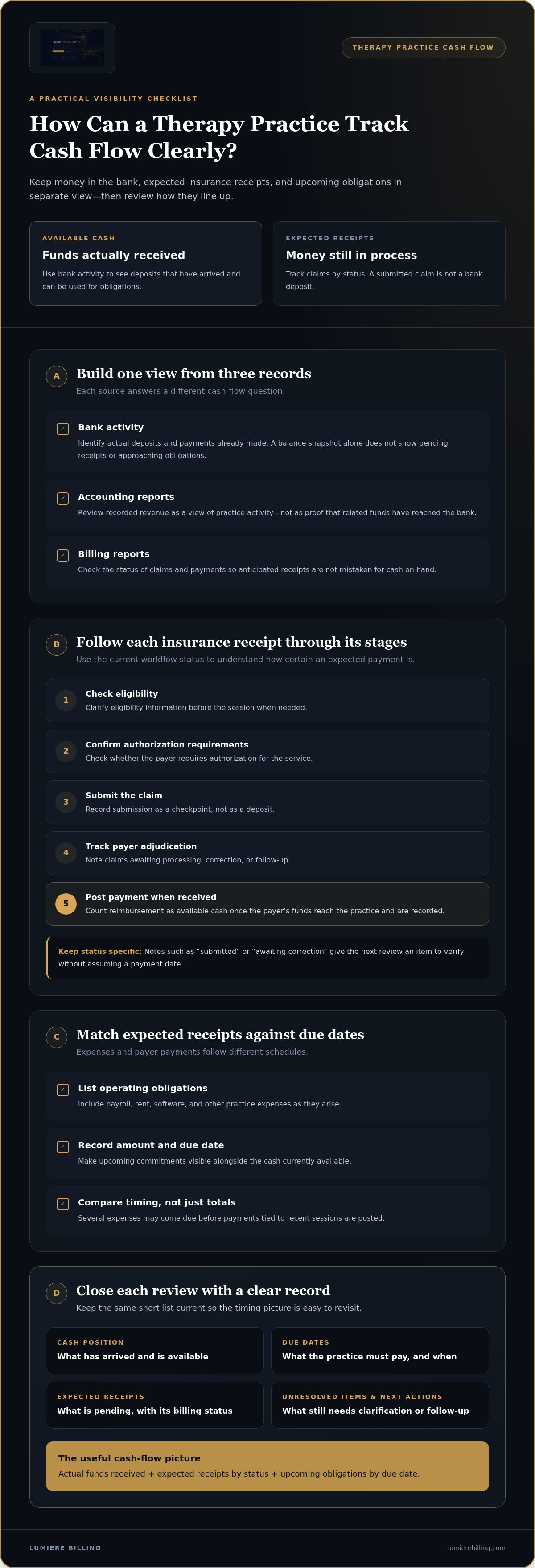
A service doesn’t move directly from the calendar to a bank deposit. Between the appointment and payment, a claim passes through checkpoints, and each one affects how confidently a practice can estimate when reimbursement may arrive. The sequence commonly includes checking eligibility, confirming whether authorization is required, submitting the claim, waiting for payer adjudication, and posting the payment once it’s received. A delay or open question at any stage can make the expected receipt less certain.
Where can uncertainty enter the billing-to-payment process?
Uncertainty can start before the session. Eligibility information may need clarification, or the payer’s policy may require authorization for a service. After the visit, a claim may need correction or follow-up before the payer can complete processing. These are distinct workflow issues, so tracking only the number of claims submitted won’t show which items are progressing and which need action.
Submission is a checkpoint, not a deposit. A claim can be sent and still require adjudication, correction, or follow-up. Payment posting happens later, when the payer’s funds reach the practice and are recorded. For a useful estimate, distinguish claims submitted from claims processed and payments received. Check current payer policies for requirements, since coverage, authorization, submission, and payment procedures can vary. For a broader view of how these activities connect, see behavioral health revenue cycle management.
This workflow visibility is one operational layer of cash flow management for therapy practices. Tie expected receipts to their actual status instead of treating every submitted claim as money already on its way. A dated status note, such as “submitted” or “awaiting correction,” gives the next review a specific item to verify without assuming a payment date.
Why do expenses create pressure even when revenue is coming in?
Practice obligations follow their own schedules. Payroll, rent, software, and other commitments may have predictable due dates, while payer receipts can arrive on different dates depending on claim status and payer processing. Several expenses may come due before payments associated with recent sessions are posted. A total billed-revenue figure may not make that mismatch visible.
Hypothetical example: A practice adds a clinician and takes on additional payroll and scheduling costs. If the clinician’s claims are still moving through verification, authorization, or payer review, the new expenses may begin before related payments arrive. The owner can assess the change by reviewing the new obligations alongside the status of claims expected to support them, rather than relying on a general expectation of future revenue.
Expansion, hiring, or another new commitment can change both the amount and timing of cash a practice needs. There’s no single reserve amount that fits every practice; obligations and payment patterns differ. Review those patterns to identify where uncertainty sits. If billing stages are difficult to see or manage consistently, Lumiere Billing’s behavioral health revenue cycle support connects verification, authorization, claims, and follow-up as part of the broader payment workflow.
Which Cash-Flow Review Gives a Therapy Practice Useful Visibility?
No single report answers every cash-flow question. A bank account shows what’s available now, accounting reports organize financial activity over a period, and billing reports reveal where insurance claims and payments stand. Use these views together to distinguish a timing gap from a workflow issue that needs follow-up. For cash flow management for therapy practices, the goal is to make relevant movements visible, not to chase one perfect number.
| View | What it shows | Useful signals | Limitations |
|---|---|---|---|
| Bank-account review | Cash currently in the account and recorded transactions | Available funds, recent deposits, and cleared payments | Doesn’t show pending claims or explain financial activity across a reporting period |
| Accounting reports | Income and expenses organized for a defined period | Revenue and expense patterns over time | May not show whether expected payer funds have reached the bank |
| Billing workflow reports | Claims, payments, and unresolved billing work by status | Items awaiting action and the progress of payment activity | Don’t replace bookkeeping, tax advice, or financial planning |
What can an accounting view show that a bank balance cannot?
Financial statements, such as an income statement, organize income and expenses across a reporting period. They can help an owner see how the practice performed during that period, while a bank balance shows what funds are present at a particular moment. Recorded revenue and cash on hand can differ because revenue may be recognized before the related payer deposit arrives, or because receipts and expenses fall in different periods.
Use both views rather than assuming one is wrong. Accounting methods and reporting choices affect interpretation, so discuss questions about financial statements, tax treatment, or planning with a qualified accounting professional.
What can billing reports reveal about expected receipts?
Billing reports add operational detail by separating claims submitted, payments posted, and work still unresolved. This helps explain why an amount shown in billing activity isn’t necessarily cash deposited yet. Look for patterns in your own practice history, such as unresolved items clustering around a particular payer or process step. Avoid treating an outside benchmark as a target without understanding how it compares with your practice’s services and payer mix.
Specific workflow issues can complicate that picture. For examples of process problems that may interrupt claim progress, review behavioral health billing errors to avoid. Billing reports complement, rather than replace, accounting records. Compare periods consistently, note what changed in the practice, and use each report to answer the question it’s designed for.
How Can You Build a Repeatable Cash-Flow Routine?
A useful review doesn’t need to become a complex forecasting exercise. It needs consistent inputs, clear ownership, and a record of what happens next. Choose a cadence your practice can maintain, then use the same reports and sequence each time. This makes changes easier to spot without treating one unusual deposit or expense as a lasting trend.
- Start with current cash. Record the available bank balance and note recent deposits or payments that haven’t cleared. This establishes what’s on hand, not what may arrive later.
- List upcoming obligations. Review payroll, rent, software, and other expected expenses, including their due dates. Flag new or changed commitments that affect the next review period.
- Review expected receipts. Use consistent accounting and billing reports to identify payer payments that are posted, claims still in process, and items awaiting follow-up. Keep expected money distinct from deposits already received.
- Investigate open questions. For each unresolved item, note its status, the next action, and who owns it. If the timing is uncertain, record that uncertainty instead of presenting an estimate as a confirmed deposit date.
- Revisit and compare. At the next check-in, update open items and compare the pattern with the practice’s own prior reviews. Record decisions, responsible people, and dates for revisiting questions that remain unresolved.
What should a regular practice cash check-in include?
Gather the same accounting and billing reports before each review so you’re comparing like with like. Put upcoming obligations beside expected receipts, and mark which payment dates are known, estimated, or unclear. End by documenting decisions, owners, and follow-up dates. A repeatable record helps the practice see whether an open issue was resolved or simply carried forward.
Recurring reviews turn vague cash concerns into answerable questions about timing, status, and next action. The aim is not perfect certainty, but a clearer view of what needs attention.
How can owners respond when a pattern keeps recurring?
Look for repetition before changing course. If claims from a particular workflow step repeatedly need follow-up, investigate that operational pattern rather than reacting to one delayed payment. Keep billing questions separate from bookkeeping, tax, legal, or personal wellbeing concerns. Those require different expertise; consult an appropriately qualified professional when a question falls outside operational billing.
For cash flow management for therapy practices, a review routine is most useful when someone can act on what it reveals. If billing statuses remain hard to interpret or workflow follow-up lacks clear ownership, explore behavioral health revenue cycle support to bring greater visibility to billing activity.
When Can Behavioral Health Billing Support Help With Cash-Flow Visibility?
Owner-led reviews can reveal when the concern isn’t simply a difference between deposits and due dates. If claims remain unresolved without a clear next step, payment status is difficult to trace, or no one owns follow-up, the practice may need more visibility into its billing workflow. This won’t guarantee a particular financial result, but it can clarify what work is progressing, what needs attention, and where an operational handoff may be unclear.
What operational questions can specialized billing support address?
Behavioral health revenue cycle management connects several stages that affect billing visibility: insurance verification, prior authorization, claims submission, denial prevention, and collections support. Clear process ownership helps show whether a task is complete, pending, or awaiting follow-up, giving owners more context when investigating billing questions.
For an overview of how this operating model can be structured, see outsourced mental health billing. The useful question is not only whether claims have been sent, but whether the practice can see what happens next and who is responsible for moving open work forward.
How can a billing audit fit into the next step?
A billing audit can provide a focused review of billing and revenue-cycle processes. It can help examine workflow visibility and unresolved tasks, but it doesn’t promise increased collections or a specific cash outcome. Before a review, identify where your own check-ins leave unanswered questions, such as which claim stages are difficult to track or how follow-up responsibility is assigned.
Prepare a short list of those questions and the reports or workflow details that prompted them. This gives the discussion a practical starting point and keeps attention on processes the practice can examine. Lumiere Billing offers a free billing audit for practices seeking a closer look at their behavioral health revenue-cycle processes.
Billing support has a defined scope. It can address operational revenue-cycle work, but it doesn’t replace bookkeeping, tax guidance, legal advice, or mental health care. Bring accounting or tax questions to a qualified accounting professional, legal concerns to an appropriately qualified legal professional, and care needs to a mental health professional. Keeping those roles distinct helps the practice direct each question to the right kind of support.
If your routine review has surfaced unclear billing stages or ownerless follow-up, request a free billing audit to examine those revenue-cycle questions. Clearer workflow information can support cash flow management for therapy practices by helping owners understand where billing activity stands, without confusing expected receipts with guaranteed results.
Make Your Next Cash-Flow Review Count
Choose one unanswered question from your next financial check-in and turn it into a specific follow-up. Is a recurring delay tied to a billing step, or was it an isolated timing issue? Who can clarify it, and when will you revisit the answer? A clear question, owner, and follow-up date give the next review a purpose and make cash flow management for therapy practices an ongoing operating habit rather than a reaction to a stressful balance.
Lumiere Billing focuses exclusively on behavioral health revenue cycle management, with work spanning the stages that shape billing visibility. A focused review can bring open workflow questions into view without promising a particular financial result. Start a review of your billing workflow to take the next step with greater clarity.
Progress doesn’t require perfect certainty. A clearer question, a named owner, and a follow-up date can give your practice a steadier place to begin.
Frequently Asked Questions
What is cash flow management for a therapy practice?
Cash flow management for therapy practices is the process of organizing cash-related information and deciding what needs attention next. Make the review repeatable by setting a consistent reporting period, identifying who prepares each report, and recording unresolved questions with an owner and follow-up date. This turns disconnected financial observations into a practical operating routine.
How is cash flow different from profit in a therapy practice?
Profit is an accounting measure for a reporting period; cash flow tracks the movement of funds. If the two views appear inconsistent, ask an accounting professional which accounting method the reports use and how transactions are recorded. Bring the specific statements and reporting dates to that conversation. This can help distinguish a bookkeeping or timing question from a concern that calls for a different kind of review.
Can a therapy practice have revenue but still run short on cash?
Yes. If this happens, first check whether the concern is isolated or recurring, then compare the same reporting periods rather than relying on memory. Review whether patient balances, payer receipts, or a recent change in operating commitments contributed. A short written note about what changed and what evidence supports it can keep the next decision grounded. Don’t assume that a cash shortage alone identifies the underlying cause.
How often should a private practice review cash flow?
There’s no universal schedule that suits every practice. Choose an interval that gives the owner time to notice changes before important decisions and is practical for the team to maintain. A practice might revisit its cadence after a meaningful operational change, such as adding a clinician or changing its payer mix. The schedule is a management choice, not a substitute for individualized accounting guidance.
What causes unpredictable cash flow in a therapy practice?
Potential contributors include shifts in patient payment patterns, changes in payer mix, added staffing commitments, or administrative backlogs. These possibilities don’t establish what’s happening in a particular practice. To narrow the question, compare records from periods before and after a change, and note which items moved together. This can help identify a pattern to investigate rather than attributing every fluctuation to one delayed reimbursement.
Should a therapy practice use a separate account for business cash?
A separate business account can make transaction records easier to review, but the appropriate setup depends on the practice’s circumstances and professional advice. Before opening, closing, or changing accounts, consider how the change may affect bookkeeping, access to records, and the practice’s existing arrangements. A qualified accounting professional can address accounting implications, while a legal professional can advise on legal questions. This answer isn’t banking, tax, or legal advice.
When should a practice seek help reviewing its billing workflow?
Consider a closer review if staff can’t readily explain what happened to a specific billing item or if documented follow-up remains incomplete. To prepare, gather representative records, such as relevant claim status details, payer communications, and notes about actions already taken. This makes it easier to discuss the process without presuming the cause. Specialized support can assess operational billing questions, but it doesn’t replace accounting advice or guarantee a financial result.
Frequently Asked Questions
Start by grouping the practice’s operating inflows and outflows. This makes the timing easier to review: These movements don’t always line up. A payment may be expected but not yet posted, while payroll or rent has a known due date. Keep actual deposits separate from anticipated receipts so an unpaid claim isn’t counted as cash on hand. For expenses, record both the amount and the date it is due. Investment or financing activity may also affect cash, depending on the owner’s situation. For a straightforward operating review, focus first on routine receipts and obligations. That gives you a clearer baseline for understanding the practice’s day-to-day cash movement. A service doesn’t move directly from the calendar to a bank deposit. Between the appointment and payment, a claim passes through checkpoints, and each one affects how confidently a practice can estimate when reimbursement may arrive. The sequence commonly includes checking eligibility, confirming whether authorization is required, submitting the claim, waiting for payer adjudication, and posting the payment once it’s received. A delay or open question at any stage can make the expected receipt less certain.
Uncertainty can start before the session. Eligibility information may need clarification, or the payer’s policy may require authorization for a service. After the visit, a claim may need correction or follow-up before the payer can complete processing. These are distinct workflow issues, so tracking only the number of claims submitted won’t show which items are progressing and which need action. Submission is a checkpoint, not a deposit. A claim can be sent and still require adjudication, correction, or follow-up. Payment posting happens later, when the payer’s funds reach the practice and are recorded. For a useful estimate, distinguish claims submitted from claims processed and payments received. Check current payer policies for requirements, since coverage, authorization, submission, and payment procedures can vary. For a broader view of how these activities connect, see behavioral health revenue cycle management. This workflow visibility is one operational layer of cash flow management for therapy practices. Tie expected receipts to their actual status instead of treating every submitted claim as money already on its way. A dated status note, such as “submitted” or “awaiting correction,” gives the next review a specific item to verify without assuming a payment date.
Practice obligations follow their own schedules. Payroll, rent, software, and other commitments may have predictable due dates, while payer receipts can arrive on different dates depending on claim status and payer processing. Several expenses may come due before payments associated with recent sessions are posted. A total billed-revenue figure may not make that mismatch visible. Hypothetical example: A practice adds a clinician and takes on additional payroll and scheduling costs. If the clinician’s claims are still moving through verification, authorization, or payer review, the new expenses may begin before related payments arrive. The owner can assess the change by reviewing the new obligations alongside the status of claims expected to support them, rather than relying on a general expectation of future revenue. Expansion, hiring, or another new commitment can change both the amount and timing of cash a practice needs. There’s no single reserve amount that fits every practice; obligations and payment patterns differ. Review those patterns to identify where uncertainty sits. If billing stages are difficult to see or manage consistently, Lumiere Billing’s behavioral health revenue cycle support connects verification, authorization, claims, and follow-up as part of the broader payment workflow. No single report answers every cash-flow question. A bank account shows what’s available now, accounting reports organize financial activity over a period, and billing reports reveal where insurance claims and payments stand. Use these views together to distinguish a timing gap from a workflow issue that needs follow-up. For cash flow management for therapy practices, the goal is to make relevant movements visible, not to chase one perfect number.
Financial statements, such as an income statement, organize income and expenses across a reporting period. They can help an owner see how the practice performed during that period, while a bank balance shows what funds are present at a particular moment. Recorded revenue and cash on hand can differ because revenue may be recognized before the related payer deposit arrives, or because receipts and expenses fall in different periods. Use both views rather than assuming one is wrong. Accounting methods and reporting choices affect interpretation, so discuss questions about financial statements, tax treatment, or planning with a qualified accounting professional.
Billing reports add operational detail by separating claims submitted, payments posted, and work still unresolved. This helps explain why an amount shown in billing activity isn’t necessarily cash deposited yet. Look for patterns in your own practice history, such as unresolved items clustering around a particular payer or process step. Avoid treating an outside benchmark as a target without understanding how it compares with your practice’s services and payer mix. Specific workflow issues can complicate that picture. For examples of process problems that may interrupt claim progress, review behavioral health billing errors to avoid. Billing reports complement, rather than replace, accounting records. Compare periods consistently, note what changed in the practice, and use each report to answer the question it’s designed for. A useful review doesn’t need to become a complex forecasting exercise. It needs consistent inputs, clear ownership, and a record of what happens next. Choose a cadence your practice can maintain, then use the same reports and sequence each time. This makes changes easier to spot without treating one unusual deposit or expense as a lasting trend.
Gather the same accounting and billing reports before each review so you’re comparing like with like. Put upcoming obligations beside expected receipts, and mark which payment dates are known, estimated, or unclear. End by documenting decisions, owners, and follow-up dates. A repeatable record helps the practice see whether an open issue was resolved or simply carried forward. Recurring reviews turn vague cash concerns into answerable questions about timing, status, and next action. The aim is not perfect certainty, but a clearer view of what needs attention.
Look for repetition before changing course. If claims from a particular workflow step repeatedly need follow-up, investigate that operational pattern rather than reacting to one delayed payment. Keep billing questions separate from bookkeeping, tax, legal, or personal wellbeing concerns. Those require different expertise; consult an appropriately qualified professional when a question falls outside operational billing. For cash flow management for therapy practices, a review routine is most useful when someone can act on what it reveals. If billing statuses remain hard to interpret or workflow follow-up lacks clear ownership, explore behavioral health revenue cycle support to bring greater visibility to billing activity. Owner-led reviews can reveal when the concern isn’t simply a difference between deposits and due dates. If claims remain unresolved without a clear next step, payment status is difficult to trace, or no one owns follow-up, the practice may need more visibility into its billing workflow. This won’t guarantee a particular financial result, but it can clarify what work is progressing, what needs attention, and where an operational handoff may be unclear.
Behavioral health revenue cycle management connects several stages that affect billing visibility: insurance verification, prior authorization, claims submission, denial prevention, and collections support. Clear process ownership helps show whether a task is complete, pending, or awaiting follow-up, giving owners more context when investigating billing questions. For an overview of how this operating model can be structured, see outsourced mental health billing. The useful question is not only whether claims have been sent, but whether the practice can see what happens next and who is responsible for moving open work forward.
A billing audit can provide a focused review of billing and revenue-cycle processes. It can help examine workflow visibility and unresolved tasks, but it doesn’t promise increased collections or a specific cash outcome. Before a review, identify where your own check-ins leave unanswered questions, such as which claim stages are difficult to track or how follow-up responsibility is assigned. Prepare a short list of those questions and the reports or workflow details that prompted them. This gives the discussion a practical starting point and keeps attention on processes the practice can examine. Lumiere Billing offers a free billing audit for practices seeking a closer look at their behavioral health revenue-cycle processes. Billing support has a defined scope. It can address operational revenue-cycle work, but it doesn’t replace bookkeeping, tax guidance, legal advice, or mental health care. Bring accounting or tax questions to a qualified accounting professional, legal concerns to an appropriately qualified legal professional, and care needs to a mental health professional. Keeping those roles distinct helps the practice direct each question to the right kind of support. If your routine review has surfaced unclear billing stages or ownerless follow-up, request a free billing audit to examine those revenue-cycle questions. Clearer workflow information can support cash flow management for therapy practices by helping owners understand where billing activity stands, without confusing expected receipts with guaranteed results. Choose one unanswered question from your next financial check-in and turn it into a specific follow-up. Is a recurring delay tied to a billing step, or was it an isolated timing issue? Who can clarify it, and when will you revisit the answer? A clear question, owner, and follow-up date give the next review a purpose and make cash flow management for therapy practices an ongoing operating habit rather than a reaction to a stressful balance. Lumiere Billing focuses exclusively on behavioral health revenue cycle management, with work spanning the stages that shape billing visibility. A focused review can bring open workflow questions into view without promising a particular financial result. Start a review of your billing workflow to take the next step with greater clarity. Progress doesn’t require perfect certainty. A clearer question, a named owner, and a follow-up date can give your practice a steadier place to begin.
Cash flow management for therapy practices is the process of organizing cash-related information and deciding what needs attention next. Make the review repeatable by setting a consistent reporting period, identifying who prepares each report, and recording unresolved questions with an owner and follow-up date. This turns disconnected financial observations into a practical operating routine.
Profit is an accounting measure for a reporting period; cash flow tracks the movement of funds. If the two views appear inconsistent, ask an accounting professional which accounting method the reports use and how transactions are recorded. Bring the specific statements and reporting dates to that conversation. This can help distinguish a bookkeeping or timing question from a concern that calls for a different kind of review.
Yes. If this happens, first check whether the concern is isolated or recurring, then compare the same reporting periods rather than relying on memory. Review whether patient balances, payer receipts, or a recent change in operating commitments contributed. A short written note about what changed and what evidence supports it can keep the next decision grounded. Don’t assume that a cash shortage alone identifies the underlying cause.
There’s no universal schedule that suits every practice. Choose an interval that gives the owner time to notice changes before important decisions and is practical for the team to maintain. A practice might revisit its cadence after a meaningful operational change, such as adding a clinician or changing its payer mix. The schedule is a management choice, not a substitute for individualized accounting guidance.
Potential contributors include shifts in patient payment patterns, changes in payer mix, added staffing commitments, or administrative backlogs. These possibilities don’t establish what’s happening in a particular practice. To narrow the question, compare records from periods before and after a change, and note which items moved together. This can help identify a pattern to investigate rather than attributing every fluctuation to one delayed reimbursement.
A separate business account can make transaction records easier to review, but the appropriate setup depends on the practice’s circumstances and professional advice. Before opening, closing, or changing accounts, consider how the change may affect bookkeeping, access to records, and the practice’s existing arrangements. A qualified accounting professional can address accounting implications, while a legal professional can advise on legal questions. This answer isn’t banking, tax, or legal advice.
Consider a closer review if staff can’t readily explain what happened to a specific billing item or if documented follow-up remains incomplete. To prepare, gather representative records, such as relevant claim status details, payer communications, and notes about actions already taken. This makes it easier to discuss the process without presuming the cause. Specialized support can assess operational billing questions, but it doesn’t replace accounting advice or guarantee a financial result.
Free billing audit
Find out what your billing is really costing you
We'll review your claims, denials and collections and show you exactly where revenue is leaking. Free, no obligation, no contract.
Schedule a Free Billing Audit