How Can Therapists Reduce Burnout from Administrative Tasks?

Adding more hours is often the wrong first move. Therapist burnout administrative tasks can quietly consume the time and attention clinicians need for client care, especially when notes, billing, and follow-up keep spilling into personal time.
It can feel as though the workload is simply too large. Often, though, pressure builds around specific points of friction: information entered in multiple systems, a billing issue sent back to the clinician, or documentation with no protected place in the day. You don’t need to overhaul everything at once. First identify where administrative work accumulates, then make realistic workflow changes that preserve continuity of care.
This article will help you identify which tasks drain the most attention, distinguish clinical responsibilities from operational work, and choose practical ways to reduce friction. It also explains how specialized behavioral-health billing support can help with insurance-related administration while clinicians retain responsibility for clinical care. A clearer view of the work is the first step toward protecting time for what matters most.
Key Takeaways
- Notice when recurring operational work, rather than a demanding week, may be contributing to therapist burnout administrative tasks.
- Map tasks across a representative workweek, noting time, repetition, handoffs, and interruptions to identify where friction builds.
- Choose whether to simplify, standardize, automate, or delegate based on each task’s repetition, risk, judgment needs, and available capacity.
- Test one workflow change at a time, with a clear owner, documented steps, and a realistic date to review its effect on care.
- Identify billing tasks that operational support can manage, while keeping clinical responsibilities with clinicians.
How can administrative tasks contribute to therapist burnout?
Administrative burden is the work that surrounds care: documenting sessions, coordinating appointments, checking benefits, securing authorizations, submitting claims, and following up on unresolved issues. These tasks help keep a practice running, but they’re distinct from providing therapy. When they regularly extend beyond scheduled work hours or interrupt time intended for recovery, they can become a source of strain.
That strain isn’t a personal failing. A demanding week may bring a temporary increase in notes or scheduling changes; recurring overload is different. It might show up as unfinished tasks routinely carried into evenings, frequent interruptions during documentation, or billing follow-up that keeps returning without a clear owner. Look for patterns rather than judging by a single busy day. Those patterns can vary by role, practice setup, and payer mix.
Administrative strain describes pressure from operational work; it isn’t a clinical diagnosis. Keeping that distinction in mind helps frame therapist burnout administrative tasks as a workflow issue to examine, rather than evidence that a clinician has failed to cope.
Which administrative tasks can crowd a therapist’s day?
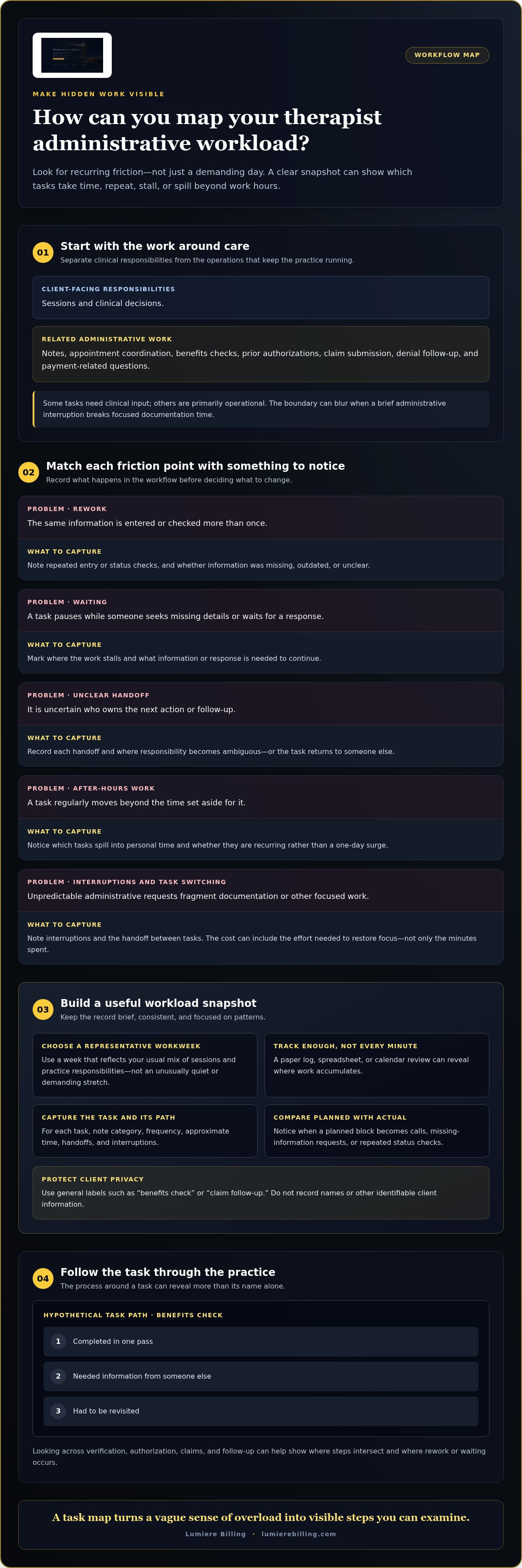
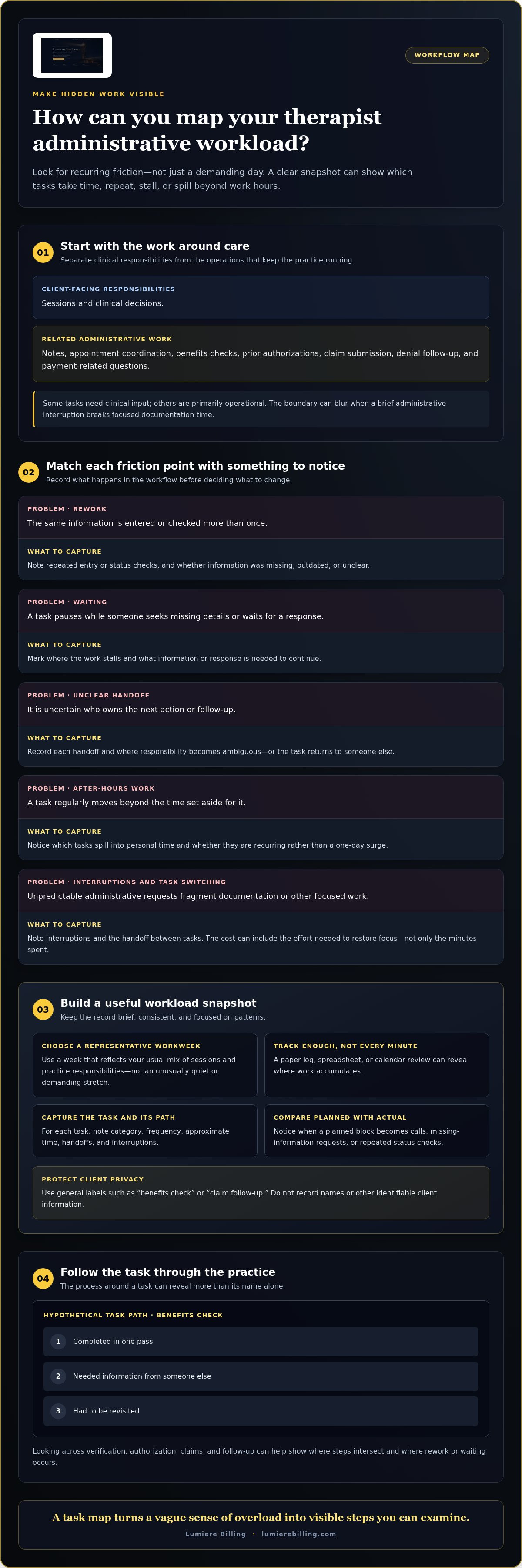
Start by separating work that directly involves client care from the operations that keep the practice running. Client-facing responsibilities include sessions and clinical decisions. Related administrative work can include notes, appointment coordination, benefits checks, prior authorizations, claim submission, denial follow-up, and payment-related questions. Some tasks require clinical input; others are primarily operational.
The boundary can blur. A brief interruption to answer a billing question may break a focused documentation block, making it harder to return to the note. Several small interruptions can leave a task feeling fragmented, even if the total time spent seems manageable. The cost isn’t only the minutes spent; it’s also the effort of restoring focus.
Why can administrative work feel bigger than the task list?
Clinical and operational work call for different kinds of attention. Moving from a session to a claim detail, then back to a note, requires a mental reset. When tasks arrive unpredictably, the day can feel fragmented, leaving fewer uninterrupted stretches for careful documentation or recovery between responsibilities.
Unclear ownership adds to the pressure. If no one knows who checks an authorization status or follows up on a rejected claim, more than one person may repeat the same check, or the task may sit until someone notices it again. The effect depends on how a practice is organized. The same administrative process can create different pressures for different clinicians and teams.
A useful first distinction is whether the workload is an unusual surge or a recurring pattern. Notice which tasks spill into personal time, interrupt focused work, or return because the next step is uncertain. That view can reveal where friction occurs before you decide what to change.
How can you map your therapist administrative workload?
Before changing a workflow, make its hidden steps visible. Use a representative workweek that reflects your usual mix of sessions and practice responsibilities, rather than an unusually quiet or demanding stretch. You don’t need to account for every minute. The aim is to see which administrative tasks take time, repeat, stall, or spill beyond work hours.
A paper log, spreadsheet, or calendar review can capture enough detail. For each task, note its category, how often it occurs, approximate time, handoffs, and interruptions. Don’t record names or other identifiable client information. General labels such as “benefits check” or “claim follow-up” are enough to spot patterns.
How can you create a useful workload snapshot?
Compare the administrative blocks you planned with what actually happened. If time set aside for claims became a mix of calls, missing-information requests, and repeated status checks, record those changes. A quick note at the end of each workday may be easier to maintain than continuous time tracking. Keep the record brief and consistent so it reveals patterns without becoming another demanding task.
Record both the task and its path through the practice. For example, note whether a benefits check was completed in one pass, required information from someone else, or had to be revisited. This helps separate the work itself from delays and rework around it.
How can you spot recurring workflow friction?
Look for tasks that return because information is missing, outdated, or unclear. Mark duplicate entry, waiting points, and handoffs where responsibility becomes ambiguous. A billing-process view can help show where verification, authorization, claims, and follow-up intersect. The behavioral health revenue cycle management overview provides context for those steps.
A task map turns a vague sense of overload into visible, recurring steps you can examine.
- Rework: The same information is entered or checked more than once.
- Waiting: A task pauses while someone seeks missing details or a response.
- Unclear handoffs: It’s uncertain who owns the next action or follow-up.
- After-hours work: A task regularly moves beyond the time set aside for it.
If insurance-related tasks appear repeatedly in the map, a closer operational review may help. A free billing audit can examine billing workflow friction alongside the task map, while clinical responsibilities remain with the clinician. This gives you a practical starting point for addressing therapist burnout administrative tasks without assuming every practice has the same pressure points.
Should you simplify, standardize, automate, or delegate administrative tasks?
Once you’ve identified a recurring pressure point, choose a response that fits the work. Frequency matters, but so do risk, the judgment a task requires, and the capacity available to manage it. A repetitive task isn’t automatically a good candidate for automation or delegation if an error could affect care, claims, or client information.
- Simplify: Remove steps that don’t serve a clear purpose. First understand why each step exists and what depends on it, so you don’t eliminate a necessary check or handoff.
- Standardize: Use a consistent checklist, template, or sequence for repeatable, nonclinical work. Define who owns the task, what counts as complete, and when an exception should be escalated.
- Automate: Consider automation for predictable, repetitive steps, while preserving human review where judgment or verification matters. A tool should reduce friction, not obscure responsibility for the result.
- Delegate: Shift operational work to an appropriate team member or specialist when roles, procedures, and access controls are clear. Clinical decisions remain with the clinician.
When should a practice simplify or standardize a task?
Simplify a process when it contains duplication or unnecessary handoffs, but trace the task first: what information is collected, why it’s needed, and who uses it next? Standardize when the same nonclinical steps recur and variation creates avoidable confusion. A shared checklist can clarify the owner, completion point, and escalation path without prescribing clinical judgment.
When might automation or delegation make sense?
Automation may suit stable steps with clear inputs and outputs; delegation may suit operational work that doesn’t require a clinician’s judgment. In either case, assign oversight and define how exceptions return to someone who can resolve them. Review billing follow-up as a possible bottleneck before changing the process. Repeated corrections may point to an upstream handoff or information gap. This behavioral health billing errors article covers common sources of billing-process rework.
A practical test is to ask four questions: Does the task happen often? Could a mistake carry meaningful risk? Does it require clinical judgment? Is there a person or process with capacity to own it? The answers help distinguish a task to streamline from one that needs careful review or a clearer handoff. They also help keep changes proportionate, rather than asking a practice to redesign everything at once.
For billing-related friction, a free billing audit can help review where operational steps may be creating rework or competing with clinical time. A focused review can inform a practical response to therapist burnout administrative tasks while keeping clinical responsibility with clinicians.
How can you reduce administrative overload without disrupting care?
Change one pressure point at a time. A whole-practice overhaul can create confusion while clinicians and staff are trying to maintain continuity of care. Instead, choose a recurring task that disrupts the day, clarify how it currently moves through the practice, and test a small adjustment before expanding it.
Protect time for the work, too. Set administrative blocks that fit the practice’s schedule, and make expectations clear for nonurgent requests that arrive during those blocks. Define what warrants an interruption and how urgent matters should reach the right person. This isn’t about making care less accessible. It’s about preventing every operational message from interrupting focused work by default.
How can you run a small workflow reset?
Choose a task based on how often it recurs and how much it affects daily work. Before changing a tool or shifting responsibility, write down the current steps, handoffs, and points where the process stalls. Then assign an owner, document the revised steps, and set a realistic date to review the change. Start with a test, not a permanent overhaul.
Ask the people who handle the task where instructions are unclear or information tends to go missing. Their feedback can reveal practical gaps that aren’t visible in a process document alone. Keep the test narrow: change one step or handoff, explain the change to the people involved, and adjust before applying the process elsewhere.
How can you tell whether a change is helping?
Compare the same measures before and after the reset. Look at approximate time spent, outstanding backlog, repeated work, handoffs, and tasks that extend beyond scheduled hours. Also ask clinicians and administrative staff whether the process feels clearer and ownership is easier to identify. A faster step isn’t an improvement if it creates more rework or leaves tasks incomplete.
Check care continuity alongside operational measures. Are tasks being completed at the appropriate point in the workflow? Can clinicians focus on their clinical responsibilities without the administrative change disrupting client care? If the process is unclear, creates new delays, or shifts the burden to someone else, revise the test rather than assuming it has worked.
- Keep: The change makes ownership clearer and reduces unnecessary repetition without disrupting care.
- Adjust: The process is easier in one area but creates a new delay or handoff elsewhere.
- Reconsider: The new steps add effort without addressing the original friction.
A measured reset makes therapist burnout administrative tasks easier to address as workflow problems, rather than as a reason to ask clinicians to stretch their days further. If billing follow-up is the pressure point, a free billing audit can help review where billing-related workflow friction is accumulating.
How can billing support give therapists more room for client care?
Insurance administration is a chain of connected tasks, not just claim submission. Benefits verification may require information before a visit. Authorization work may involve gathering details and tracking a decision. Claims need accurate information and follow-up, denials need review, and payment posting connects payer activity to the practice’s records. When ownership or handoffs are unclear, an operational question can circle back to the clinician.
That distinction matters. Clinicians retain clinical responsibilities, including care decisions and the clinical information needed to support services. Operational specialists can manage revenue-cycle processes such as verification, authorization coordination, claim submission, denial follow-up, and payment posting. Clear procedures for when clinical input is needed help connect those roles without making clinicians the default owner of every billing task.
Which billing tasks can add recurring administrative work?
Each billing step depends on timely information moving between people and processes. An incomplete handoff may mean staff have to request missing details, revisit a status, or clarify who should act next. These loops create repeated work without necessarily pointing to an individual as the problem. Mapping the sequence from verification through payment posting helps reveal where follow-up routinely returns to the clinician.
What can specialized revenue cycle support address?
Lumiere Billing specializes in revenue cycle management for behavioral-health providers. Its end-to-end support includes insurance verification, prior authorization, claims submission, denial prevention, and analytics. These are operational functions, not therapy or EHR services. The aim is to manage billing workflows while clinicians remain responsible for clinical care and the information only they can provide.
Support is most useful when it addresses friction visible in a practice’s workflow. Repeated authorization follow-up, for example, may point to a coordination issue, while recurring claim corrections may call for a closer review of the submission process. Analytics can make billing activity more visible, and denial prevention focuses on operational processes that may contribute to avoidable issues. Neither replaces clinical judgment, and no workflow can promise a particular payment outcome.
When reviewing therapist burnout administrative tasks, look at which billing steps repeatedly pull clinicians away from their primary responsibilities. A focused review can clarify where information enters the process, who owns each action, and where handoffs need attention. It can also help distinguish work that requires clinical input from routine revenue-cycle tasks that operational specialists can manage.
A free billing audit offers a practical way to review billing workflows and identify where administrative friction may be accumulating. Use that visibility to guide a focused discussion about workflow ownership and operational support, while keeping client care at the center.
Make room for the work only you can do
Reducing therapist burnout administrative tasks doesn’t require a perfect system or a sweeping redesign. Start with one deliberate choice: stop treating recurring friction as an inevitable part of the job. Give a high-pressure process a clear owner, protect time to handle it, and check whether the change makes work clearer without interrupting client care.
Keep the review practical. If billing tasks continue to pull clinicians into repeated follow-up, use that pattern as a signal to examine the workflow and where operational support could fit. The aim isn’t to move clinical judgment out of clinicians’ hands. It’s to reserve their attention for work that depends on it.
Lumiere Billing works exclusively with behavioral-health providers. If you’re ready to examine billing workflow friction, request a free billing audit as a starting point for a focused review.
Small, well-chosen changes can create a more workable rhythm. Begin with one process, learn from what happens, and build from there.
Frequently Asked Questions
Is therapist burnout a medical diagnosis?
No. Burnout itself isn’t a medical diagnosis, and noticing exhaustion or detachment doesn’t establish that you have a mental health condition. These experiences can still deserve attention, especially if they persist or affect daily functioning. A licensed health professional can help assess symptoms and discuss appropriate support. Treat the term as a description of strain, not as a substitute for individualized clinical evaluation.
Can therapists experience burnout even with a manageable caseload?
Yes. The pressures behind therapist burnout administrative tasks can persist even when the appointment schedule feels manageable. A caseload doesn’t capture every demand, such as complex coordination, emotionally demanding sessions, limited recovery between appointments, or uncertainty about practice operations. Consider the full work pattern, including preparation and follow-up, rather than relying on session count alone. Two clinicians with similar schedules may experience very different demands.
What are some early signs that a therapist may need more support?
Possible signs include feeling unusually depleted before the workday begins, struggling to concentrate, becoming more irritable, or finding it harder to recover between workdays. You might also notice delayed responses, more frequent mistakes, or a growing sense of detachment from work. These signs don’t diagnose burnout, and they can have different causes. If they persist or worsen, discuss them with a qualified health professional or trusted supervisor.
How can a solo therapist reduce administrative work without hiring staff?
A solo therapist can reduce avoidable effort by clarifying the practice’s operating rules. For example, set clear intake cutoffs, prepare responses for routine scheduling questions, and review recurring payer or practice notices at a planned time instead of reacting to each alert. Check which tasks can be removed or handled through existing systems. If billing remains a persistent bottleneck, specialized revenue-cycle support is another option besides hiring an employee.
How can a practice review administrative workload without exposing client information?
Use task labels and aggregate counts, not client names, record numbers, diagnoses, or session details. A log might note “benefits check,” approximate minutes, and whether a handoff was needed. Keep the log in a practice-approved secure location, limit access to people involved in the review, and avoid copying information into personal apps or unapproved tools. If a task cannot be described safely without client details, exclude those details from the review.
What should a therapist do if burnout is affecting their ability to provide care?
Take the impact seriously and seek timely support from a qualified health professional, supervisor, or trusted clinical colleague. If you’re concerned that fatigue or impaired concentration could affect safe care, assess your capacity before continuing as usual. Consider appropriate schedule adjustments and follow professional standards and practice procedures for continuity of care. If there’s an immediate safety risk, contact local emergency services or a crisis resource.
Frequently Asked Questions
Start by separating work that directly involves client care from the operations that keep the practice running. Client-facing responsibilities include sessions and clinical decisions. Related administrative work can include notes, appointment coordination, benefits checks, prior authorizations, claim submission, denial follow-up, and payment-related questions. Some tasks require clinical input; others are primarily operational. The boundary can blur. A brief interruption to answer a billing question may break a focused documentation block, making it harder to return to the note. Several small interruptions can leave a task feeling fragmented, even if the total time spent seems manageable. The cost isn’t only the minutes spent; it’s also the effort of restoring focus.
Clinical and operational work call for different kinds of attention. Moving from a session to a claim detail, then back to a note, requires a mental reset. When tasks arrive unpredictably, the day can feel fragmented, leaving fewer uninterrupted stretches for careful documentation or recovery between responsibilities. Unclear ownership adds to the pressure. If no one knows who checks an authorization status or follows up on a rejected claim, more than one person may repeat the same check, or the task may sit until someone notices it again. The effect depends on how a practice is organized. The same administrative process can create different pressures for different clinicians and teams. A useful first distinction is whether the workload is an unusual surge or a recurring pattern. Notice which tasks spill into personal time, interrupt focused work, or return because the next step is uncertain. That view can reveal where friction occurs before you decide what to change. Before changing a workflow, make its hidden steps visible. Use a representative workweek that reflects your usual mix of sessions and practice responsibilities, rather than an unusually quiet or demanding stretch. You don’t need to account for every minute. The aim is to see which administrative tasks take time, repeat, stall, or spill beyond work hours. A paper log, spreadsheet, or calendar review can capture enough detail. For each task, note its category, how often it occurs, approximate time, handoffs, and interruptions. Don’t record names or other identifiable client information. General labels such as “benefits check” or “claim follow-up” are enough to spot patterns.
Compare the administrative blocks you planned with what actually happened. If time set aside for claims became a mix of calls, missing-information requests, and repeated status checks, record those changes. A quick note at the end of each workday may be easier to maintain than continuous time tracking. Keep the record brief and consistent so it reveals patterns without becoming another demanding task. Record both the task and its path through the practice. For example, note whether a benefits check was completed in one pass, required information from someone else, or had to be revisited. This helps separate the work itself from delays and rework around it.
Look for tasks that return because information is missing, outdated, or unclear. Mark duplicate entry, waiting points, and handoffs where responsibility becomes ambiguous. A billing-process view can help show where verification, authorization, claims, and follow-up intersect. The behavioral health revenue cycle management overview provides context for those steps. A task map turns a vague sense of overload into visible, recurring steps you can examine. If insurance-related tasks appear repeatedly in the map, a closer operational review may help. A free billing audit can examine billing workflow friction alongside the task map, while clinical responsibilities remain with the clinician. This gives you a practical starting point for addressing therapist burnout administrative tasks without assuming every practice has the same pressure points. Once you’ve identified a recurring pressure point, choose a response that fits the work. Frequency matters, but so do risk, the judgment a task requires, and the capacity available to manage it. A repetitive task isn’t automatically a good candidate for automation or delegation if an error could affect care, claims, or client information.
Simplify a process when it contains duplication or unnecessary handoffs, but trace the task first: what information is collected, why it’s needed, and who uses it next? Standardize when the same nonclinical steps recur and variation creates avoidable confusion. A shared checklist can clarify the owner, completion point, and escalation path without prescribing clinical judgment.
Automation may suit stable steps with clear inputs and outputs; delegation may suit operational work that doesn’t require a clinician’s judgment. In either case, assign oversight and define how exceptions return to someone who can resolve them. Review billing follow-up as a possible bottleneck before changing the process. Repeated corrections may point to an upstream handoff or information gap. This behavioral health billing errors article covers common sources of billing-process rework. A practical test is to ask four questions: Does the task happen often? Could a mistake carry meaningful risk? Does it require clinical judgment? Is there a person or process with capacity to own it? The answers help distinguish a task to streamline from one that needs careful review or a clearer handoff. They also help keep changes proportionate, rather than asking a practice to redesign everything at once. For billing-related friction, a free billing audit can help review where operational steps may be creating rework or competing with clinical time. A focused review can inform a practical response to therapist burnout administrative tasks while keeping clinical responsibility with clinicians. Change one pressure point at a time. A whole-practice overhaul can create confusion while clinicians and staff are trying to maintain continuity of care. Instead, choose a recurring task that disrupts the day, clarify how it currently moves through the practice, and test a small adjustment before expanding it. Protect time for the work, too. Set administrative blocks that fit the practice’s schedule, and make expectations clear for nonurgent requests that arrive during those blocks. Define what warrants an interruption and how urgent matters should reach the right person. This isn’t about making care less accessible. It’s about preventing every operational message from interrupting focused work by default.
Choose a task based on how often it recurs and how much it affects daily work. Before changing a tool or shifting responsibility, write down the current steps, handoffs, and points where the process stalls. Then assign an owner, document the revised steps, and set a realistic date to review the change. Start with a test, not a permanent overhaul. Ask the people who handle the task where instructions are unclear or information tends to go missing. Their feedback can reveal practical gaps that aren’t visible in a process document alone. Keep the test narrow: change one step or handoff, explain the change to the people involved, and adjust before applying the process elsewhere.
Compare the same measures before and after the reset. Look at approximate time spent, outstanding backlog, repeated work, handoffs, and tasks that extend beyond scheduled hours. Also ask clinicians and administrative staff whether the process feels clearer and ownership is easier to identify. A faster step isn’t an improvement if it creates more rework or leaves tasks incomplete. Check care continuity alongside operational measures. Are tasks being completed at the appropriate point in the workflow? Can clinicians focus on their clinical responsibilities without the administrative change disrupting client care? If the process is unclear, creates new delays, or shifts the burden to someone else, revise the test rather than assuming it has worked. A measured reset makes therapist burnout administrative tasks easier to address as workflow problems, rather than as a reason to ask clinicians to stretch their days further. If billing follow-up is the pressure point, a free billing audit can help review where billing-related workflow friction is accumulating. Insurance administration is a chain of connected tasks, not just claim submission. Benefits verification may require information before a visit. Authorization work may involve gathering details and tracking a decision. Claims need accurate information and follow-up, denials need review, and payment posting connects payer activity to the practice’s records. When ownership or handoffs are unclear, an operational question can circle back to the clinician. That distinction matters. Clinicians retain clinical responsibilities, including care decisions and the clinical information needed to support services. Operational specialists can manage revenue-cycle processes such as verification, authorization coordination, claim submission, denial follow-up, and payment posting. Clear procedures for when clinical input is needed help connect those roles without making clinicians the default owner of every billing task.
Each billing step depends on timely information moving between people and processes. An incomplete handoff may mean staff have to request missing details, revisit a status, or clarify who should act next. These loops create repeated work without necessarily pointing to an individual as the problem. Mapping the sequence from verification through payment posting helps reveal where follow-up routinely returns to the clinician.
Lumiere Billing specializes in revenue cycle management for behavioral-health providers. Its end-to-end support includes insurance verification, prior authorization, claims submission, denial prevention, and analytics. These are operational functions, not therapy or EHR services. The aim is to manage billing workflows while clinicians remain responsible for clinical care and the information only they can provide. Support is most useful when it addresses friction visible in a practice’s workflow. Repeated authorization follow-up, for example, may point to a coordination issue, while recurring claim corrections may call for a closer review of the submission process. Analytics can make billing activity more visible, and denial prevention focuses on operational processes that may contribute to avoidable issues. Neither replaces clinical judgment, and no workflow can promise a particular payment outcome. When reviewing therapist burnout administrative tasks, look at which billing steps repeatedly pull clinicians away from their primary responsibilities. A focused review can clarify where information enters the process, who owns each action, and where handoffs need attention. It can also help distinguish work that requires clinical input from routine revenue-cycle tasks that operational specialists can manage. A free billing audit offers a practical way to review billing workflows and identify where administrative friction may be accumulating. Use that visibility to guide a focused discussion about workflow ownership and operational support, while keeping client care at the center. Reducing therapist burnout administrative tasks doesn’t require a perfect system or a sweeping redesign. Start with one deliberate choice: stop treating recurring friction as an inevitable part of the job. Give a high-pressure process a clear owner, protect time to handle it, and check whether the change makes work clearer without interrupting client care. Keep the review practical. If billing tasks continue to pull clinicians into repeated follow-up, use that pattern as a signal to examine the workflow and where operational support could fit. The aim isn’t to move clinical judgment out of clinicians’ hands. It’s to reserve their attention for work that depends on it. Lumiere Billing works exclusively with behavioral-health providers. If you’re ready to examine billing workflow friction, request a free billing audit as a starting point for a focused review. Small, well-chosen changes can create a more workable rhythm. Begin with one process, learn from what happens, and build from there.
No. Burnout itself isn’t a medical diagnosis, and noticing exhaustion or detachment doesn’t establish that you have a mental health condition. These experiences can still deserve attention, especially if they persist or affect daily functioning. A licensed health professional can help assess symptoms and discuss appropriate support. Treat the term as a description of strain, not as a substitute for individualized clinical evaluation.
Yes. The pressures behind therapist burnout administrative tasks can persist even when the appointment schedule feels manageable. A caseload doesn’t capture every demand, such as complex coordination, emotionally demanding sessions, limited recovery between appointments, or uncertainty about practice operations. Consider the full work pattern, including preparation and follow-up, rather than relying on session count alone. Two clinicians with similar schedules may experience very different demands.
Possible signs include feeling unusually depleted before the workday begins, struggling to concentrate, becoming more irritable, or finding it harder to recover between workdays. You might also notice delayed responses, more frequent mistakes, or a growing sense of detachment from work. These signs don’t diagnose burnout, and they can have different causes. If they persist or worsen, discuss them with a qualified health professional or trusted supervisor.
A solo therapist can reduce avoidable effort by clarifying the practice’s operating rules. For example, set clear intake cutoffs, prepare responses for routine scheduling questions, and review recurring payer or practice notices at a planned time instead of reacting to each alert. Check which tasks can be removed or handled through existing systems. If billing remains a persistent bottleneck, specialized revenue-cycle support is another option besides hiring an employee.
Use task labels and aggregate counts, not client names, record numbers, diagnoses, or session details. A log might note “benefits check,” approximate minutes, and whether a handoff was needed. Keep the log in a practice-approved secure location, limit access to people involved in the review, and avoid copying information into personal apps or unapproved tools. If a task cannot be described safely without client details, exclude those details from the review.
Take the impact seriously and seek timely support from a qualified health professional, supervisor, or trusted clinical colleague. If you’re concerned that fatigue or impaired concentration could affect safe care, assess your capacity before continuing as usual. Consider appropriate schedule adjustments and follow professional standards and practice procedures for continuity of care. If there’s an immediate safety risk, contact local emergency services or a crisis resource.
Free billing audit
Find out what your billing is really costing you
We'll review your claims, denials and collections and show you exactly where revenue is leaking. Free, no obligation, no contract.
Schedule a Free Billing Audit