Faster Credentialing for Behavioral Health: 2026 Guide

The payer’s clock isn’t yours to control. Many avoidable delays are. A faster credentialing behavioral health strategy starts with complete, consistent applications and disciplined follow-up, not a promise that every payer will approve enrollment on a fixed schedule. A missing detail, mismatched profile, or unclear task owner can leave an application stalled while a clinician waits to join a network.
If you’re trying to move enrollment forward without creating new errors, the frustration is familiar: you need visibility, but updates can be hard to track. And being credentialed doesn’t always mean a provider is fully enrolled or ready to bill that payer. The distinction matters. Until enrollment is confirmed and the effective date is clear, billing expectations need careful review.
This guide explains what your practice can control, what depends on payer review and processing, and how to prepare stronger applications and track each step through confirmation. You’ll learn how to organize documents and provider data, assign ownership for follow-ups and roster updates, and keep status visible across payers. The goal is fewer preventable pauses, clearer decisions, and realistic expectations about timing.
Key Takeaways
- Faster credentialing behavioral health means reducing practice-controlled delays, not assuming a payer will review or approve an application on a set schedule.
- Compare payer requirements before preparing an application, then check that provider details match across records to reduce avoidable clarification requests.
- Track each application by payer and clinician, including submission confirmation, outstanding items, contact attempts, current status, and next action.
- Use a follow-up checklist to confirm receipt, document payer responses, and close the loop only when enrollment status and effective-date details are clear.
- Assess whether your staff can maintain consistent ownership and reporting, or whether specialized behavioral health credentialing support could improve workflow visibility.
Faster Credentialing Behavioral Health: What Practices Can Control
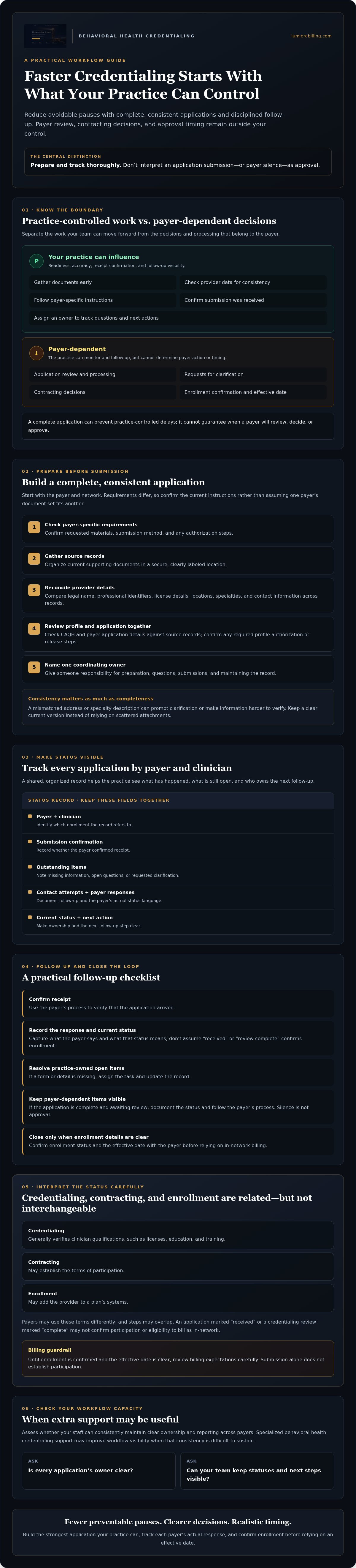
Faster credentialing means making an application ready for review sooner by reducing delays your practice can control. It does not mean controlling a payer’s review time, contracting decisions, or approval. A well-managed process can prevent avoidable pauses, but it can’t guarantee when a payer will act.
Credentialing generally involves verifying a clinician’s qualifications, such as licenses, education, and training. This process of credentialing is related to, but not always the same as, payer contracting or enrollment. Contracting may establish the terms of participation, while enrollment may add the provider to a plan’s systems. Payers use these terms differently, and steps may overlap.
Track the payer’s actual status language and ask what each status means. An application marked “received” or a credentialing review marked “complete” may not confirm that the clinician is enrolled, participating, or eligible to bill as in-network. The payer’s confirmation and effective-date information matter.
Why Credentialing Delays Affect Behavioral Health Practices
Until the relevant payer requirements are met, a clinician’s ability to bill as an in-network provider may be limited, depending on the plan’s rules and the provider’s status. Submitting an application alone doesn’t establish participation. An unclear start date can also complicate scheduling, patient communication, and billing workflows. Confirm enrollment status and the effective date with the payer before relying on in-network billing.
Which Parts of the Credentialing Timeline Can a Practice Influence?
Practices can gather documents early, keep provider details consistent across records, follow payer-specific submission instructions, and confirm that applications were received. They can also assign someone to track open questions and record follow-up actions. These steps improve readiness and visibility; they don’t accelerate the payer’s internal review or determine its contracting decision.
Requirements and timing vary by payer, network, and application. Separate the timeline into two categories:
- Practice-controlled: document collection, data accuracy, submission completeness, receipt confirmation, and organized follow-up.
- Payer-dependent: application review, requests for clarification, contracting decisions, and confirmation of enrollment or an effective date.
This distinction clarifies the next step. If a form is missing, the practice can resolve it. If the application is complete and awaiting payer review, document the status, follow up through the payer’s process, and don’t treat silence as approval.
How to Prepare a Complete Behavioral Health Credentialing Application
A complete application starts before anyone fills out a form. Identify the payer and network, then check current requirements, submission method, and authorization steps. Requirements differ, so don’t assume a document set that worked for one payer will satisfy another. Assign one owner to coordinate preparation, resolve questions, and maintain a secure, organized record of documents, submissions, and payer responses.
Next, gather the provider’s source records and compare them with the application. A small mismatch, such as an old practice address or a specialty described differently across records, can prompt a clarification request or make information harder to verify. Accuracy depends on consistency as well as completeness.
Align Provider Records Before Submitting
Reconcile professional identifiers, legal name, license details, practice locations, specialties, and contact information. Check that supporting documents are current and agree with the application. Use the payer’s checklist to confirm which materials it requests. Keep records in a restricted, clearly labeled location so the assigned owner can identify the current version and retrieve it without relying on scattered email attachments.
Keep CAQH and Payer Applications in Sync
Review the provider’s CAQH profile for completeness and compare it with the payer application and source records. Confirm any required profile authorization or release steps against current payer instructions. A complete profile alone doesn’t establish that a payer has received or accepted an application. Practices can consult a CAQH enrollment guide for profile-management details, while treating each payer’s current requirements as the final reference.
Before submitting, have the owner compare names, identifiers, locations, specialties, dates, and contact details across all materials. Save a copy of what was sent, record the submission date and method, and retain any confirmation or reference number. This creates a clear starting point for follow-up and helps the practice identify exactly what the payer received.
Application-readiness checklist: “Review payer requirements, reconcile provider records, verify supporting documents and profile authorizations, submit through the required channel, and save proof of submission.”
These repeatable checks support faster credentialing behavioral health by reducing avoidable practice-side corrections, not by promising a payer decision on a particular schedule. If your team needs clearer ownership and more consistent application tracking, review behavioral health credentialing and enrollment support as part of your workflow planning.
How to Find and Fix Credentialing Bottlenecks
A stalled application needs a diagnosis, not just another status call. First determine whether the next action belongs to the practice or the payer. This helps staff avoid repeatedly contacting a payer while a missing document or conflicting record remains unresolved. A well-managed workflow makes both the blocker and its owner visible.
| Practice-side blocker | Payer-side waiting |
|---|---|
| Incomplete fields, expired documents, mismatched details, or missing authorizations | Application received and awaiting review, with no practice action currently requested |
| Payer request not assigned, answered, or documented | Clarification submitted and awaiting payer assessment |
| Provider, location, or affiliation change not reflected in the roster | Contracting or enrollment status pending payer confirmation |
Practice-Controlled Delays to Resolve First
Before escalating, check the application and supporting records for blank fields, expired documents, conflicting identifiers or locations, and incomplete authorization steps. If a payer asks for clarification, assign a specific staff owner to gather the response, submit it through the requested channel, and record what was resolved and when. Avoid sending repeated versions without confirming which information is current.
Roster accuracy matters after initial submission, too. When a clinician’s location, affiliation, or status changes, review which payer records may need an update and assign responsibility for keeping them aligned. A current provider roster helps staff spot discrepancies before they trigger another round of questions.
Payer-Controlled Delays to Monitor Transparently
When the application is complete and no practice action is outstanding, document the payer’s acknowledgment, stated status, any requested next step, and the date of the latest contact. Use the payer’s designated communication channel and current instructions. Follow-up can clarify status or surface a request, but it can’t override the payer’s review, contracting decision, or processing queue.
Keep one tracker for each application. At minimum, record:
- Payer and clinician, plus the submission date.
- Current status and outstanding items, including who owns each practice-side task.
- Contact attempts and responses, with dates, channel, and reference details when available.
- Next action, its owner, and any payer-stated timing or instructions.
This record makes the source of delay easier to identify: an unresolved practice task, a payer request, or a pending review. For roster changes, consult your existing provider roster management guidance and verify payer-specific update procedures. Keep the tracker current, and escalate a concrete blocker rather than simply increasing the number of follow-ups.
A Practical Behavioral Health Credentialing Follow-Up Checklist
Follow-up works best when every application has a clear owner, documented status, and next action. This checklist helps your practice keep the process moving without assuming that frequent contact can control payer review. Use the payer’s current instructions for communication channels and timing, and record dates rather than applying a one-size-fits-all follow-up interval.
Before and Immediately After Submission
- Pre-submission: Confirm the payer and network, provider details, required attachments, and correct submission channel. Check that payer-specific instructions have been followed.
- At submission: Save a copy of the application and supporting documents. Record the submission date, method, and any confirmation or reference information received.
- Assign ownership: Name the person responsible for monitoring status, responding to payer requests, and recording the next action. Note when that action is due based on payer instructions or the practice’s tracking process.
- Confirm receipt: Record the payer’s acknowledgment, or note that confirmation is still outstanding and what the owner will do next.
When an Application Is Pending or Returned
First identify what the payer needs. A returned application may require a missing document, clarification, or correction. Assign the task, check the response against provider records, and send it through the requested channel. Update the same tracking record with the request date, responsible owner, response or resubmission date, and the payer’s resulting status.
For renewals, use the same disciplined recordkeeping and consult your mental health provider re-credentialing guide for renewal-specific considerations. Keep renewal activity distinct from initial enrollment so staff can see which requirement, response, or confirmation applies to each process.
Close the Loop Before Relying on Participation
- Confirm directly with the payer whether the clinician is enrolled and participating in the intended plan or network.
- Verify the effective date and any payer instructions that affect in-network billing. Record who confirmed the information, when, and through which channel.
- Update the practice’s tracking record and notify staff who rely on the enrollment status. If the payer has not confirmed participation or an effective date, keep the status marked as pending rather than treating submission as approval.
A consistent checklist can support faster credentialing behavioral health by making ownership and next steps visible, while leaving payer decisions with the payer. Practices that need operational help coordinating credentialing and enrollment tasks can review behavioral health credentialing support.
When Behavioral Health Credentialing Support Can Help
Internal ownership may be enough when a practice has a clear process, staff capacity to maintain provider records, and reliable visibility into every payer application. Specialist support may be worth considering when follow-ups compete with other duties, applications lack a consistent owner, or leaders can’t easily tell which items are pending and who must act. The goal isn’t simply to outsource paperwork. It’s to make responsibility, status, and next steps clear.
When evaluating support, look at how the work is managed, not just whether applications are submitted. Ask how payer-specific differences and corrections are handled, and how the practice can see progress. Support can coordinate applications and follow-up, but payer review, contracting decisions, and timing remain outside the partner’s control.
Questions to Ask a Credentialing Support Partner
- Who owns each task? Clarify who manages applications, CAQH maintenance, payer follow-up, and provider roster updates, and how responsibilities are shared with your staff.
- How will we see progress? Ask what status information is reported, how outstanding items are assigned, and how completed actions are recorded.
- How are payer differences handled? Confirm how the team checks current requirements, identifies application errors, and coordinates corrections or responses to payer requests.
- What happens when a case stalls? Ask how unresolved issues are surfaced and escalated, and what information the practice receives when the next step depends on the payer.
Answers should describe a visible workflow, not promise approval or a specific turnaround. Your practice should be able to identify the application status, next action, and responsible person without reconstructing the history from emails.
Connect Enrollment Work to the Wider Revenue Cycle
Accurate provider, payer, and effective-date information supports downstream billing workflows. If enrollment status is unclear or details don’t align, staff may need to verify participation before relying on in-network billing processes. Credentialing and enrollment support is connected to, but distinct from, broader revenue cycle management. For the larger operational picture, consult a behavioral health revenue cycle management guide alongside your enrollment procedures.
Lumiere Billing focuses exclusively on behavioral health revenue cycle management and offers credentialing and enrollment support, including payer contracting, CAQH maintenance, and enrollment applications. The right operational partner should coordinate those tasks and keep status visible while being transparent about what still depends on payer action.
Learn about credentialing and enrollment support
Build a Credentialing Process Your Team Can See
Faster credentialing behavioral health isn’t about rushing payer decisions. It’s about giving each application clear ownership, keeping provider information consistent, and knowing what’s pending, what’s resolved, and what still depends on the payer. Those habits help your practice prepare stronger submissions and plan with more confidence, without treating submission as proof of participation.
When credentialing tasks compete with other operational demands, specialized support may help bring structure to the work. Lumiere Billing focuses exclusively on behavioral health revenue cycle management, with credentialing and enrollment support that includes payer contracting, CAQH maintenance, and applications. Support can coordinate the process, while payer review and approval remain the payer’s responsibility.
Ready to discuss a workflow that fits your practice? Discuss behavioral health credentialing support. With clear ownership and steady visibility, your team can move forward one well-managed step at a time.
Frequently Asked Questions
Can behavioral health credentialing be expedited?
A practice can often reduce avoidable delays, but it can’t control a payer’s internal review or approval. For faster credentialing behavioral health, submit complete, consistent applications, respond to requests for information, and keep a clear record of each application’s status and next action. Confirm current requirements and status directly with each payer. A support service or frequent follow-up can coordinate the work, but neither guarantees a faster payer decision.
How long does behavioral health provider credentialing take?
There’s no single reliable timeline for every clinician, payer, or application. Processing may depend on the payer’s requirements, application completeness, contracting steps, and requests for additional information. Ask each payer for its current guidance and record the response alongside the application’s status. Plan around confirmed information, not a general estimate. A submission receipt or acknowledgment confirms receipt, not active participation or permission to bill as an in-network provider.
What causes credentialing applications to be delayed?
Common practice-side causes include incomplete fields, inconsistent provider details, missing or outdated documents, and slow responses to payer questions. Payer review queues and contracting steps can also affect progress. To identify the actual blocker, record payer requests and compare application details with the provider’s current source records. Resolve correctable issues first. A tracker helps distinguish a practice task from an external wait, so follow-up addresses the right next step.
Does CAQH speed up behavioral health credentialing?
A complete, accurate CAQH profile can support an application when a payer uses or requests that information, but it doesn’t replace every payer’s application or other requirements. Check whether the payer requires profile authorization, additional documents, or separate contracting steps. Before submission, compare profile details with provider records, including identifiers, practice locations, and specialties. Then track required updates and payer confirmation. CAQH participation alone doesn’t guarantee faster review or enrollment.
Can a clinician see patients before credentialing is complete?
Whether a clinician can see a patient and whether the practice can bill a session as in-network are separate questions. The answer depends on applicable payer rules, contract terms, enrollment status, and effective dates. Before representing a clinician as participating or submitting a claim under that status, confirm the requirements directly with the payer. If participation hasn’t been confirmed, don’t treat an application submission or pending review as proof of in-network eligibility.
What should a behavioral health credentialing tracker include?
Track the clinician, payer, application date, submission method, confirmation details, outstanding documents, contact history, payer responses, and current status. Assign an owner and record the next action so requests don’t disappear between teams. Protect provider information using your practice’s appropriate recordkeeping safeguards. When a payer confirms enrollment, add the effective date and confirmation details. The tracker supports visibility, but payer confirmation remains the source for participation status.
When should a behavioral health practice outsource credentialing?
Consider outside support when application ownership is unclear, follow-ups are missed, records are difficult to reconcile, or enrollment work exceeds your team’s capacity. Evaluate behavioral health experience, task ownership, status reporting, and how application corrections are handled. Lumiere Billing specializes exclusively in behavioral health revenue cycle management and offers Credentialing & Enrollment support, including payer contracting, CAQH maintenance, and applications. A partner can coordinate these tasks, but can’t guarantee payer decisions or timing.
Frequently Asked Questions
Practices can gather documents early, keep provider details consistent across records, follow payer-specific submission instructions, and confirm that applications were received. They can also assign someone to track open questions and record follow-up actions. These steps improve readiness and visibility; they don’t accelerate the payer’s internal review or determine its contracting decision. Requirements and timing vary by payer, network, and application. Separate the timeline into two categories: This distinction clarifies the next step. If a form is missing, the practice can resolve it. If the application is complete and awaiting payer review, document the status, follow up through the payer’s process, and don’t treat silence as approval. A complete application starts before anyone fills out a form. Identify the payer and network, then check current requirements, submission method, and authorization steps. Requirements differ, so don’t assume a document set that worked for one payer will satisfy another. Assign one owner to coordinate preparation, resolve questions, and maintain a secure, organized record of documents, submissions, and payer responses. Next, gather the provider’s source records and compare them with the application. A small mismatch, such as an old practice address or a specialty described differently across records, can prompt a clarification request or make information harder to verify. Accuracy depends on consistency as well as completeness.
A practice can often reduce avoidable delays, but it can’t control a payer’s internal review or approval. For faster credentialing behavioral health, submit complete, consistent applications, respond to requests for information, and keep a clear record of each application’s status and next action. Confirm current requirements and status directly with each payer. A support service or frequent follow-up can coordinate the work, but neither guarantees a faster payer decision.
There’s no single reliable timeline for every clinician, payer, or application. Processing may depend on the payer’s requirements, application completeness, contracting steps, and requests for additional information. Ask each payer for its current guidance and record the response alongside the application’s status. Plan around confirmed information, not a general estimate. A submission receipt or acknowledgment confirms receipt, not active participation or permission to bill as an in-network provider.
Common practice-side causes include incomplete fields, inconsistent provider details, missing or outdated documents, and slow responses to payer questions. Payer review queues and contracting steps can also affect progress. To identify the actual blocker, record payer requests and compare application details with the provider’s current source records. Resolve correctable issues first. A tracker helps distinguish a practice task from an external wait, so follow-up addresses the right next step.
A complete, accurate CAQH profile can support an application when a payer uses or requests that information, but it doesn’t replace every payer’s application or other requirements. Check whether the payer requires profile authorization, additional documents, or separate contracting steps. Before submission, compare profile details with provider records, including identifiers, practice locations, and specialties. Then track required updates and payer confirmation. CAQH participation alone doesn’t guarantee faster review or enrollment.
Whether a clinician can see a patient and whether the practice can bill a session as in-network are separate questions. The answer depends on applicable payer rules, contract terms, enrollment status, and effective dates. Before representing a clinician as participating or submitting a claim under that status, confirm the requirements directly with the payer. If participation hasn’t been confirmed, don’t treat an application submission or pending review as proof of in-network eligibility.
Track the clinician, payer, application date, submission method, confirmation details, outstanding documents, contact history, payer responses, and current status. Assign an owner and record the next action so requests don’t disappear between teams. Protect provider information using your practice’s appropriate recordkeeping safeguards. When a payer confirms enrollment, add the effective date and confirmation details. The tracker supports visibility, but payer confirmation remains the source for participation status.
Consider outside support when application ownership is unclear, follow-ups are missed, records are difficult to reconcile, or enrollment work exceeds your team’s capacity. Evaluate behavioral health experience, task ownership, status reporting, and how application corrections are handled. Lumiere Billing specializes exclusively in behavioral health revenue cycle management and offers Credentialing & Enrollment support, including payer contracting, CAQH maintenance, and applications. A partner can coordinate these tasks, but can’t guarantee payer decisions or timing.