Behavioral Health Billing Support: A Guide for Practices

Comprehensive behavioral health billing support connects the steps around each claim, from insurance verification and authorization through submission, follow-up, and payment posting. A claim can be complete and still stall if information or responsibility is lost at a handoff.
When billing tasks are split across staff and disconnected workflows, it can be hard to see which claims remain unresolved, why denials occur, or how collections are progressing. Payer requirements, authorization details, and provider information all need consistent coordination because each handoff affects the next step.
This guide explains what end-to-end billing support should cover and how coordinated revenue cycle management can improve visibility into claims, denials, accounts receivable, and collections. It also covers how credentialing, practice advisory, and analytics fit into the billing process, and offers practical questions for reviewing your workflows.
Lumiere Billing focuses exclusively on behavioral health practices and works as an extension of practice teams. Its revenue cycle services connect billing activities to give practices a clearer view of financial operations and help clinicians and staff focus on care.
Key Takeaways
- Comprehensive behavioral health billing support coordinates the patient-to-payment lifecycle, connecting verification, authorization, claims, follow-up, and payment posting.
- Map who owns each workflow handoff so unresolved claims and follow-up responsibilities are easy to identify.
- Compare coordinated billing with fragmented task handling by reviewing workflow continuity, reporting access, and visibility into collections.
- Review recurring claim and denial patterns over time instead of drawing conclusions from a single claim.
- Lumiere Billing connects behavioral health revenue cycle management with denial prevention and analytics to help practices see billing activity more clearly.
What comprehensive behavioral health billing support should solve
Comprehensive behavioral health billing support coordinates the work on a patient account from coverage review through claim resolution and payment posting. It connects tasks that may be split across intake, clinical, credentialing, and billing teams, so information and responsibility follow the account instead of stopping at a handoff.
Behavioral health billing requires coordination across workflows. Coverage and authorization requirements can vary by payer and service, while provider enrollment and demographic details affect how claims are prepared and processed. For example, a change to provider information needs to reach the billing workflow before affected claims are submitted. Support that connects these steps can address issues earlier than a process focused only on claim submission or troubleshooting after rejection.
Where disconnected billing workflows create friction
A typical sequence starts with intake collecting insurance details, followed by a benefits or authorization review. Clinical documentation and claim preparation come next. If information is missing or changes along the way, the person handling the next step may not know what remains unresolved. The claim may then need clarification or correction before it can move forward.
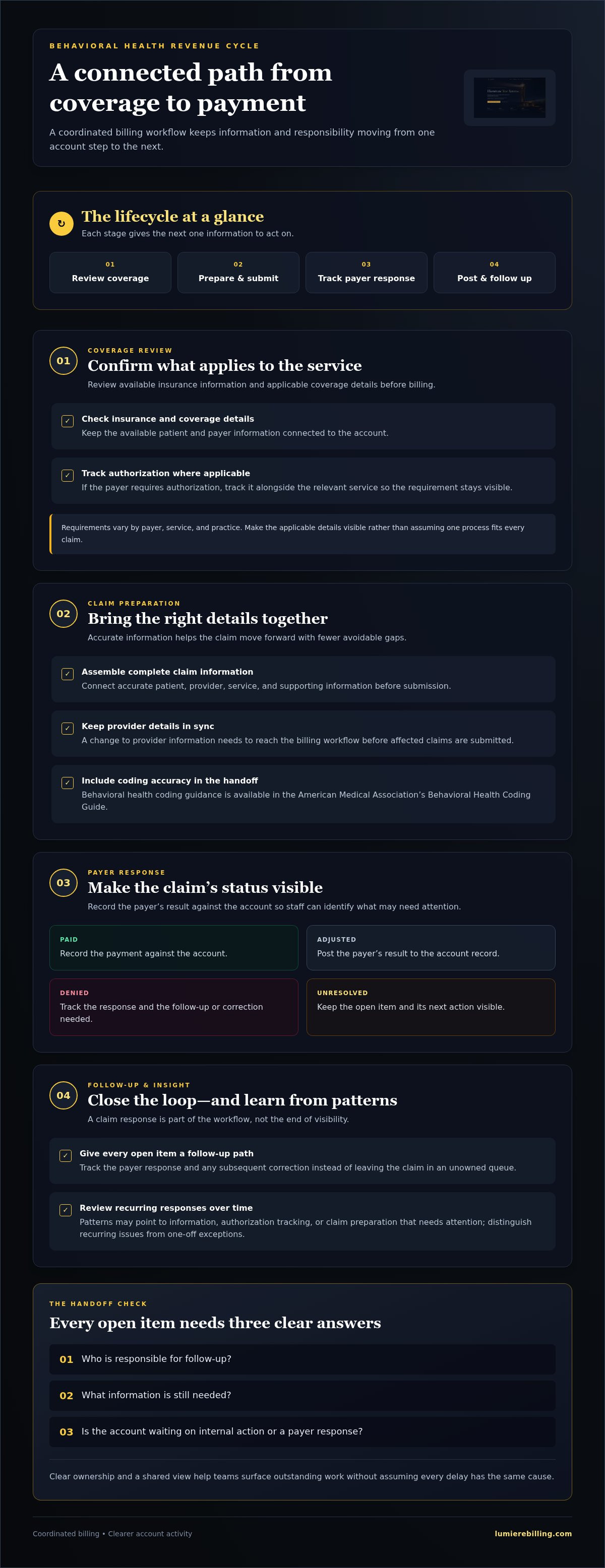
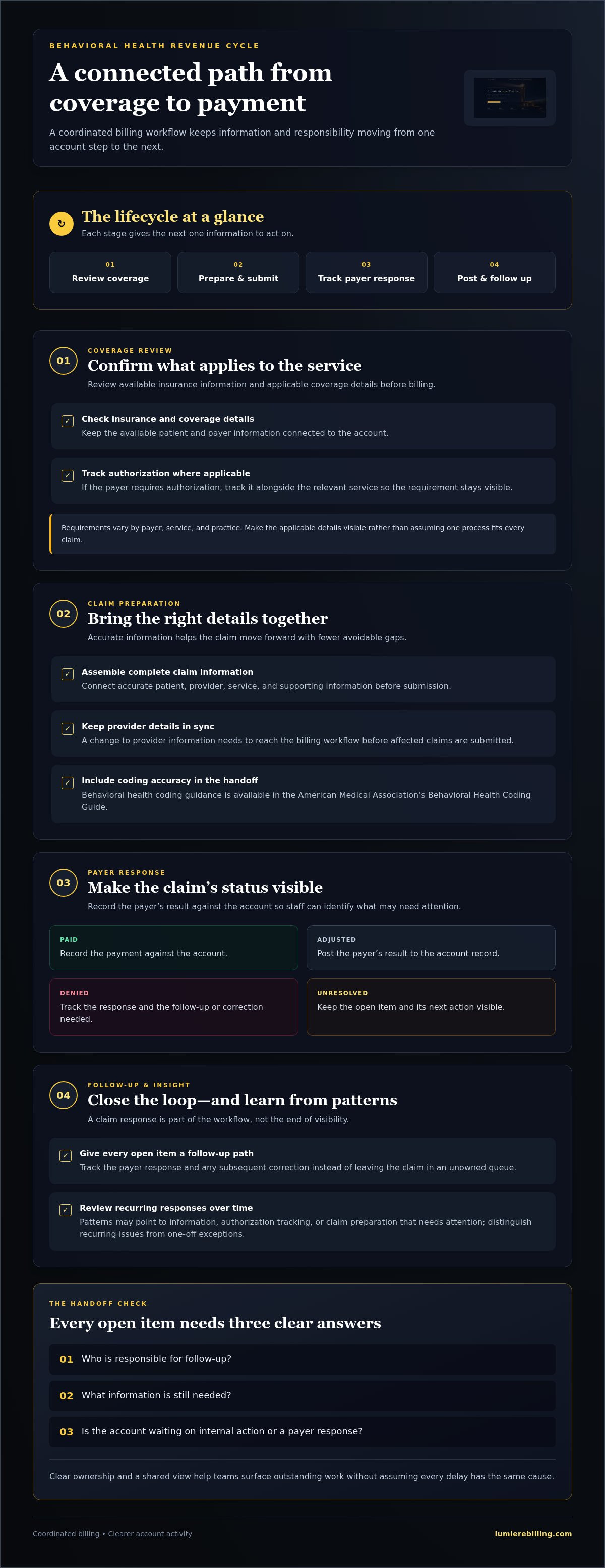
Clear ownership makes status easier to track. For each open item, staff should be able to identify who is responsible for follow-up, what information is still needed, and whether the account is waiting on internal action or a payer response. That shared view helps teams surface outstanding work without assuming every delay has the same cause.
What practices should expect from a specialist partner
Behavioral health specialization means focusing on the billing workflows and coordination needs of behavioral health practices. A partner working as an extension of the practice team can connect insurance verification, prior authorization, provider data, claims follow-up, and payment posting within a coordinated revenue cycle.
Integrated care adds another dimension. The Primary Care Behavioral Health (PCBH) model describes behavioral health services delivered in primary care settings, where teams may coordinate across care contexts. Billing requirements still depend on the relevant payer and circumstances, so workflows should make those details visible rather than rely on assumptions. For broader context on how billing activities fit together, see this behavioral health RCM guide.
The practical distinction is continuity. Isolated task handling completes an individual step. Comprehensive support connects the steps, tracks unresolved work, and gives the practice a clearer view of each account’s progress.
How comprehensive behavioral health billing support connects each workflow
Billing is a sequence, not a stack of unrelated tasks. Comprehensive behavioral health billing support connects coverage review, authorization tracking where applicable, claim preparation and submission, payer follow-up, and payment posting. Because requirements vary by payer, service, and practice, the workflow should reflect the requirements that apply to each account rather than assume one process fits every claim.
A coordinated billing lifecycle reviews coverage and applicable authorization requirements, submits complete claims, tracks payer responses, follows up on unresolved items, and records payments so account activity stays visible. Each stage gives the next one information to act on.
From eligibility and authorization to clean claim submission
Before billing for a service, the team reviews available insurance information and applicable coverage details. If a payer requires authorization, tracking it alongside the relevant service keeps the requirement visible as work moves forward. The process then brings together accurate patient, provider, service, and supporting information for claim submission.
Complete information matters. Missing or inconsistent details may prompt a claim correction or additional follow-up, depending on the payer’s response. Coding accuracy is also part of this handoff. The American Medical Association’s Behavioral Health Coding Guide provides behavioral health coding guidance.
From payer response to posting, follow-up, and reporting
When a payer responds, payment posting records the result against the account. The record helps staff see whether the claim was paid, adjusted, denied, or remains unresolved, and what action may be needed next. Each denial or open balance should have a clear follow-up path, with the response and any subsequent correction tracked rather than left in an unowned queue.
Denial prevention links follow-up to earlier workflow steps. Recurring payer responses can point to information, authorization tracking, or claim preparation that may need attention. Analytics can make patterns across claims and collections easier to see, helping leaders distinguish recurring issues from one-off exceptions. For examples of common problems to watch for, read the behavioral health billing errors guide.
Lumiere Billing’s behavioral health revenue cycle support connects work from verification through payment posting, with denial prevention and analytics supporting visibility along the way.
Comprehensive versus fragmented billing support: what changes for a practice?
The difference is not simply who completes each billing task. It is whether responsibility, status, and next steps stay visible as work moves across the revenue cycle. Comprehensive behavioral health billing support connects those handoffs. Fragmented support may leave each task with a different person or workflow, making it harder to see what remains open.
| Area | Coordinated lifecycle ownership | Disconnected task handling |
|---|---|---|
| Visibility | Claim status and next steps are tracked across workflows. | Updates may sit in separate queues, records, or staff communications. |
| Follow-up | Responsibility for unresolved claims and denials is clear. | Ownership may be unclear when an item passes between teams. |
| Continuity | Relevant information moves between billing stages. | Teams may need to reassemble context at each handoff. |
| Reporting | Practice leaders can review consistent billing categories. | Reporting may be limited to individual tasks or scattered updates. |
What connected ownership looks like in day-to-day billing
Defined ownership clarifies who reviews an open item, records its status, and carries the next action forward. If a payer requests additional information, for example, a clear workflow identifies who coordinates the response and how the account status is updated. Consistent communication also connects administrative needs with relevant information from clinical and intake workflows.
This visibility supports oversight, but it does not control payer decisions. A coordinated process can show what was submitted, what response arrived, and what follow-up is underway. It cannot guarantee a coverage determination or payment outcome.
How to assess visibility without losing practice oversight
Useful reporting can bring several operational views together:
- Claims status: Submitted, awaiting response, or requiring action.
- Denials: Recorded reasons and follow-up status.
- Accounts receivable: Open balances and their current stage.
- Collections: Posted payments and collection activity over time.
Practice leaders should understand how each category is defined, the period a report covers, and how often it is reviewed. A shared review cadence gives the team a regular opportunity to clarify priorities and recurring issues while preserving day-to-day visibility for the practice. Outsourcing is not automatically the right fit for every workflow. The important test is whether the chosen structure provides clear ownership and usable information. For a closer look at specialist support, see the behavioral health billing services guide.
A practical framework for reviewing your behavioral health billing support
A useful review shows more than how many claims were processed. It should show where work is moving, where it pauses, who owns the next step, and what patterns may need attention. A strong billing review connects ownership, handoffs, follow-up, and reporting to give practice leaders a clearer view of recurring workflow issues.
Questions that reveal gaps in billing visibility
Use a consistent set of questions to examine the process, not just individual account outcomes:
- Ownership: For each open claim, can the team identify who owns the next action?
- Handoffs: Does relevant information move clearly between intake, clinical, and billing workflows?
- Follow-up: Can staff see which claims or denials need attention and what has already been done?
- Reporting: Can leaders identify recurring denial categories and unresolved account trends?
- Definitions: Are reporting periods and measures, such as open claims or collections, defined consistently?
Review these questions across a meaningful period and look for repeated signals. One claim may have an unusual explanation, while a recurring pattern across accounts can point to a workflow that deserves closer examination. Consistent definitions make comparisons more useful and reduce the risk of mistaking a reporting change for an operational change.
Turning billing findings into practice-level action
Patterns can help leaders decide where to investigate. Repeated missing information may call for a closer look at intake steps or how details are handed to billing. Denials associated with authorization may prompt a review of tracking responsibilities and payer follow-up. If a pattern appears connected to provider enrollment information, credentialing support may be relevant. Practice advisory can help leaders assess operational workflows, while analytics make recurring activity easier to examine.
Match the response to the finding and the practice context. A billing trend can identify a question for the team to investigate, but it should not dictate clinical decisions. Clinicians retain clinical judgment, while administrative processes can be reviewed for clearer documentation handoffs, task ownership, or follow-up. Record the action taken and revisit the same measures later to see whether the operational pattern changes.
Lumiere Billing offers a free billing audit to review your practice’s billing workflows and bring operational questions into focus.
How Lumiere Billing delivers comprehensive behavioral health billing support
Lumiere Billing works exclusively with behavioral health providers, bringing focused revenue cycle support to practice operations. Its services connect key stages, from insurance verification and authorization coordination to claims, denial prevention, payment posting, and analytics. The aim is to give practice leaders a clearer operational picture and provide a connected partner for teams managing care and administration.
A specialist workflow designed around behavioral health practices
Comprehensive behavioral health billing support keeps billing activities connected to the workflows around them. Lumiere’s revenue cycle management covers the billing process from verification through final payment posting, with authorization coordination and claim follow-up supporting continuity. Denial prevention focuses attention on billing issues that may be addressed through workflow review, while analytics help practices examine claims and collection activity.
Credentialing and enrollment support addresses provider information and participation details that inform billing workflows. Practice advisory helps practices review operational processes and EHR workflows, with guidance shaped around their needs. These services support billing operations; they do not replace clinicians’ judgment or care decisions.
Start with a clearer view of your billing operations
A billing audit gives practice leaders a structured starting point for examining workflows, handoffs, and visibility. It can help identify where responsibility changes hands, how unresolved items are tracked, and what information would make billing activity easier to review. The audit provides a basis for considering next steps, not a promise of a particular claims or collections outcome.
Analytics add visibility by organizing activity and trends for review. Leaders can use the information to explore recurring patterns, consider whether a workflow merits closer attention, and decide what operational questions to address. Findings are most useful when interpreted in the context of the practice’s processes and payer requirements.
If your team wants a clearer view of its billing workflows, request a free billing audit to begin reviewing where your revenue cycle may need greater coordination.
Bring greater clarity to your practice’s billing operations
Strong billing support depends on connected workflows, clear ownership, and reporting that helps leaders see where accounts stand. Reviewing recurring patterns in claims, denials, and collections can help a practice identify administrative gaps and choose practical next steps without treating one claim as the whole story.
Comprehensive behavioral health billing support should fit the realities of behavioral health practices. Lumiere Billing specializes exclusively in behavioral health providers, with revenue cycle management spanning insurance verification through final payment posting. A free billing audit gives practices a starting point for examining workflow handoffs and billing visibility.
To bring your billing process into clearer view, request a free billing audit. A more coordinated operational picture can help your team make informed decisions and protect more time for the work of care.
Frequently Asked Questions
What does comprehensive behavioral health billing support include?
Comprehensive behavioral health billing support coordinates the administrative work involved in moving an account through the revenue cycle. This can include insurance verification, prior authorization coordination where required, claim submission, denial follow-up, payment posting, and reporting. Connecting these steps helps ensure unresolved work has clear ownership. Workflows depend on the practice, services, and payer requirements, so the process may differ from one claim to another.
How does behavioral health billing support improve revenue cycle visibility?
Connected workflows and consistent reporting help practice leaders see where accounts stand and what action remains. Useful views may include claim status, denial categories, unresolved balances, accounts receivable, and posted collections. Clear definitions matter: teams should know what each measure includes and which reporting period it covers. This makes it easier to notice recurring patterns without assuming every claim delay has the same cause.
Can a billing partner manage prior authorizations and claims together?
Yes. A billing partner can coordinate prior authorization tracking with claim preparation and follow-up, keeping relevant information connected across the workflow. Lumiere Billing includes prior authorization coordination and claims submission within its revenue cycle management for behavioral health providers. Requirements vary by payer and service, so authorization steps should reflect the requirements that apply. Coordination supports workflow continuity, but it cannot determine or guarantee a payer’s decision.
How can a behavioral health practice identify gaps in its billing support?
Start by reviewing who owns open claims, how follow-up actions are recorded, and whether leaders can see recurring denials or unresolved account trends. Check that staff understand reporting definitions and review periods. Look for patterns across accounts instead of drawing conclusions from one unusual claim. This can help distinguish a recurring handoff or information issue from an isolated exception and guide a focused workflow review.
What is the difference between billing support and revenue cycle management?
Billing support can refer to specific tasks, such as submitting claims or following up on denials. Revenue cycle management takes a broader view by connecting billing activities across the account lifecycle, from insurance verification through final payment posting. The terms can overlap, so clarify which workflows are handled, how follow-up is assigned, and what reporting is available. The key distinction is task coverage versus coordinated lifecycle oversight.
Does comprehensive billing support include credentialing?
It can. Credentialing and enrollment support addresses provider enrollment and payer participation information that can affect billing workflows. Connecting provider details and enrollment tasks to revenue cycle operations helps practices identify information that may need review before billing proceeds. Lumiere Billing offers Credentialing & Enrollment alongside revenue cycle management. The specific work depends on the practice’s needs and the provider information involved.
How can a behavioral health billing audit help my practice?
A billing audit can help a practice examine workflow handoffs, ownership of unresolved work, and visibility into claims and collections. It can surface questions about recurring denials, follow-up processes, or reporting for leaders to investigate. Lumiere Billing offers a free billing audit as a starting point for reviewing billing operations. The audit can inform possible next steps, but it does not guarantee a particular payment or denial outcome.
Frequently Asked Questions
Comprehensive behavioral health billing support coordinates the administrative work involved in moving an account through the revenue cycle. This can include insurance verification, prior authorization coordination where required, claim submission, denial follow-up, payment posting, and reporting. Connecting these steps helps ensure unresolved work has clear ownership. Workflows depend on the practice, services, and payer requirements, so the process may differ from one claim to another.
Connected workflows and consistent reporting help practice leaders see where accounts stand and what action remains. Useful views may include claim status, denial categories, unresolved balances, accounts receivable, and posted collections. Clear definitions matter: teams should know what each measure includes and which reporting period it covers. This makes it easier to notice recurring patterns without assuming every claim delay has the same cause.
Yes. A billing partner can coordinate prior authorization tracking with claim preparation and follow-up, keeping relevant information connected across the workflow. Lumiere Billing includes prior authorization coordination and claims submission within its revenue cycle management for behavioral health providers. Requirements vary by payer and service, so authorization steps should reflect the requirements that apply. Coordination supports workflow continuity, but it cannot determine or guarantee a payer’s decision.
Start by reviewing who owns open claims, how follow-up actions are recorded, and whether leaders can see recurring denials or unresolved account trends. Check that staff understand reporting definitions and review periods. Look for patterns across accounts instead of drawing conclusions from one unusual claim. This can help distinguish a recurring handoff or information issue from an isolated exception and guide a focused workflow review.
Billing support can refer to specific tasks, such as submitting claims or following up on denials. Revenue cycle management takes a broader view by connecting billing activities across the account lifecycle, from insurance verification through final payment posting. The terms can overlap, so clarify which workflows are handled, how follow-up is assigned, and what reporting is available. The key distinction is task coverage versus coordinated lifecycle oversight.
It can. Credentialing and enrollment support addresses provider enrollment and payer participation information that can affect billing workflows. Connecting provider details and enrollment tasks to revenue cycle operations helps practices identify information that may need review before billing proceeds. Lumiere Billing offers Credentialing & Enrollment alongside revenue cycle management. The specific work depends on the practice’s needs and the provider information involved.
A billing audit can help a practice examine workflow handoffs, ownership of unresolved work, and visibility into claims and collections. It can surface questions about recurring denials, follow-up processes, or reporting for leaders to investigate. Lumiere Billing offers a free billing audit as a starting point for reviewing billing operations. The audit can inform possible next steps, but it does not guarantee a particular payment or denial outcome.
Free billing audit
Find out what your billing is really costing you
We'll review your claims, denials and collections and show you exactly where revenue is leaking. Free, no obligation, no contract.
Schedule a Free Billing Audit