Behavioral Health Billing Compliance: 2026 Guide

Billing compliance rarely breaks in one dramatic moment. It frays across handoffs: a note that doesn’t support the code, a missed authorization check, or a claim pattern no one is tracking. A focused approach to compliance consulting behavioral health billing treats these small gaps as operational signals, then connects them to checks that staff can repeat.
When ownership is unclear or payer requirements aren’t reflected in daily workflows, it’s difficult to know which risks to address first. A one-time audit can identify problems, but findings need owners and follow-up to help prevent them from recurring. Compliance works best as a continuous control system built into everyday revenue-cycle tasks and designed to support care without disrupting it.
This 2026 guide explains how to identify billing risks, establish repeatable checks for documentation, coding, claims, and follow-up, and use reporting to make patterns visible. You’ll also learn how defined ownership can strengthen oversight across the revenue cycle. Lumiere Billing brings behavioral health expertise to this work through analytics and compliance, practice advisory, and revenue cycle management, working alongside practice teams to bring greater clarity to billing operations.
Key Takeaways
- Define billing compliance around accurate, defensible claims, and keep it distinct from broader privacy, workplace safety, and corporate programs.
- Trace controls through the full claim lifecycle, from eligibility and authorization to remittance review and follow-up.
- Understand how software, a one-time review, and ongoing compliance consulting behavioral health billing each contribute different roles and outputs.
- Turn findings into action by mapping workflows, reviewing representative records, prioritizing risks, assigning owners, and monitoring changes.
- See how behavioral health-focused support can connect verification, authorization, claims, denials, analytics, and compliance oversight.
Why behavioral health billing compliance needs attention across the revenue cycle
Billing compliance is not a binder that sits apart from daily operations. It is the set of policies, checks, and records that helps a practice submit claims that accurately reflect the services delivered and can be supported if questions arise. Billing compliance is the operational system of documented responsibilities and repeatable checks that supports accurate, defensible claims from intake through payment follow-up.
That focus is narrower than a practice’s broader compliance program. Privacy, workplace safety, and corporate compliance address important responsibilities, but they don’t replace controls for verifying coverage, tracking authorization, supporting charges in the record, and handling claim responses. Each billing step needs a clear owner and a reliable handoff.
Behavioral health services rely on clinical documentation to support what was billed, while workflows may involve different service types, payers, and administrative systems. When the note, claim, and follow-up process don’t align, a small gap can be difficult to trace. A structured approach to compliance consulting behavioral health billing examines these connections in the work itself, rather than treating compliance as a checklist detached from the revenue cycle.
What does billing compliance consulting cover?
A billing-focused review can examine how a practice verifies coverage, tracks authorizations, maintains billing documentation, prepares and submits claims, manages responses, and reports recurring issues. The scope should reflect the practice’s services, payer mix, systems, and actual workflow. The aim is practical: identify where controls or ownership need clarity, then organize corrective action. This operational guidance is distinct from legal representation.
Where can compliance gaps surface in behavioral health billing?
Start with the handoffs. Was coverage checked and recorded? Can staff see the current authorization status? Does the billed service have supporting documentation? Is a rejected claim routed for correction, and does payment posting flag discrepancies? Unclear ownership can let exceptions pass unnoticed, while inconsistent processes make the same issue harder to spot across claims.
These checkpoints are connected. A missed authorization update, for example, may not become visible until a claim is denied. The team may then have to trace where the handoff failed. Reviewing patterns across verification, documentation, submission, and payment follow-up can show whether an error is isolated or points to a workflow weakness. For more examples of preventable breakdowns, see the behavioral health billing errors guide.
How billing compliance controls follow a behavioral health claim
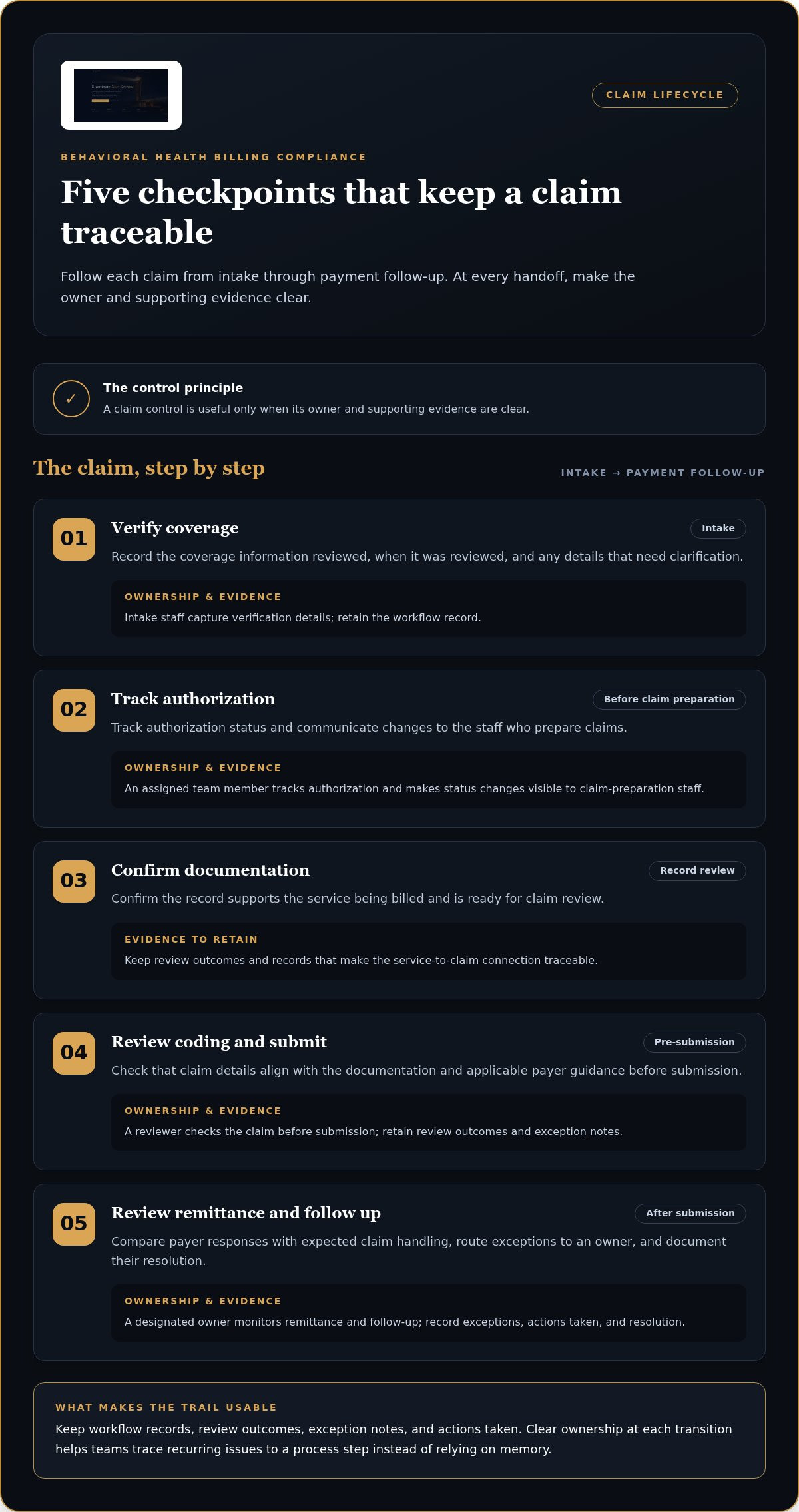
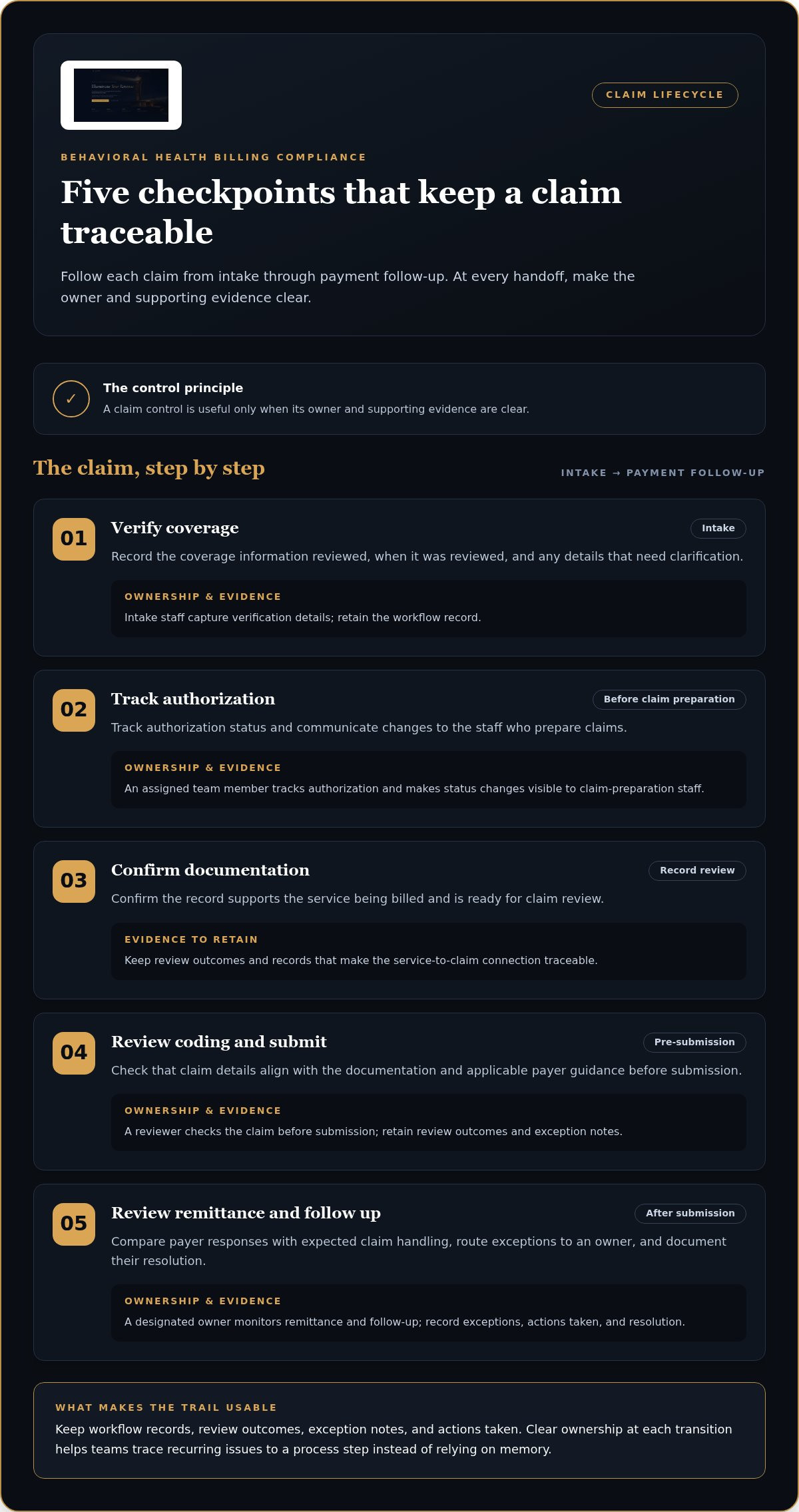
A claim moves through connected checkpoints, and each one should leave a clear trail. A control isn't complete just because a task appears on a checklist. A claim control is useful only when its owner and supporting evidence are clear. That principle makes compliance consulting behavioral health billing practical: oversight follows the claim from intake through payment follow-up.
- Verification: Record the coverage information reviewed, when it was reviewed, and any details that need clarification.
- Authorization: Track authorization status and communicate changes to the staff who prepare claims.
- Documentation: Confirm the record supports the service being billed and is ready for claim review.
- Coding review and submission: Check that claim details align with the documentation and applicable payer guidance before submission.
- Remittance and follow-up: Compare payer responses with expected claim handling, route exceptions to an owner, and document their resolution.
This sequence helps show where a claim can lose support or visibility. The University of Oklahoma Health Sciences Center describes the role of healthcare billing compliance education and monitoring in identifying risk areas. For a behavioral health practice, that means connecting education to the handoffs staff actually manage, then checking whether the controls work consistently.
Which billing checkpoints deserve documented ownership?
Assign responsibility at each transition. Intake staff can capture verification details, an assigned team member can track authorization, a reviewer can check the claim before submission, and a designated owner can monitor remittance and follow-up. Keep evidence such as workflow records, review outcomes, exception notes, and actions taken. These records make it easier to trace a recurring issue to a process step instead of relying on memory.
Define an escalation path as well. Staff should know who resolves unclear payer guidance and who reviews recurring exceptions. Verify payer-specific requirements against current authoritative guidance, and record how the team handled questions or changes. Keep decisions in an accessible workflow record rather than relying on informal messages that can be hard to trace later.
How do documentation, coding, and payer rules connect?
Claim details should correspond to the documented service and the payer’s applicable requirements. CPT and HCPCS are examples of coding systems used in healthcare billing, but a code alone doesn’t establish that a claim is supported. Review the relevant documentation and current payer guidance together. Code-specific requirements can vary, so confirm them before applying them in a workflow.
For the broader picture, the behavioral health revenue cycle management guide explains how billing stages connect. Practices looking to make those handoffs more visible can also explore Lumiere Billing’s analytics and compliance support.
Behavioral health billing compliance consulting versus software or a one-time review
Software, a focused review, and ongoing consulting solve different problems. A tool can organize claim data and make workflow activity easier to see. A review can surface gaps at a point in time. Ongoing operational support helps interpret what those findings mean for staff workflows and coordinate follow-through. None guarantees compliance or eliminates denials. The right approach depends on the oversight a practice needs and how it will act on what it learns.
| Approach | Primary role | Typical output |
|---|---|---|
| Software | Captures and organizes information, supports workflow visibility, and produces reports. | Records, alerts, and data views for staff to review. |
| One-time review | Examines selected billing workflows or records at a defined point. | Findings and recommendations that need assigned owners and follow-up. |
| Ongoing operational consulting | Reviews how billing work functions over time and helps coordinate process changes. | Prioritized actions, clearer responsibilities, and recurring checks. |
What can software support, and where does consulting add context?
Technology can bring claim details, workflow status, and reporting into view. It can’t independently determine whether a process fits a practice’s services and payer mix, explain why staff handle an exception differently, or coordinate a corrective step across teams. Those tasks require accountable review. Lumiere Billing specializes in behavioral health revenue cycle work and provides operational services rather than proprietary EHR software. In compliance consulting behavioral health billing, technology is one input to oversight, not a substitute for people interpreting workflows and owning follow-through.
When is a one-time billing review not enough?
A review gives the practice a snapshot, but billing operations continue to change. Staff handoffs shift, workflows are revised, and payer guidance may be updated. A finding that isn’t assigned or checked again can remain unresolved. A corrected process can also drift without routine monitoring. Turn each finding into an action with a responsible owner, a defined next step, and a recurring check to see whether the change is holding.
The right balance depends on what the review reveals and how much operational visibility the practice needs. A focused assessment can clarify priorities; ongoing support can keep corrective work connected to everyday claim handling. For an overview of related revenue-cycle support, explore the behavioral health billing services guide.
How to assess billing compliance risks and turn findings into controls
A useful review does more than list discrepancies. It clarifies which workflow produced them, who can address them, and how the practice will check whether a fix holds. Build the review around the practice’s actual services and payer relationships, rather than using a one-size-fits-all audit recipe.
Define the scope, map the workflow, review representative records, prioritize findings, assign corrective actions, and monitor whether the controls work.
How should a practice scope a billing compliance review?
Start by identifying the services and payer relationships in scope, the systems staff use, and the handoffs between clinical and billing teams. Note existing review routines so the assessment builds on them instead of duplicating effort. Before examining records, write down the questions and criteria. For example: Does each step have an owner? Does the process leave evidence? How are exceptions routed and resolved?
Then select records and workflows that can help answer those questions. The appropriate sample depends on the practice’s service mix, payer mix, and review objective; an illustrative sample is not a universal audit requirement. Document what was examined and any limits on what the review can conclude. That keeps observations precise and prevents a small sample from being treated as a complete picture.
How do findings become lasting workflow improvements?
Prioritize each finding by its operational significance, whether it appears to recur, and what remediation it needs. A single unclear handoff may call for a named owner and a workflow change. A repeated exception may need closer monitoring or broader staff guidance. Make each finding actionable, not just descriptive.
- Finding: State what was observed and where in the workflow it occurred.
- Owner and action: Name the person responsible and the corrective step.
- Due date and evidence: Set a target date and identify what will demonstrate completion.
- Follow-up: Record status and how the practice will confirm the change is working.
Trend reporting helps distinguish an isolated exception from a recurring process issue. Review patterns across relevant claims, payer responses, and workflow stages, then adjust checks when the evidence points to a wider gap. This is where compliance consulting behavioral health billing can connect findings to practical controls and ongoing visibility. Practices looking to structure that work can explore Lumiere Billing’s Free Billing Audit and analytics and compliance support.
How Lumiere Billing supports behavioral health billing compliance
A practical compliance framework connects controls to the work that moves each claim forward: checking coverage, tracking authorization, submitting claims, resolving denials, and monitoring patterns. A specialized revenue-cycle partner can help a practice review how these workflows function together, clarify process priorities, and make billing oversight more visible.
Lumiere Billing specializes exclusively in behavioral health revenue cycle management. Its work connects billing operations with analytics and compliance oversight, rather than treating compliance as a detached checklist. This operational support is distinct from legal representation and proprietary software. Lumiere Billing works alongside practice teams on revenue-cycle processes, helping reduce the administrative load so clinicians can focus on patient care.
What does a specialized billing partnership bring together?
Verification, prior authorization, claim submission, denial management, and compliance visibility are linked stages, not separate tasks. A breakdown at one handoff can affect work downstream. Reviewing these stages as connected workflows can help a practice see where responsibilities or checks need greater clarity.
Analytics can help surface recurring patterns across claims and denials, while practice advisory can support the assessment of process issues and potential corrective steps. The purpose is useful visibility and defined follow-through, not a promise that every claim will be paid or every compliance concern removed. In compliance consulting behavioral health billing, specialized context matters because a review should reflect behavioral health workflows and the practice’s own operations.
What is a practical next step for a behavioral health practice?
Before requesting a review, gather the questions that are most pressing for your team. Note where ownership feels unclear, which handoffs are difficult to track, and what billing concerns keep returning. Examples might include authorization tracking, recurring denial themes, or limited reporting on claim follow-up. This gives the review a focused starting point without assuming the cause or outcome in advance.
Lumiere Billing’s free billing audit offers a way to examine billing priorities and identify areas for review. It can help bring operational questions into focus, with findings based on the workflows and information considered. The next step is straightforward: Request a free billing audit.
Build clearer billing oversight into everyday operations
Strong behavioral health billing compliance depends on more than a periodic review. Clear ownership, documented checkpoints, and follow-through help practices spot where billing processes need attention and turn findings into repeatable controls. Reporting adds visibility, helping teams distinguish an isolated exception from a pattern worth addressing.
Effective compliance consulting behavioral health billing should fit the practice’s services, payer mix, and workflows. Lumiere Billing specializes exclusively in behavioral health providers, connecting insurance verification, prior authorization, claims, denials, analytics, and compliance oversight as part of revenue-cycle support.
A useful first step is to identify the billing questions your team wants to resolve. A free billing audit can help surface priorities for review without promising a particular finding or outcome. Request a free billing audit and take a focused step toward clearer ownership and more consistent oversight. Better visibility starts with a practical review, and steady controls can help your team move forward with greater confidence.
Frequently Asked Questions
What does compliance consulting for behavioral health billing include?
It typically includes reviewing billing workflows, documentation practices, claim handling, reporting, and role ownership. A review might trace a claim from insurance verification and authorization through submission, denial follow-up, and payment posting to find unclear handoffs or missing checks. The scope depends on the practice’s services, systems, and payer mix. Compliance consulting behavioral health billing focuses on operational controls and guidance, not legal representation or a guaranteed result.
Why does behavioral health billing require specialized compliance oversight?
Behavioral health billing depends on workflows that connect clinical records with billing decisions, payer requirements, authorizations, and claim follow-up. A process designed for another healthcare setting may not reflect a behavioral health practice’s service mix or documentation flow. Specialized oversight examines those connections in context, including where staff handoffs occur and how recurring exceptions are tracked. The goal is clearer processes and visibility, not a one-size-fits-all checklist.
Can billing compliance consulting reduce claim denials?
It can help a practice identify and address process issues that contribute to denials, such as incomplete claim review, unclear authorization tracking, or inconsistent follow-up. Consulting can also help establish checks and reporting to see whether corrective actions are working. It can’t guarantee that denials will stop: payer decisions and claim-specific circumstances vary. Practices should review denial patterns and verify payer requirements using current authoritative guidance.
How often should a behavioral health practice review its billing compliance workflows?
Set a regular review cadence that fits the practice’s services, payer mix, volume, and existing controls, then revisit workflows when meaningful changes occur. A new service, system change, staff handoff, or payer update may warrant an earlier check. Ongoing monitoring of exceptions and denial patterns can help determine whether a full review is needed. There’s no single schedule that suits every practice, so document the rationale and follow-up plan.
What is the difference between billing compliance consulting and HIPAA consulting?
Billing compliance consulting focuses on the operational steps that support accurate claims, such as documentation review, authorization tracking, claim handling, and payment follow-up. HIPAA consulting focuses on privacy and security obligations involving protected health information. The areas can intersect because billing workflows handle sensitive information, but they address different controls. A billing review doesn’t replace a broader privacy or security program, and each area should have appropriate oversight.
Does billing compliance consulting replace legal advice?
No. Billing compliance consulting provides operational guidance on workflows, records, claim handling, and process controls. It isn’t legal representation and doesn’t replace advice from a qualified attorney. If a practice faces a legal question, formal investigation, or potential legal exposure, it should seek appropriate legal counsel. Keeping the roles distinct helps the practice get billing operations support without confusing it with legal interpretation.
How can a practice prepare for a behavioral health billing compliance review?
Start by listing the services, payer relationships, systems, and staff handoffs the review should cover. Gather relevant workflow documents, review records, claim or denial reports, and examples of recurring billing concerns. Prepare specific questions, such as who owns authorization tracking or how exceptions reach a reviewer. The sample and review criteria should fit the practice’s operations; an illustrative sample isn’t a universal audit requirement.
What should a behavioral health practice do after a billing compliance issue is identified?
Document what was found, where it occurred, and whether it appears isolated or recurring. Assign an owner, define a corrective action, set a target date, and identify evidence that will show completion. Then follow up to confirm the change is working and monitor related claims or exceptions for patterns. If the issue raises a legal question, involve qualified legal counsel rather than treating operational billing guidance as legal advice.
Frequently Asked Questions
A billing-focused review can examine how a practice verifies coverage, tracks authorizations, maintains billing documentation, prepares and submits claims, manages responses, and reports recurring issues. The scope should reflect the practice’s services, payer mix, systems, and actual workflow. The aim is practical: identify where controls or ownership need clarity, then organize corrective action. This operational guidance is distinct from legal representation.
Start with the handoffs. Was coverage checked and recorded? Can staff see the current authorization status? Does the billed service have supporting documentation? Is a rejected claim routed for correction, and does payment posting flag discrepancies? Unclear ownership can let exceptions pass unnoticed, while inconsistent processes make the same issue harder to spot across claims. These checkpoints are connected. A missed authorization update, for example, may not become visible until a claim is denied. The team may then have to trace where the handoff failed. Reviewing patterns across verification, documentation, submission, and payment follow-up can show whether an error is isolated or points to a workflow weakness. For more examples of preventable breakdowns, see the behavioral health billing errors guide. A claim moves through connected checkpoints, and each one should leave a clear trail. A control isn't complete just because a task appears on a checklist. A claim control is useful only when its owner and supporting evidence are clear. That principle makes compliance consulting behavioral health billing practical: oversight follows the claim from intake through payment follow-up. This sequence helps show where a claim can lose support or visibility. The University of Oklahoma Health Sciences Center describes the role of healthcare billing compliance education and monitoring in identifying risk areas. For a behavioral health practice, that means connecting education to the handoffs staff actually manage, then checking whether the controls work consistently.
Assign responsibility at each transition. Intake staff can capture verification details, an assigned team member can track authorization, a reviewer can check the claim before submission, and a designated owner can monitor remittance and follow-up. Keep evidence such as workflow records, review outcomes, exception notes, and actions taken. These records make it easier to trace a recurring issue to a process step instead of relying on memory. Define an escalation path as well. Staff should know who resolves unclear payer guidance and who reviews recurring exceptions. Verify payer-specific requirements against current authoritative guidance, and record how the team handled questions or changes. Keep decisions in an accessible workflow record rather than relying on informal messages that can be hard to trace later.
Claim details should correspond to the documented service and the payer’s applicable requirements. CPT and HCPCS are examples of coding systems used in healthcare billing, but a code alone doesn’t establish that a claim is supported. Review the relevant documentation and current payer guidance together. Code-specific requirements can vary, so confirm them before applying them in a workflow. For the broader picture, the behavioral health revenue cycle management guide explains how billing stages connect. Practices looking to make those handoffs more visible can also explore Lumiere Billing’s analytics and compliance support. Software, a focused review, and ongoing consulting solve different problems. A tool can organize claim data and make workflow activity easier to see. A review can surface gaps at a point in time. Ongoing operational support helps interpret what those findings mean for staff workflows and coordinate follow-through. None guarantees compliance or eliminates denials. The right approach depends on the oversight a practice needs and how it will act on what it learns.
Technology can bring claim details, workflow status, and reporting into view. It can’t independently determine whether a process fits a practice’s services and payer mix, explain why staff handle an exception differently, or coordinate a corrective step across teams. Those tasks require accountable review. Lumiere Billing specializes in behavioral health revenue cycle work and provides operational services rather than proprietary EHR software. In compliance consulting behavioral health billing, technology is one input to oversight, not a substitute for people interpreting workflows and owning follow-through.
A review gives the practice a snapshot, but billing operations continue to change. Staff handoffs shift, workflows are revised, and payer guidance may be updated. A finding that isn’t assigned or checked again can remain unresolved. A corrected process can also drift without routine monitoring. Turn each finding into an action with a responsible owner, a defined next step, and a recurring check to see whether the change is holding. The right balance depends on what the review reveals and how much operational visibility the practice needs. A focused assessment can clarify priorities; ongoing support can keep corrective work connected to everyday claim handling. For an overview of related revenue-cycle support, explore the behavioral health billing services guide. A useful review does more than list discrepancies. It clarifies which workflow produced them, who can address them, and how the practice will check whether a fix holds. Build the review around the practice’s actual services and payer relationships, rather than using a one-size-fits-all audit recipe. Define the scope, map the workflow, review representative records, prioritize findings, assign corrective actions, and monitor whether the controls work.
Start by identifying the services and payer relationships in scope, the systems staff use, and the handoffs between clinical and billing teams. Note existing review routines so the assessment builds on them instead of duplicating effort. Before examining records, write down the questions and criteria. For example: Does each step have an owner? Does the process leave evidence? How are exceptions routed and resolved? Then select records and workflows that can help answer those questions. The appropriate sample depends on the practice’s service mix, payer mix, and review objective; an illustrative sample is not a universal audit requirement. Document what was examined and any limits on what the review can conclude. That keeps observations precise and prevents a small sample from being treated as a complete picture.
Prioritize each finding by its operational significance, whether it appears to recur, and what remediation it needs. A single unclear handoff may call for a named owner and a workflow change. A repeated exception may need closer monitoring or broader staff guidance. Make each finding actionable, not just descriptive. Trend reporting helps distinguish an isolated exception from a recurring process issue. Review patterns across relevant claims, payer responses, and workflow stages, then adjust checks when the evidence points to a wider gap. This is where compliance consulting behavioral health billing can connect findings to practical controls and ongoing visibility. Practices looking to structure that work can explore Lumiere Billing’s Free Billing Audit and analytics and compliance support. A practical compliance framework connects controls to the work that moves each claim forward: checking coverage, tracking authorization, submitting claims, resolving denials, and monitoring patterns. A specialized revenue-cycle partner can help a practice review how these workflows function together, clarify process priorities, and make billing oversight more visible. Lumiere Billing specializes exclusively in behavioral health revenue cycle management. Its work connects billing operations with analytics and compliance oversight, rather than treating compliance as a detached checklist. This operational support is distinct from legal representation and proprietary software. Lumiere Billing works alongside practice teams on revenue-cycle processes, helping reduce the administrative load so clinicians can focus on patient care.
Verification, prior authorization, claim submission, denial management, and compliance visibility are linked stages, not separate tasks. A breakdown at one handoff can affect work downstream. Reviewing these stages as connected workflows can help a practice see where responsibilities or checks need greater clarity. Analytics can help surface recurring patterns across claims and denials, while practice advisory can support the assessment of process issues and potential corrective steps. The purpose is useful visibility and defined follow-through, not a promise that every claim will be paid or every compliance concern removed. In compliance consulting behavioral health billing, specialized context matters because a review should reflect behavioral health workflows and the practice’s own operations.
Before requesting a review, gather the questions that are most pressing for your team. Note where ownership feels unclear, which handoffs are difficult to track, and what billing concerns keep returning. Examples might include authorization tracking, recurring denial themes, or limited reporting on claim follow-up. This gives the review a focused starting point without assuming the cause or outcome in advance. Lumiere Billing’s free billing audit offers a way to examine billing priorities and identify areas for review. It can help bring operational questions into focus, with findings based on the workflows and information considered. The next step is straightforward: Request a free billing audit. Strong behavioral health billing compliance depends on more than a periodic review. Clear ownership, documented checkpoints, and follow-through help practices spot where billing processes need attention and turn findings into repeatable controls. Reporting adds visibility, helping teams distinguish an isolated exception from a pattern worth addressing. Effective compliance consulting behavioral health billing should fit the practice’s services, payer mix, and workflows. Lumiere Billing specializes exclusively in behavioral health providers, connecting insurance verification, prior authorization, claims, denials, analytics, and compliance oversight as part of revenue-cycle support. A useful first step is to identify the billing questions your team wants to resolve. A free billing audit can help surface priorities for review without promising a particular finding or outcome. Request a free billing audit and take a focused step toward clearer ownership and more consistent oversight. Better visibility starts with a practical review, and steady controls can help your team move forward with greater confidence.
It typically includes reviewing billing workflows, documentation practices, claim handling, reporting, and role ownership. A review might trace a claim from insurance verification and authorization through submission, denial follow-up, and payment posting to find unclear handoffs or missing checks. The scope depends on the practice’s services, systems, and payer mix. Compliance consulting behavioral health billing focuses on operational controls and guidance, not legal representation or a guaranteed result.
Behavioral health billing depends on workflows that connect clinical records with billing decisions, payer requirements, authorizations, and claim follow-up. A process designed for another healthcare setting may not reflect a behavioral health practice’s service mix or documentation flow. Specialized oversight examines those connections in context, including where staff handoffs occur and how recurring exceptions are tracked. The goal is clearer processes and visibility, not a one-size-fits-all checklist.
It can help a practice identify and address process issues that contribute to denials, such as incomplete claim review, unclear authorization tracking, or inconsistent follow-up. Consulting can also help establish checks and reporting to see whether corrective actions are working. It can’t guarantee that denials will stop: payer decisions and claim-specific circumstances vary. Practices should review denial patterns and verify payer requirements using current authoritative guidance.
Set a regular review cadence that fits the practice’s services, payer mix, volume, and existing controls, then revisit workflows when meaningful changes occur. A new service, system change, staff handoff, or payer update may warrant an earlier check. Ongoing monitoring of exceptions and denial patterns can help determine whether a full review is needed. There’s no single schedule that suits every practice, so document the rationale and follow-up plan.
Billing compliance consulting focuses on the operational steps that support accurate claims, such as documentation review, authorization tracking, claim handling, and payment follow-up. HIPAA consulting focuses on privacy and security obligations involving protected health information. The areas can intersect because billing workflows handle sensitive information, but they address different controls. A billing review doesn’t replace a broader privacy or security program, and each area should have appropriate oversight.
No. Billing compliance consulting provides operational guidance on workflows, records, claim handling, and process controls. It isn’t legal representation and doesn’t replace advice from a qualified attorney. If a practice faces a legal question, formal investigation, or potential legal exposure, it should seek appropriate legal counsel. Keeping the roles distinct helps the practice get billing operations support without confusing it with legal interpretation.
Start by listing the services, payer relationships, systems, and staff handoffs the review should cover. Gather relevant workflow documents, review records, claim or denial reports, and examples of recurring billing concerns. Prepare specific questions, such as who owns authorization tracking or how exceptions reach a reviewer. The sample and review criteria should fit the practice’s operations; an illustrative sample isn’t a universal audit requirement.
Document what was found, where it occurred, and whether it appears isolated or recurring. Assign an owner, define a corrective action, set a target date, and identify evidence that will show completion. Then follow up to confirm the change is working and monitor related claims or exceptions for patterns. If the issue raises a legal question, involve qualified legal counsel rather than treating operational billing guidance as legal advice.
Free billing audit
Find out what your billing is really costing you
We'll review your claims, denials and collections and show you exactly where revenue is leaking. Free, no obligation, no contract.
Schedule a Free Billing Audit