Strategic Planning for Behavioral Health: 2026 Guide

What if your practice’s next growth opportunity is also the initiative most likely to strain your clinicians and operations? Strategic planning for behavioral health practices works when clinical priorities, staffing capacity, and financial visibility point in the same direction.
It’s difficult to choose what deserves leadership attention when every priority feels urgent. Growth decisions are harder to assess when operational and revenue-cycle information is incomplete. A plan can look compelling on paper, then stall because no one has the capacity, clear ownership, or measures to move it forward.
This 2026 guide will help you build a practical plan around a small number of practice-specific priorities. You’ll learn how to assess current conditions, compare initiatives with clinical and operational capacity, use financial signals to inform decisions, and turn priorities into accountable next steps.
The goal isn’t strategy for its own sake. It’s a workable rhythm of action and review, supported by a clearer view of how your practice operates and where revenue-cycle issues may affect its options.
Key Takeaways
- Define a strategic direction that guides long-term decisions, separate from daily fixes and scheduling.
- Build a dependable baseline by distinguishing confirmed facts from assumptions and unanswered questions.
- Use strategic planning for behavioral health practices to compare growth options against patient needs, clinical quality, staffing, and financial resilience.
- Turn selected priorities into quarterly actions with clear owners, measures, and regular progress reviews.
- Use revenue-cycle insights to understand how verification, authorization, claims, denials, and analytics inform wider practice decisions.
What Strategic Planning Means for a Behavioral Health Practice
Strategic planning is the disciplined process of choosing where a practice is going, which priorities will move it forward, and how leaders will measure progress. It turns broad intentions into decisions about patient access, care quality, workforce sustainability, and financial health. The goal isn’t to predict every challenge or guarantee an outcome. It’s to set a clear direction and provide a basis for making trade-offs.
A strategic plan is different from an appointment calendar, a list of urgent fixes, or a business plan that sits untouched. Day-to-day management keeps current services moving. Strategy examines whether those services, workflows, and resources still support the practice’s mission over time. For foundational context, What is Strategic Planning? outlines the broader concepts. In behavioral health, applying them means connecting decisions to clinical realities and operating capacity.
Effective strategic planning for behavioral health practices considers the whole system. Expanding access, for example, may require more than adding appointment slots. Leaders may also need to consider clinician availability, administrative workload, service mix, and the financial processes that support care. A sound strategy makes these connections visible so growth choices don’t outrun the people and systems responsible for delivering services.
How Is Strategic Planning Different From Day-to-Day Management?
Recurring decisions keep today’s work on track, such as filling a schedule opening, assigning coverage, or resolving a claim issue. Strategic decisions shape the practice over time: whether to redesign intake to improve access, adjust the service mix, build staffing capacity, or address an administrative workflow that repeatedly slows care. These choices call for a broader view of their impact and trade-offs.
An urgent issue can point to a strategic concern, but it shouldn’t dictate the entire plan. A temporary scheduling disruption may need an immediate fix. A recurring pattern of long waits may warrant a deeper review of capacity and access goals.
Which Practice Conditions Signal a Need to Revisit Strategy?
Look for patterns, not just isolated setbacks. Persistent access constraints, competing priorities, recurring workflow bottlenecks, or growth plans that exceed available staffing can signal that the current direction needs review. A single difficult month may be temporary. The same problem appearing across repeated reviews deserves leadership attention.
Bring clinical, administrative, and financial perspectives into the discussion. Clinicians can clarify how changes affect care, administrative teams can identify workflow friction, and financial information can help leaders understand available resources. Comparing these views helps distinguish a temporary disruption from a structural issue without allowing one department’s concerns to define the strategy alone.
Build a Reliable Baseline Before Setting Behavioral Health Priorities
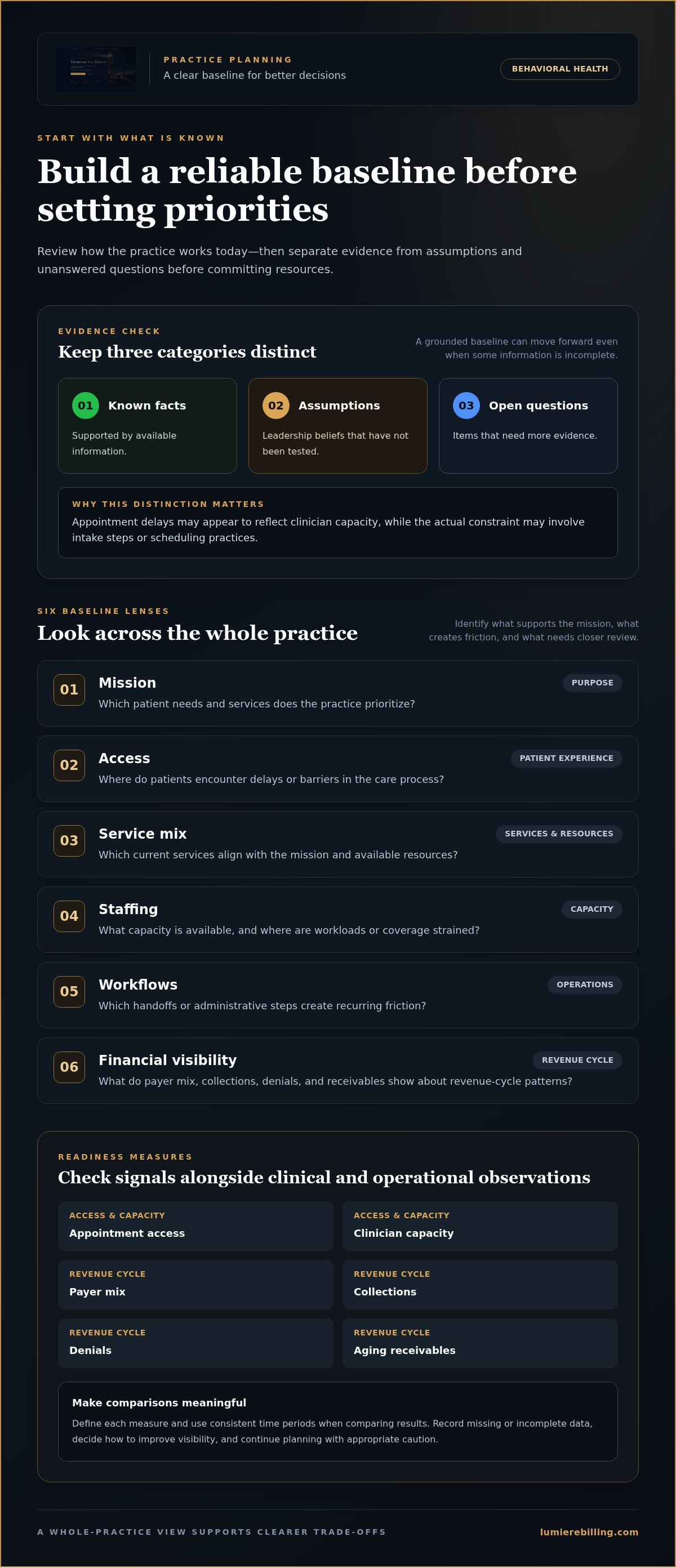
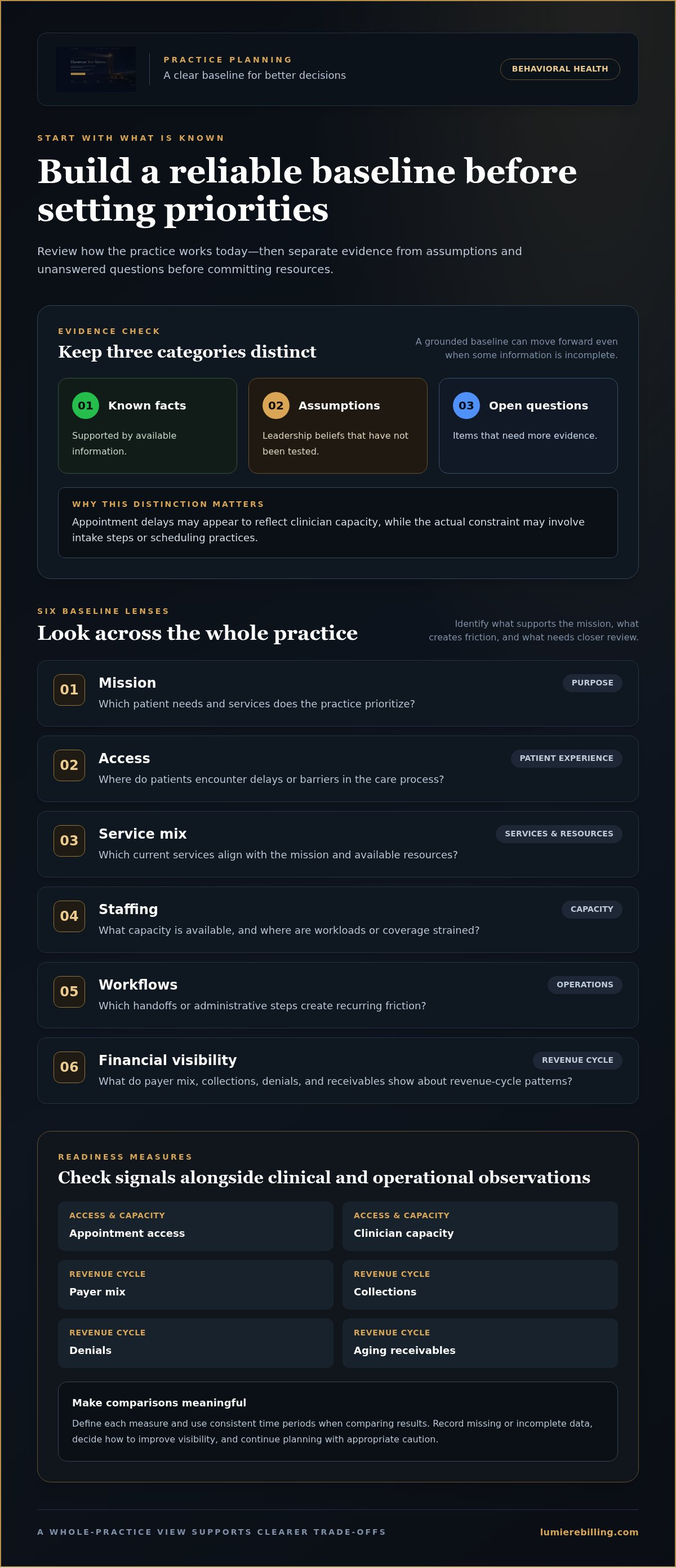
Before choosing what to change, establish a clear picture of how the practice works now. Revisit the mission and compare it with patient access, service mix, staffing capacity, core workflows, and financial visibility. You don’t need to collect every possible metric. Identify which conditions support the mission, which create friction, and which need closer review before leaders commit resources.
Keep three categories distinct: known facts supported by available information, assumptions leadership has not tested, and open questions that require more evidence. For example, a team may believe appointment delays reflect clinician capacity, when the constraint may instead involve intake steps or scheduling practices. This distinction keeps strategic planning for behavioral health practices grounded in evidence without letting incomplete data stall discussion.
- Mission: Which patient needs and services does the practice prioritize?
- Access: Where do patients encounter delays or barriers in the care process?
- Service mix: Which current services align with the mission and available resources?
- Staffing: What capacity is available, and where are workloads or coverage strained?
- Workflows: Which handoffs or administrative steps create recurring friction?
- Financial visibility: What do payer mix, collections, denials, and receivables show about revenue-cycle patterns?
Include revenue-cycle information in the baseline because it can reveal operational patterns that affect planning. It’s one lens, not the whole strategy. For more detail on how these processes fit together, the behavioral health revenue cycle management guide provides deeper RCM education.
Which Data Helps Leaders Understand Practice Readiness?
Review measures such as appointment access, clinician capacity, payer mix, collections, denials, and aging receivables alongside clinical and operational observations. Define each measure and use consistent time periods when comparing results. Otherwise, a change in definitions can make a trend appear where none exists. Record missing or incomplete data, decide how to improve visibility, and continue planning with appropriate caution.
How Can Leaders Include Clinical and Administrative Perspectives?
Gather input from clinicians, operations staff, billing teams, and practice leadership. Ask where the same workflow creates friction for patients, clinicians, or administrative teams, then compare those observations with available measures. Discuss patient-related patterns using appropriately aggregated information that protects confidentiality. Workforce capacity also deserves a clear-eyed review. The National Academy for State Health Policy’s Behavioral Health Workforce Trends offers broader context for capacity discussions.
Once leaders have identified current-state issues, they can decide which findings need deeper review before setting priorities. Lumiere Billing’s behavioral health revenue-cycle support can bring billing operations and financial patterns into that assessment, giving practice leaders a clearer view of one important part of readiness.
Compare Behavioral Health Growth Priorities Against Real Capacity
A promising opportunity isn’t automatically the right next move. Compare each option against patient need, clinical quality, staffing, infrastructure, and financial resilience before committing leadership attention. In strategic planning for behavioral health practices, this comparison helps distinguish growth the practice can support now from growth that depends on unresolved capacity or operational questions.
Use a decision table to make trade-offs visible. The examples below are prompts, not recommendations. Fill in the practice’s own evidence, assumptions, and owners. For a broader example of how an organization sets goals and priorities, see HHS Strategic Planning.
| Option | Key assumption and dependency | Risk to assess | Decision owner |
|---|---|---|---|
| Focused access improvement | Demand can be met by adjusting intake or scheduling workflows. | Changes may shift workload without resolving the underlying capacity constraint. | Clinical and operations leads |
| Service expansion | Patient need, clinician expertise, and operational support align. | New services may add documentation, authorization, or coordination demands. | Clinical leadership |
| Hiring plan | Recruitment and onboarding can address a defined capacity gap. | Workload or access may remain strained while staffing needs are unmet. | Practice leadership |
| Workflow redesign | A repeatable process is creating avoidable friction. | A redesign may move work between teams rather than reduce it. | Operations lead |
Compare each option using the same questions: Does it address a defined patient need? Can the team protect care quality during implementation? Are staffing, supervision, scheduling, and administrative support sufficient? What infrastructure or financial conditions must be in place? A short list of testable priorities is more useful than a wish list that exceeds leadership and staff capacity.
How Should a Practice Evaluate a Growth Opportunity?
Map dependencies before approving a change. A service expansion, for example, may require clinician capacity and supervision, along with credentialing, payer enrollment, authorization workflows, and documentation readiness. Identify who owns each dependency and what evidence would show it’s ready. An attractive opportunity becomes executable only when the practice can support it responsibly.
What If Leadership Data Is Incomplete or Uncertain?
Don’t disguise uncertainty as a forecast. Label assumptions, identify the smallest useful data-gathering step, and use scenarios or ranges where evidence is limited. Set a decision checkpoint to revisit the option when essential information improves. This keeps planning active without forcing a premature commitment or delaying every decision until the data is perfect.
For practices weighing operational and revenue-cycle dependencies, behavioral health practice advisory can help connect findings to strategic choices.
Turn the Strategic Plan Into Measurable Quarterly Actions
A plan becomes useful when people know what happens next, who is responsible, and how progress will be judged. For strategic planning for behavioral health practices, use a quarterly action cycle to turn a few priorities into work the team can carry out and review. Keep the starting list manageable. Too many simultaneous initiatives can divide attention and make it harder to tell whether a change is working.
Use this sequence to make each priority operational:
- Choose priorities. Select the most important practice goals for the quarter, based on patient need and available capacity. State what is in scope and what can wait.
- Assign owners. Name one accountable lead for each priority, then identify the teams or roles responsible for specific tasks. Shared work still needs clear ownership.
- Define measures. Pair an outcome measure, such as improved appointment access, with leading indicators the team can influence, such as completion of defined scheduling steps.
- Schedule actions. Break the work into practical milestones, assign target dates, and identify dependencies before they become blockers.
- Review progress. Use leadership check-ins to examine measures, surface barriers, and decide whether to continue, adjust, or escalate the work.
For revenue-cycle improvement priorities, choose measures that reflect the intended change rather than tracking activity for its own sake. A billing initiative might monitor a relevant collections or denial pattern alongside a process measure the team can influence. The behavioral health billing errors guide can help frame improvement work around recurring revenue-cycle issues.
Which Measures Keep a Practice Strategy Observable?
Choose measures that connect directly to each priority: access measures for an access goal, capacity indicators for a staffing initiative, workflow completion for a process redesign, or collections for a revenue-cycle goal. For each measure, record its definition, data source, accountable owner, review frequency, and how leaders should interpret changes.
A metric needs a clear definition and an owner so the team can interpret it consistently and act on what it shows. Balance lagging outcomes with leading indicators. Outcomes may take time to change, while early process measures can show whether implementation is on track. Avoid adding metrics that don’t inform a decision.
How Often Should Practice Leaders Review the Plan?
Schedule regular leadership reviews, including a quarterly check of priorities and progress. Keep discussions focused on what moved, what is blocked, and which decisions need escalation. Revisit the plan sooner if evidence, staffing, payer conditions, or patient needs change materially. Share concise updates with affected teams so they understand decisions without taking on unnecessary reporting.
If revenue-cycle visibility is limiting your ability to assess improvement priorities, request a free billing audit to identify current-state issues that can inform the plan.
How Lumiere Billing Can Support Behavioral Health Practice Planning
Revenue-cycle visibility can help leaders assess how billing operations fit into a wider practice plan. It won’t determine clinical priorities, but it can reveal patterns to investigate before decisions about staffing, access, or expansion are finalized. For strategic planning for behavioral health practices, this information is one part of the picture, alongside clinical judgment, patient needs, and operational capacity.
Lumiere Billing specializes exclusively in behavioral health revenue cycle management. Its services include insurance verification, prior authorization, claims submission, denial prevention, and analytics. Together, these services help leaders examine the billing process and identify operational questions for planning discussions. Analytics can provide visibility into patterns, while practice advisory can help translate operational findings into strategic next steps.
Where Can Revenue-Cycle Insight Inform Strategic Decisions?
Authorization patterns may prompt leaders to review how requests move through the workflow and where administrative effort is concentrated. Claims and denial patterns can help identify processes that warrant closer attention, while collections information may inform discussions of financial resilience. These indicators are signals to investigate, not conclusions about clinical quality or the right course of care. Revenue-cycle data can support planning, but it doesn’t replace clinical judgment or leadership decisions about patient needs.
Keep the question specific. If a service expansion is under consideration, leaders might examine whether its authorization and claims workflows are understood and supported. If administrative work is absorbing staff capacity, reviewing revenue-cycle processes can help clarify where operational attention may be needed. The aim is better information for a decision, not a promised financial result.
How Can an Advisory Relationship Support Execution?
Practice advisory provides operational guidance, workflow audits, and support as leaders assess practice expansion decisions. Lumiere Billing works as an extension of the practice team, helping connect operational observations with the priorities leaders have chosen so clinicians can focus on patient care. This support is most useful when it fits the practice’s existing accountability structure rather than creating a separate track of work.
To make advisory input actionable, connect each finding to an agreed priority, an owner, and a measure the practice already reviews. For example, if a workflow audit highlights a process that may affect administrative capacity, leaders can decide whether it merits action, who will coordinate next steps, and what evidence will indicate progress. The practice retains ownership of its goals and clinical decisions; operational guidance brings relevant information into view.
A clearer baseline can help leaders decide where to focus, but unresolved billing questions may still cloud the picture. Request a free billing audit as a focused starting point for identifying current-state issues that can inform your planning discussions.
Make Your Next Planning Decision With Clearer Insight
The next step doesn’t need to be a major initiative. Choose one unresolved planning question, identify what evidence would help answer it, and decide who will bring that information to the next leadership discussion. A small, well-supported decision can create more momentum than a broad plan without operational clarity.
That’s the practical value of strategic planning for behavioral health practices: it helps leaders make deliberate choices while keeping patient care and organizational sustainability in view. Financial visibility can sharpen those choices, but it should inform the strategy, not define it.
Lumiere Billing specializes exclusively in behavioral health providers, with support spanning revenue cycle management, credentialing and enrollment, practice advisory, analytics, and compliance. If billing operations are one of the unknowns affecting your planning, a focused review can bring current-state issues into view. Request your free billing audit as a starting point for a more informed discussion.
Your plan doesn’t have to answer everything at once. Start with the question that matters most, then build the next step from what you learn.
Frequently Asked Questions
What should a behavioral health practice include in a strategic plan?
A strategic plan should connect the practice’s mission to a few priorities, each with an owner, measures, needed resources, and a review cadence. Strategic planning for behavioral health practices means setting direction and making deliberate choices, not compiling every task the organization might perform. For example, if access is a priority, specify which patient pathway needs attention and what staffing or administrative support the change will require.
How often should a behavioral health practice update its strategic plan?
Review progress regularly, then reconsider the plan periodically to confirm that its priorities still fit the practice. Scheduled reviews help leaders distinguish a temporary delay from a pattern that calls for a change in direction. Don’t wait for the next planned review if clinician capacity shifts, patient needs change materially, or payer conditions affect an important assumption. Update the relevant decision, owner, or measure rather than automatically rewriting the entire plan.
Can a small behavioral health practice benefit from strategic planning?
Yes. A small practice can use a lean planning process to decide what deserves attention and where limited staff time should go. The process might involve a focused leadership discussion, a short written record of priorities, and simple progress checks built into existing meetings. Fit the framework to the practice’s size and complexity. A small team may need fewer measures and less documentation, not an elaborate planning structure.
What metrics should a behavioral health practice track when planning for growth?
Choose measures that match the growth goal rather than adopting universal targets. An access initiative might track appointment availability and follow-through; a staffing decision could examine clinician capacity and workload; a workflow redesign may monitor completion of key process steps. Revenue-cycle indicators, such as collections or denial patterns, can add financial context. Define each measure consistently and use it to inform decisions, not as a stand-alone judgment of care quality.
How can a behavioral health practice grow without overloading clinicians?
Assess clinician capacity alongside the administrative work and infrastructure a growth decision requires. Before expanding a service or accepting more demand, identify who will handle supervision, scheduling, documentation, and related coordination. Stage decisions where possible: begin with a defined, manageable change, monitor its effects on workload and care quality, then decide whether to continue or adjust. Growth should fit available resources, not depend on sustained overextension.
What happens if a practice has incomplete data for strategic planning?
Incomplete data doesn’t have to stop planning, but it should shape how confidently leaders act. Label assumptions, identify which unanswered question could change the decision, and gather only enough evidence to clarify that point. For example, review a defined sample of scheduling records before committing to a broad access redesign. Record when leaders will revisit the choice so uncertain projections don’t quietly become established facts.
Who should participate in strategic planning for a behavioral health practice?
Include practice leadership and the clinical and administrative perspectives relevant to the decisions under review. A service-mix discussion may need clinical input, while a workflow or revenue-cycle priority may also call for operations and billing perspectives. Participation can be focused rather than all-inclusive: invite people who understand the affected work and will carry out decisions. Discuss patient-related patterns in appropriately aggregated form to protect confidentiality.
Frequently Asked Questions
Recurring decisions keep today’s work on track, such as filling a schedule opening, assigning coverage, or resolving a claim issue. Strategic decisions shape the practice over time: whether to redesign intake to improve access, adjust the service mix, build staffing capacity, or address an administrative workflow that repeatedly slows care. These choices call for a broader view of their impact and trade-offs. An urgent issue can point to a strategic concern, but it shouldn’t dictate the entire plan. A temporary scheduling disruption may need an immediate fix. A recurring pattern of long waits may warrant a deeper review of capacity and access goals.
Look for patterns, not just isolated setbacks. Persistent access constraints, competing priorities, recurring workflow bottlenecks, or growth plans that exceed available staffing can signal that the current direction needs review. A single difficult month may be temporary. The same problem appearing across repeated reviews deserves leadership attention. Bring clinical, administrative, and financial perspectives into the discussion. Clinicians can clarify how changes affect care, administrative teams can identify workflow friction, and financial information can help leaders understand available resources. Comparing these views helps distinguish a temporary disruption from a structural issue without allowing one department’s concerns to define the strategy alone. Before choosing what to change, establish a clear picture of how the practice works now. Revisit the mission and compare it with patient access, service mix, staffing capacity, core workflows, and financial visibility. You don’t need to collect every possible metric. Identify which conditions support the mission, which create friction, and which need closer review before leaders commit resources. Keep three categories distinct: known facts supported by available information, assumptions leadership has not tested, and open questions that require more evidence. For example, a team may believe appointment delays reflect clinician capacity, when the constraint may instead involve intake steps or scheduling practices. This distinction keeps strategic planning for behavioral health practices grounded in evidence without letting incomplete data stall discussion. Include revenue-cycle information in the baseline because it can reveal operational patterns that affect planning. It’s one lens, not the whole strategy. For more detail on how these processes fit together, the behavioral health revenue cycle management guide provides deeper RCM education.
Review measures such as appointment access, clinician capacity, payer mix, collections, denials, and aging receivables alongside clinical and operational observations. Define each measure and use consistent time periods when comparing results. Otherwise, a change in definitions can make a trend appear where none exists. Record missing or incomplete data, decide how to improve visibility, and continue planning with appropriate caution.
Gather input from clinicians, operations staff, billing teams, and practice leadership. Ask where the same workflow creates friction for patients, clinicians, or administrative teams, then compare those observations with available measures. Discuss patient-related patterns using appropriately aggregated information that protects confidentiality. Workforce capacity also deserves a clear-eyed review. The National Academy for State Health Policy’s Behavioral Health Workforce Trends offers broader context for capacity discussions. Once leaders have identified current-state issues, they can decide which findings need deeper review before setting priorities. Lumiere Billing’s behavioral health revenue-cycle support can bring billing operations and financial patterns into that assessment, giving practice leaders a clearer view of one important part of readiness. A promising opportunity isn’t automatically the right next move. Compare each option against patient need, clinical quality, staffing, infrastructure, and financial resilience before committing leadership attention. In strategic planning for behavioral health practices, this comparison helps distinguish growth the practice can support now from growth that depends on unresolved capacity or operational questions. Use a decision table to make trade-offs visible. The examples below are prompts, not recommendations. Fill in the practice’s own evidence, assumptions, and owners. For a broader example of how an organization sets goals and priorities, see HHS Strategic Planning. Compare each option using the same questions: Does it address a defined patient need? Can the team protect care quality during implementation? Are staffing, supervision, scheduling, and administrative support sufficient? What infrastructure or financial conditions must be in place? A short list of testable priorities is more useful than a wish list that exceeds leadership and staff capacity.
Map dependencies before approving a change. A service expansion, for example, may require clinician capacity and supervision, along with credentialing, payer enrollment, authorization workflows, and documentation readiness. Identify who owns each dependency and what evidence would show it’s ready. An attractive opportunity becomes executable only when the practice can support it responsibly.
Don’t disguise uncertainty as a forecast. Label assumptions, identify the smallest useful data-gathering step, and use scenarios or ranges where evidence is limited. Set a decision checkpoint to revisit the option when essential information improves. This keeps planning active without forcing a premature commitment or delaying every decision until the data is perfect. For practices weighing operational and revenue-cycle dependencies, behavioral health practice advisory can help connect findings to strategic choices. A plan becomes useful when people know what happens next, who is responsible, and how progress will be judged. For strategic planning for behavioral health practices, use a quarterly action cycle to turn a few priorities into work the team can carry out and review. Keep the starting list manageable. Too many simultaneous initiatives can divide attention and make it harder to tell whether a change is working. Use this sequence to make each priority operational: For revenue-cycle improvement priorities, choose measures that reflect the intended change rather than tracking activity for its own sake. A billing initiative might monitor a relevant collections or denial pattern alongside a process measure the team can influence. The behavioral health billing errors guide can help frame improvement work around recurring revenue-cycle issues.
Choose measures that connect directly to each priority: access measures for an access goal, capacity indicators for a staffing initiative, workflow completion for a process redesign, or collections for a revenue-cycle goal. For each measure, record its definition, data source, accountable owner, review frequency, and how leaders should interpret changes. A metric needs a clear definition and an owner so the team can interpret it consistently and act on what it shows. Balance lagging outcomes with leading indicators. Outcomes may take time to change, while early process measures can show whether implementation is on track. Avoid adding metrics that don’t inform a decision.
Schedule regular leadership reviews, including a quarterly check of priorities and progress. Keep discussions focused on what moved, what is blocked, and which decisions need escalation. Revisit the plan sooner if evidence, staffing, payer conditions, or patient needs change materially. Share concise updates with affected teams so they understand decisions without taking on unnecessary reporting. If revenue-cycle visibility is limiting your ability to assess improvement priorities, request a free billing audit to identify current-state issues that can inform the plan. Revenue-cycle visibility can help leaders assess how billing operations fit into a wider practice plan. It won’t determine clinical priorities, but it can reveal patterns to investigate before decisions about staffing, access, or expansion are finalized. For strategic planning for behavioral health practices, this information is one part of the picture, alongside clinical judgment, patient needs, and operational capacity. Lumiere Billing specializes exclusively in behavioral health revenue cycle management. Its services include insurance verification, prior authorization, claims submission, denial prevention, and analytics. Together, these services help leaders examine the billing process and identify operational questions for planning discussions. Analytics can provide visibility into patterns, while practice advisory can help translate operational findings into strategic next steps.
Authorization patterns may prompt leaders to review how requests move through the workflow and where administrative effort is concentrated. Claims and denial patterns can help identify processes that warrant closer attention, while collections information may inform discussions of financial resilience. These indicators are signals to investigate, not conclusions about clinical quality or the right course of care. Revenue-cycle data can support planning, but it doesn’t replace clinical judgment or leadership decisions about patient needs. Keep the question specific. If a service expansion is under consideration, leaders might examine whether its authorization and claims workflows are understood and supported. If administrative work is absorbing staff capacity, reviewing revenue-cycle processes can help clarify where operational attention may be needed. The aim is better information for a decision, not a promised financial result.
Practice advisory provides operational guidance, workflow audits, and support as leaders assess practice expansion decisions. Lumiere Billing works as an extension of the practice team, helping connect operational observations with the priorities leaders have chosen so clinicians can focus on patient care. This support is most useful when it fits the practice’s existing accountability structure rather than creating a separate track of work. To make advisory input actionable, connect each finding to an agreed priority, an owner, and a measure the practice already reviews. For example, if a workflow audit highlights a process that may affect administrative capacity, leaders can decide whether it merits action, who will coordinate next steps, and what evidence will indicate progress. The practice retains ownership of its goals and clinical decisions; operational guidance brings relevant information into view. A clearer baseline can help leaders decide where to focus, but unresolved billing questions may still cloud the picture. Request a free billing audit as a focused starting point for identifying current-state issues that can inform your planning discussions. The next step doesn’t need to be a major initiative. Choose one unresolved planning question, identify what evidence would help answer it, and decide who will bring that information to the next leadership discussion. A small, well-supported decision can create more momentum than a broad plan without operational clarity. That’s the practical value of strategic planning for behavioral health practices: it helps leaders make deliberate choices while keeping patient care and organizational sustainability in view. Financial visibility can sharpen those choices, but it should inform the strategy, not define it. Lumiere Billing specializes exclusively in behavioral health providers, with support spanning revenue cycle management, credentialing and enrollment, practice advisory, analytics, and compliance. If billing operations are one of the unknowns affecting your planning, a focused review can bring current-state issues into view. Request your free billing audit as a starting point for a more informed discussion. Your plan doesn’t have to answer everything at once. Start with the question that matters most, then build the next step from what you learn.
A strategic plan should connect the practice’s mission to a few priorities, each with an owner, measures, needed resources, and a review cadence. Strategic planning for behavioral health practices means setting direction and making deliberate choices, not compiling every task the organization might perform. For example, if access is a priority, specify which patient pathway needs attention and what staffing or administrative support the change will require.
Review progress regularly, then reconsider the plan periodically to confirm that its priorities still fit the practice. Scheduled reviews help leaders distinguish a temporary delay from a pattern that calls for a change in direction. Don’t wait for the next planned review if clinician capacity shifts, patient needs change materially, or payer conditions affect an important assumption. Update the relevant decision, owner, or measure rather than automatically rewriting the entire plan.
Yes. A small practice can use a lean planning process to decide what deserves attention and where limited staff time should go. The process might involve a focused leadership discussion, a short written record of priorities, and simple progress checks built into existing meetings. Fit the framework to the practice’s size and complexity. A small team may need fewer measures and less documentation, not an elaborate planning structure.
Choose measures that match the growth goal rather than adopting universal targets. An access initiative might track appointment availability and follow-through; a staffing decision could examine clinician capacity and workload; a workflow redesign may monitor completion of key process steps. Revenue-cycle indicators, such as collections or denial patterns, can add financial context. Define each measure consistently and use it to inform decisions, not as a stand-alone judgment of care quality.
Assess clinician capacity alongside the administrative work and infrastructure a growth decision requires. Before expanding a service or accepting more demand, identify who will handle supervision, scheduling, documentation, and related coordination. Stage decisions where possible: begin with a defined, manageable change, monitor its effects on workload and care quality, then decide whether to continue or adjust. Growth should fit available resources, not depend on sustained overextension.
Incomplete data doesn’t have to stop planning, but it should shape how confidently leaders act. Label assumptions, identify which unanswered question could change the decision, and gather only enough evidence to clarify that point. For example, review a defined sample of scheduling records before committing to a broad access redesign. Record when leaders will revisit the choice so uncertain projections don’t quietly become established facts.
Include practice leadership and the clinical and administrative perspectives relevant to the decisions under review. A service-mix discussion may need clinical input, while a workflow or revenue-cycle priority may also call for operations and billing perspectives. Participation can be focused rather than all-inclusive: invite people who understand the affected work and will carry out decisions. Discuss patient-related patterns in appropriately aggregated form to protect confidentiality.
Free billing audit
Find out what your billing is really costing you
We'll review your claims, denials and collections and show you exactly where revenue is leaking. Free, no obligation, no contract.
Schedule a Free Billing Audit