How to Appeal a Denied Credentialing Application and Understand the Timeline

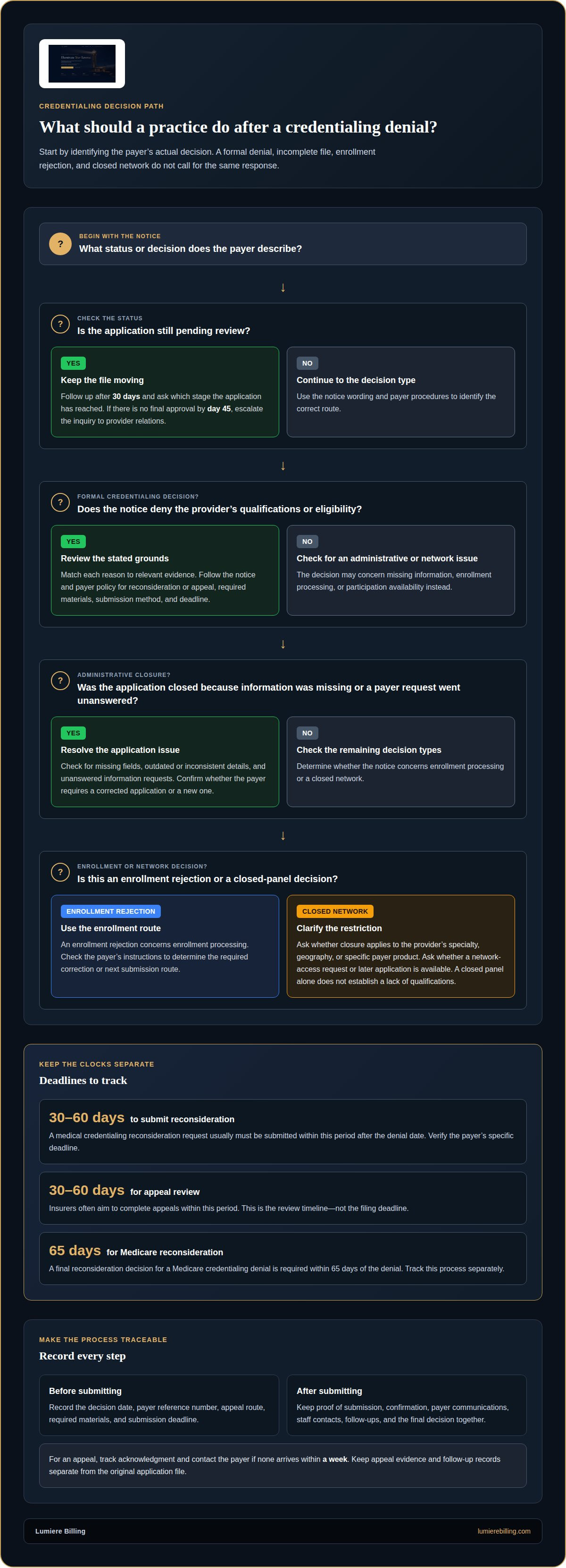
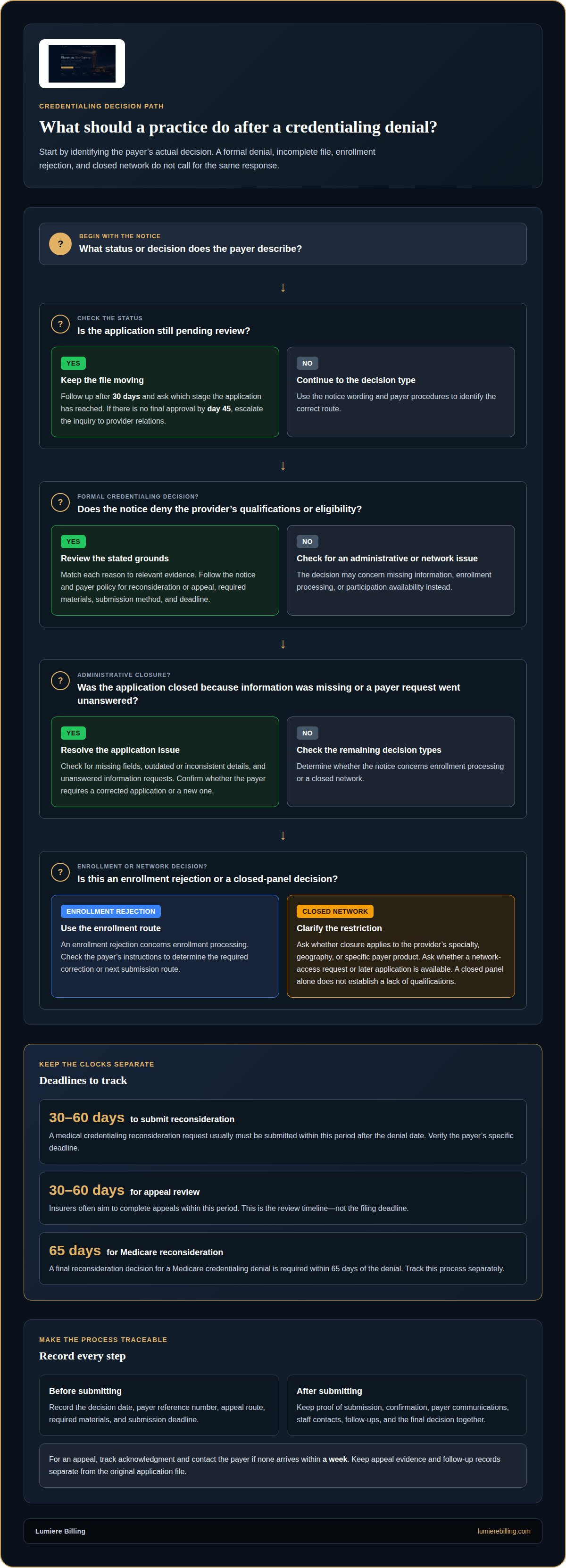
The first mistake after a credentialing denial is treating every negative notice as the same decision. Knowing what to do if your credentialing application is denied starts with identifying whether the payer issued a formal denial, closed an incomplete application, rejected an enrollment request, or declined to add providers to a closed network. Each decision may require a different response.
The timeline depends on the payer and the type of decision. For medical credentialing denials, a written reconsideration request usually must be submitted within 30 to 60 days of the denial date, while insurers often aim to complete appeals within 30 to 60 days. Those are different clocks: the first is about when to act, the second about how long review may take.
A rushed appeal can overlook the stated reason or leave a correctable application problem unresolved. This guide explains how to identify the decision, correct incomplete or inconsistent information, gather relevant supporting documents, and track deadlines. You’ll have a clearer path from notice to next step, without mistaking a paperwork issue or closed panel for a qualification-based denial.
Key Takeaways
- Identify whether the payer issued a formal credentialing denial, closed an application, rejected enrollment, or declined network participation before choosing a response.
- Use the denial notice and payer procedures to determine the correct appeal route, required materials, and deadline.
- Build supporting documentation around each stated reason, and resolve missing, outdated, or inconsistent application details.
- Keep appeal records separate from the original application, including submission details, payer communications, follow-ups, and the final decision.
- Credentialing & Enrollment support can help practices manage payer requirements and application follow-up when the process needs dedicated oversight.
1.How long does a credentialing appeal take?
- Start by recording the decision date, submission date, and payer reference number. A medical credentialing reconsideration request usually must be submitted within 30 to 60 days of the denial date. The review itself may take another 30 to 60 days. These are separate periods: the filing deadline governs when the appeal must arrive, while the review period concerns the payer’s decision.
- Have a credentialing professional follow the payer’s written instructions rather than use a generic appeal template. Payers set different documentation requirements, submission channels, deadlines, and review procedures. The professional identifies whether the notice calls for a corrected application, a new application, reconsideration, or a formal appeal. They then prepare the required materials and retain proof of submission, confirmation, and the assigned reference number.
- Set dated follow-ups instead of waiting without a record. For a pending application, follow up after 30 days and ask which stage it has reached. If it lacks final approval by day 45, escalate the inquiry to provider relations. For an appeal, track acknowledgment and contact the payer if none arrives within a week. Log each request, response, staff contact, and next action.
- Track Medicare reconsideration separately because its timeline differs. A final reconsideration decision for a Medicare credentialing denial is required within 65 days of the denial. A credentialing professional checks the decision notice for the applicable process, then monitors the submission and payer response against its stated dates. Keep appeal evidence and follow-up records together, rather than mixing them with the original application file.
- Separate payer review from licensing-board consequences. A payer appeal addresses network participation; it does not change a state license or licensing-board action. The U.S. Department of Health and Human Services Office of Inspector General maintains the List of Excluded Individuals/Entities (LEIE). An OIG exclusion generally prevents federal health care program payment for items or services furnished, ordered, or prescribed by the excluded party. A payer appeal does not lift that exclusion.
- If a payer says its panel is closed, ask whether the closure applies to the provider’s specialty, geography, or specific payer product. A closed panel alone does not establish that the provider lacks qualifications. Hypothetically, a practice might ask whether a network-access request or later reapplication is available. A credentialing professional can document the payer’s answer and the route it identifies; available options depend on that payer’s process.
Credentialing denial versus administrative closure, enrollment rejection, and closed-network decisions
First identify the payer’s actual decision, because a pending file, formal denial, and closed network call for different responses. Reapplication may be possible after correcting the stated problems, but the payer’s procedures determine whether to submit a corrected or new application and when. A credentialing professional can manage payer communications. Consult an attorney for legal advice about licensing or appeal rights.
-
How a Credentialing Professional Identifies Potential Denial Grounds
Ask the credentialing professional to classify the notice before preparing a response. A pending application remains under review; an administrative closure may follow missing information or an unanswered payer request. An enrollment rejection concerns enrollment processing, while a formal credentialing denial addresses the provider’s qualifications or eligibility. A closed-network decision concerns participation availability, not necessarily the provider’s credentials.
-
Review Notices and Appeal Deadlines
Have the professional compare the notice with the payer’s credentialing policy, provider manual, and participation contract, where applicable. They should identify the decision date, reasons, appeal route, submission method, and deadline. Appeal rights vary by payer and decision. Missing a response deadline may lead the payer to close or return an application under its procedures, so preserve the notice and related correspondence.
- Ask the professional to connect each stated reason to evidence and a response. Incomplete or inaccurate application materials are common administrative problems. Examples include missing fields, inconsistent details, or failure to answer a payer’s information request. These issues may require corrections rather than an argument about clinical qualifications. By contrast, concerns about professional conduct or competence can have broader consequences and need careful review.
- Separate network capacity from a provider-specific denial. A payer may limit participation by specialty, geography, or product, so the professional can clarify which restriction applies and whether the payer accepts a network-access request or later application. A closed panel does not, by itself, establish that a provider lacks qualifications. Record the payer’s explanation and the route it identifies.
- Reapply only after the professional confirms the payer’s permitted route. Some credentialing policies allow a second application after the problems behind a denial have been corrected. The response should address each reason, provide updated information, and follow the payer’s instructions. Submitting the same incomplete file again can leave the underlying issue unresolved.
- Match the consequences to the decision type. An administrative closure does not automatically produce a National Practitioner Data Bank report. A denial involving professional conduct or competence that may adversely affect patient health or welfare can implicate the Federal Health Care Quality Improvement Act reference, 42 USC 11101 et seq. For application management, credentialing process support can help organize payer records and responses.
Collecting updated credentials and supporting documents
- Begin the document review at least six months before the provider needs to be in-network. The credentialing professional builds a payer-specific checklist and identifies each required record, its source, and its expiration date. Payers differ in their documentation requirements, so one universal packet can leave gaps. The provider supplies current information; the professional organizes it for the relevant application or appeal.
- Collect the core credentials in one organized file. The professional gathers the provider’s medical license, DEA registration, board certification, and malpractice insurance documents. They record the issuing organization, effective dates, and expiration dates for each item. A missing license or expired insurance document can create an application problem, so the file should show which records are current and which need renewal.
- Compare every document with the payer’s request before submission. The professional checks that the provider’s name and identifying details match across the application and supporting records. If a payer requests proof of a particular credential, the response should include that document rather than an unrelated substitute. This review helps distinguish a genuinely missing item from a file that was submitted but not matched to the request.
- Build expiration reminders into the credentialing record. Set calendar alerts three months before a credential expires, then track renewal progress and payer updates. Begin credential renewal and payer updates 90 days before expiration. This schedule gives the professional time to obtain renewed documents and address processing delays before an expired credential affects an application or network record.
- Allow for processing time when a document comes from another organization. DEA registration updates can take weeks or months, while previous-employer verification requests can take weeks. Some organizations process primary-source verification requests once a month or less often. The professional records the request date, follows up with the source, and tracks whether the payer still needs evidence while verification is pending.
- Keep CAQH information aligned with the supporting file. CAQH stands for Council for Affordable Quality Healthcare, and most payers review provider information through the CAQH profile. A credentialing professional compares its details with the application and arranges re-attestation every four months. Updates should also remain consistent across CAQH, NPPES, and PECOS to reduce mismatches that can prompt additional requests.
- Prepare the response packet around the payer’s stated deadline and required format. The professional labels each document, links it to the relevant request, and keeps submission confirmation with the application record. Start credentialing 90 to 120 days before payer approval is needed, and begin gathering documents at least six months before the provider needs in-network status. These lead times help expose missing items before they hold up review.
Correcting incomplete or inconsistent application information
A credentialing professional can correct errors or submit missing information when the payer allows that route. If a denial relies on outdated or inaccurate details, the professional can provide corrected records and explain the discrepancy.
-
How a Credentialing Professional Corrects Application Deficiencies
- Match every deficiency in the payer’s notice to the original application. A credentialing professional identifies blank fields, conflicting dates, missing attachments, and unanswered requests. They distinguish an administrative omission from a substantive concern about qualifications. That distinction matters: adding a document may resolve an incomplete file, while a formal appeal may be needed to challenge the payer’s reasoning.
- Build a correction log listing each issue, its source, and how it was resolved. For a hypothetical example, if the application lists different practice dates from the provider’s work history, the professional identifies the accurate dates and supporting records. They avoid silently changing information or sending unrelated documents. A clear explanation helps the payer understand the correction and preserves a record of the actions taken.
- Address work-history gaps with a direct written explanation. The professional checks the payer’s application instructions for any required explanation of professional work-history gaps. They record the applicable dates and the provider’s explanation, including time away for family care, personal reasons, or further training when relevant. They check that the explanation matches the submitted work history.
-
How a Credentialing Professional Addresses Inaccurate or Missing Information
- Trace inaccurate or outdated information to its source before submitting a correction. The professional compares the payer’s record with current provider documents and relevant application entries. If a payer has an outdated address or credential status, the response identifies the incorrect detail, provides corrected information, and includes supporting documentation. This makes the requested change clear rather than leaving the payer to infer it.
- Confirm whether the payer accepts supplemental documents, a corrected application, or a formal appeal. The professional follows the instructions and deadline in the decision notice, then retains proof of submission. Missing information may be correctable, but the payer’s process determines whether it can be added to a closed file or requires a new application.
- Assess Medicare Corrective Action Plan eligibility separately from a standard appeal. Some Medicare enrollment denials may allow a corrective action plan, depending on the reason for the denial. The response is required within 35 days. A professional connects each cited deficiency to corrective actions and supporting evidence, rather than assuming every denial qualifies.
- Keep malpractice information accurate and complete. A professional should not omit a claim because it was dismissed or settled without admission of fault. Instead, the provider’s response should address the payer’s specific concern with factual explanations and relevant records. If the payer’s decision misstates a claim or its status, identify the error and document the correction through the applicable appeal process.
Common reasons credentialing applications are denied
- Compare the provider category on the application with the payer’s intended participation type. A physician applying under the wrong specialty or provider classification may be assessed against requirements that do not fit their practice. A typical practice might find that its application describes a provider’s clinical role differently from the payer’s category. Identify the mismatch before preparing a response, then use the payer’s terminology consistently.
- Check whether the application covers the employment-history period the payer requested. Some insurers require employment history covering five years, while others require ten years. A shorter history may leave the reviewer unable to assess the requested period. For example, a hypothetical provider might submit a résumé covering five years to a payer requesting ten. The credentialing professional can identify the gap and coordinate a complete response.
- Determine whether a required hospital privilege is still pending. A hospital may take six months to grant privileges, delaying insurance credentialing when proof of those privileges is required. That delay is not necessarily a finding that the physician lacks qualifications. A hypothetical application might remain incomplete while the hospital processes the privilege request. Track the dependency and clarify which payer requirement is waiting on that decision.
- Distinguish a qualification concern from a mismatch in the application’s description of the provider’s work. Payers may assess a provider’s specialty and scope of practice as part of their review. A hypothetical clinician whose application lists a broad specialty while supporting records describe a narrower focus may need to explain the difference. Align the response with the provider’s actual role and the payer’s stated criteria.
- Look for a payer-specific requirement the application did not address. Credentialing standards differ among payers, so a complete packet for one insurer may not answer another insurer’s questions. A hypothetical payer might request information about a provider’s practice arrangement that another application did not require. Compare the notice with that payer’s criteria and identify exactly what the reviewer says remains unresolved.
- Use the reason stated in the notice to guide the next step. Knowing what to do if your credentialing application is denied means identifying whether the issue concerns provider classification, a required record, or a review criterion. For example, a hypothetical practice might find that an application was assessed under the wrong specialty category. Get credentialing application support to organize payer-specific responses and address recurring review issues.
Lumiere Billing: Credentialing & Enrollment
Lumiere Billing provides Credentialing & Enrollment for behavioral health practices managing payer applications, denials, and follow-up. Consider this support when a denial requires coordinated document updates, a response to payer requests, or ongoing enrollment oversight. The process starts by understanding the payer’s decision and the application record, then identifying the next credentialing step. This helps practices keep enrollment tasks visible alongside broader revenue cycle responsibilities, without treating every denial as the same problem.
Share the denial notice and relevant application information so the credentialing process can be addressed in context. For support with payer credentialing and enrollment, contact Lumiere Billing.
Turn the Next Credentialing Decision Into a Clear Plan
A denial can be a turning point in how your practice manages enrollment. A practical answer to what to do if your credentialing application is denied starts with treating each payer decision as an operational signal: clarify ownership, keep the next action visible, and connect enrollment work with the practice’s broader financial workflow.
Lumiere Billing offers Revenue Cycle Management and a Free Billing Audit alongside Credentialing & Enrollment. These services help practices manage enrollment administration while keeping revenue cycle concerns in view. The right next step depends on what your practice needs help managing now.
If payer enrollment work is absorbing staff time or disrupting follow-through, contact Lumiere Billing for support. A clear process can help your team move forward with greater focus.
Frequently Asked Questions
Can a Closed Payer Panel Be Appealed?
Sometimes, but whether review is available depends on the payer’s decision and procedures. A panel-capacity decision differs from a determination about an individual provider’s credentials, so the appeal route may differ too. Read the notice’s description of the decision and review rights. If it does not explain whether review is available, ask the payer to clarify the decision type and applicable procedure in writing.
What are common reasons a healthcare credentialing application is denied?
Reasons vary by payer and provider type. A decision may relate to whether the provider meets the payer’s participation criteria, whether the payer could verify information, or whether the application satisfied its review requirements. The notice’s stated basis is more useful than assuming all denials share one cause. Separate the payer’s specific finding from any general application status update.
How can a credentialing professional request the reason for a credentialing denial and obtain the review file?
A credentialing professional can ask the payer in writing for its decision rationale and instructions for accessing materials considered during review. Include the provider’s name, NPI or payer reference number, and decision date so the payer can identify the file. Ask whether records are available, how to request them, and whether the payer requires a specific form or process. Retain the payer’s reply.
How can a credentialing professional appeal a denied application and manage the deadlines?
Prepare the appeal according to the payer’s stated process, identifying the provider, decision being challenged, grounds for reconsideration, and requested resolution. For Medicare credentialing appeals, the provider, an authorized official, or an authorized representative may sign. Use the submission method specified by the payer and preserve delivery confirmation. Assign responsibility for monitoring the response so follow-up does not depend on an untracked inbox.
What documents and evidence can a credentialing professional include in an appeal?
Choose evidence that supports the appeal’s specific argument, rather than simply including every document in the provider’s file. Useful materials may include the decision notice, relevant payer correspondence, records from the organization that created the disputed information, and a factual statement explaining the requested outcome. Label exhibits and explain their relevance. The reviewer should be able to connect each item to the issue under reconsideration.
How can a credentialing professional challenge a credentialing denial related to malpractice claims, licensing, or disciplinary history?
Compare the payer’s description with the underlying record and identify any factual disagreement precisely. A credentialing professional can organize relevant source documents and present the provider’s explanation to the payer. If the underlying record itself needs correction, a payer appeal alone may not change it; address the record with the organization responsible for maintaining it. Keep payer review separate from any licensing-board process.
What are the consequences of a credentialing denial for insurance network participation and patient care?
A denial can affect whether a provider participates in the payer’s network, which may change how the practice handles scheduling and coverage discussions. Keep the provider’s status clear in practice records and communicate it accurately to patients before services are arranged. Avoid describing the provider as in-network unless the payer has approved participation and the applicable effective date is clear. This helps prevent confusion about coverage expectations.
Frequently Asked Questions
Sometimes, but whether review is available depends on the payer’s decision and procedures. A panel-capacity decision differs from a determination about an individual provider’s credentials, so the appeal route may differ too. Read the notice’s description of the decision and review rights. If it does not explain whether review is available, ask the payer to clarify the decision type and applicable procedure in writing.
Reasons vary by payer and provider type. A decision may relate to whether the provider meets the payer’s participation criteria, whether the payer could verify information, or whether the application satisfied its review requirements. The notice’s stated basis is more useful than assuming all denials share one cause. Separate the payer’s specific finding from any general application status update.
A credentialing professional can ask the payer in writing for its decision rationale and instructions for accessing materials considered during review. Include the provider’s name, NPI or payer reference number, and decision date so the payer can identify the file. Ask whether records are available, how to request them, and whether the payer requires a specific form or process. Retain the payer’s reply.
Prepare the appeal according to the payer’s stated process, identifying the provider, decision being challenged, grounds for reconsideration, and requested resolution. For Medicare credentialing appeals, the provider, an authorized official, or an authorized representative may sign. Use the submission method specified by the payer and preserve delivery confirmation. Assign responsibility for monitoring the response so follow-up does not depend on an untracked inbox.
Choose evidence that supports the appeal’s specific argument, rather than simply including every document in the provider’s file. Useful materials may include the decision notice, relevant payer correspondence, records from the organization that created the disputed information, and a factual statement explaining the requested outcome. Label exhibits and explain their relevance. The reviewer should be able to connect each item to the issue under reconsideration.
Compare the payer’s description with the underlying record and identify any factual disagreement precisely. A credentialing professional can organize relevant source documents and present the provider’s explanation to the payer. If the underlying record itself needs correction, a payer appeal alone may not change it; address the record with the organization responsible for maintaining it. Keep payer review separate from any licensing-board process.
A denial can affect whether a provider participates in the payer’s network, which may change how the practice handles scheduling and coverage discussions. Keep the provider’s status clear in practice records and communicate it accurately to patients before services are arranged. Avoid describing the provider as in-network unless the payer has approved participation and the applicable effective date is clear. This helps prevent confusion about coverage expectations.
Free billing audit
Find out what your billing is really costing you
We'll review your claims, denials and collections and show you exactly where revenue is leaking. Free, no obligation, no contract.
Schedule a Free Billing Audit