Difference Between Rejected and Denied Claims: How to Respond

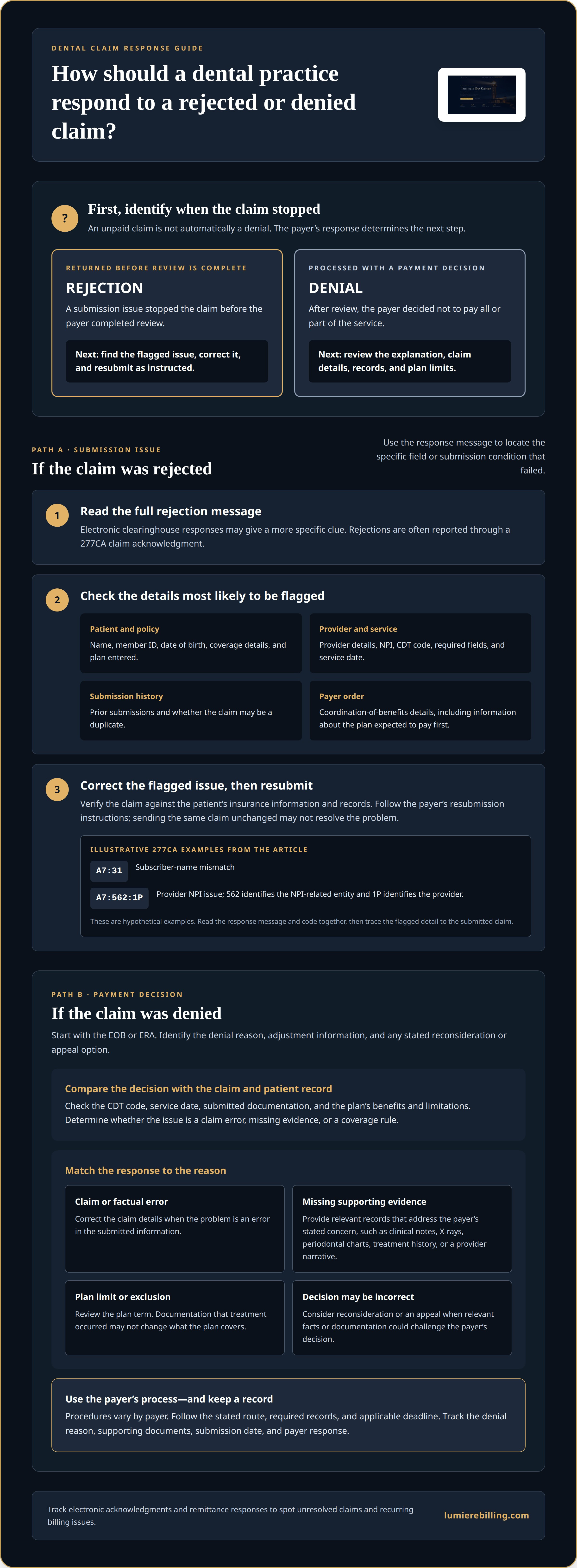
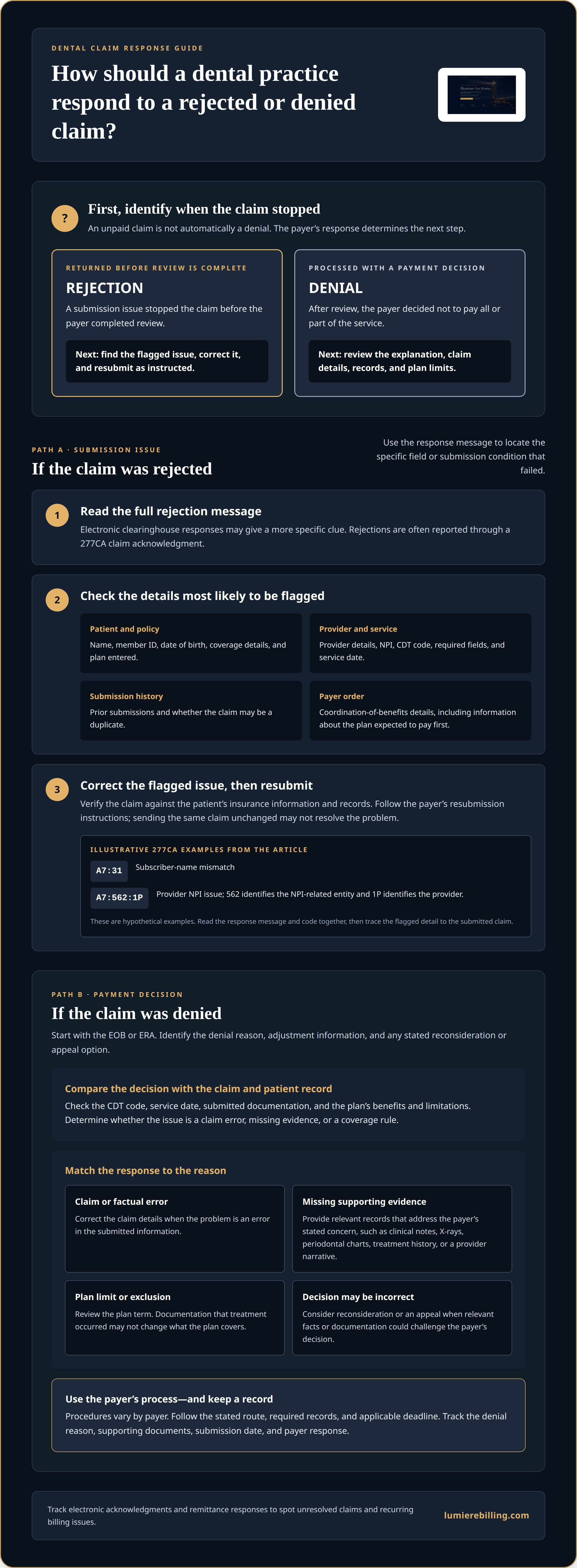
An unpaid claim isn’t always a denial. The difference between rejected and denied claims comes down to when the payer stops or processes the claim: a rejection is returned before review is complete, while a denial follows review and a decision not to pay all or part of the service. That distinction determines the next step: correct and resubmit a rejection; review the explanation and consider reconsideration or an appeal for a denial.
It’s easy to treat both notices as the same problem, especially when each delays payment. But resubmitting a denied claim as if it were rejected can lead to another denial, while appealing without a clear basis can take time without changing a decision based on plan limits.
This article covers common reasons claims are rejected or denied, how to interpret the payer’s response, and what may need correction before resubmission. It also explains when supporting records or an appeal may be appropriate, and how electronic acknowledgments and remittance information support reliable follow-up.
Key Takeaways
- Use the payer’s response message to identify whether a claim was returned before review or processed with a payment decision.
- For a rejection, locate the specific data or submission issue, correct it, and resubmit according to the payer’s instructions.
- For a denial, compare the explanation with the original claim, patient records, and plan limits before choosing a response.
- Appeal when the records support a challenge to the decision; a plan exclusion may leave no basis for changing the outcome.
- Track electronic acknowledgments and remittance responses to spot unresolved claims and recurring billing issues.
Should a dental practice appeal every denied claim?
No. A practice should review every denial, but an appeal makes sense only when relevant facts or documentation could challenge the payer’s decision. Start with the explanation of benefits (EOB) or electronic remittance advice (ERA). Identify the denial reason, adjustment information, and any stated option for reconsideration or appeal.
Next, compare the payer’s explanation with the original claim and the patient’s record. Check the CDT code, service date, submitted documentation, and the plan’s benefits and limitations. This review can show whether the issue is a claim error, missing evidence, or a coverage rule. The distinction matters: a factual error may call for a corrected claim, while disputing a payment decision may require reconsideration or an appeal.
Some denials may be worth challenging. For example, the payer may have overlooked clinical notes or X-rays supporting the service. Depending on the denial reason, useful documentation may include periodontal charts, treatment history, a provider narrative, or records supporting the CDT code. Match each item to the payer’s stated concern. Sending records without addressing that concern may leave the central issue unresolved.
- Check for correctable errors: Compare patient, provider, service, and coding details against the claim and patient record.
- Review plan terms: Identify whether a frequency limit or coverage exclusion explains the decision.
- Match documentation to the reason: Include relevant clinical records rather than an unorganized file.
- Follow the payer’s process: Use its stated reconsideration or appeal route and submission requirements.
An appeal may have little value when the denial clearly reflects a plan exclusion or benefit limit. Clinical documentation might show that treatment occurred, but it may not change what the plan covers. Distinguish disagreement with the decision from evidence that the payer applied the plan incorrectly. That distinction guides the next step.
Reconsideration and appeal procedures vary by payer. Read the remittance explanation for the available route, required records, and applicable deadline. Record the denial reason, supporting documents, submission date, and payer response. Timely follow-up helps prevent a supported challenge from stalling while the practice waits for a decision.
In a hypothetical scenario, an ERA denies a procedure because supporting records are missing. The practice locates the relevant clinical notes and X-rays, then submits them through the payer’s specified review process. If the ERA instead cites a plan exclusion, the practice weighs that plan term before investing time in an appeal. Let the denial reason guide the response, rather than appealing every unpaid claim automatically.
Common reasons dental claims are rejected
A rejection often signals a submission problem that stops a claim before payer review. The response may identify missing information, an invalid field, or a formatting issue. Read the full rejection message first. Its wording can help pinpoint the cause more reliably than resubmitting the same claim unchanged.
Patient and policy details are common trouble spots. A mistyped member ID, a subscriber name that differs from the payer’s file, or an incorrect date of birth can prevent a match. Eligibility issues can also arise when coverage details are outdated or the wrong plan is entered. Before correcting the claim, verify the patient’s identifiers and coverage information against the records available to the practice.
Provider and service data can trigger rejections, too. Missing provider details, an invalid CDT code, a required field left blank, or an incorrect service date may fail submission checks. Duplicate claims and coordination-of-benefits details can also cause problems. In a hypothetical scenario, a claim might be stopped because information about the plan expected to pay first is missing or inconsistent.
Electronic clearinghouse responses can make the fault more specific. Rejections are often reported through a 277CA claim acknowledgment. In a hypothetical response, status example A7:31 indicates a subscriber-name mismatch. Another hypothetical example, A7:562:1P, points to a provider NPI issue; in that code, 562 identifies the NPI-related entity, and 1P identifies the provider. Read the message and code together, then trace the flagged detail to the submitted claim.
- Patient mismatch: Compare the entered name, member ID, and service date with the patient’s insurance record.
- Provider issue: Review the provider information and NPI against the claim submission.
- Code or format problem: Check that the CDT code and required fields match the documented service and payer format.
- Duplicate or payer-order issue: Review prior submissions and coordination-of-benefits details before resending.
Denials have different causes because the payer has processed the claim and made a payment decision. Dental plan frequency limits or coverage exclusions may restrict payment. A payer may also cite medical-necessity concerns, missing clinical documentation, coordination-of-benefits issues, or a mismatch between the code and records. These reasons usually appear in an EOB or ERA, rather than in a pre-processing rejection notice.
Use the response type to choose what to review next. For a rejection, identify the exact claim field or submission condition that failed, correct it, and follow the payer’s resubmission instructions. For a denial, compare the remittance explanation with plan benefits and patient records; the issue may call for additional documentation, reconsideration, or an appeal. Payer and clearinghouse messages vary, so follow the specific response rather than assuming one code applies to every submission.
Correcting and resubmitting rejected claims
A rejection means the submitted claim needs correction before it can move forward. Start with the payer or clearinghouse response and identify the exact field or requirement it flags. Then compare that detail with the original claim and patient record. Correct only supported errors; changing unrelated fields can introduce new inconsistencies.
In a hypothetical scenario, a rejection identifies a mismatch in the subscriber’s name. The practice management record might show the patient’s name, while the payer file lists the subscriber. The billing team should confirm whose information belongs in each field, make the correction, and retain the response with the claim record. If the response flags provider details, review the submitted provider information rather than changing patient data.
A reliable correction process keeps the rejection message, claim, and supporting record connected. The billing team can use this sequence:
- Read the response: Identify the rejected field, code, or submission requirement.
- Trace the source: Compare the claim detail with the patient, provider, and service records.
- Correct the error: Update the inaccurate or missing information, using documented facts.
- Review the claim: Confirm the correction did not create a new mismatch in another field.
- Resubmit and track: Follow the payer’s instructions, then record the new status and response.
The resubmission should address the stated reason, not simply repeat the original file. If a CDT code appears invalid, compare it with the documented service and applicable coding guidance. If the payer flags a service date, verify it against the treatment record. Any correction must reflect what occurred, not what might make the claim pass.
After resubmitting, track the claim in the practice management system and review the payer’s next response. An accepted submission may proceed to adjudication; another rejection requires its own review. Keep the original rejection, corrected claim, submission record, and subsequent status together. This history helps prevent staff from sending the same unchanged version again.
Follow the payer’s specific correction and resubmission instructions, including any required claim references or submission method. Dental workflows differ among payers and clearinghouses, so a process that works for one response may not fit another. One claim might have failed because provider details were missing, while another needs a corrected patient identifier. Address each claim-level error separately instead of applying one broad edit.
Rejections can also reveal patterns in the billing process. If the same field repeatedly fails, review how staff capture that information and how the practice management system transfers it to claims. A focused review can distinguish an isolated entry error from a recurring workflow issue. Correcting an individual claim gets it moving again; addressing the source can reduce repeat rework.
Difference between claim rejections and denials
This distinction affects how a practice classifies work, assigns follow-up, and tracks unpaid revenue. Payer terminology varies, so staff should interpret each response in context rather than rely on a label alone. The difference between rejected and denied claims may depend on when the payer identifies an issue and how its system routes the claim.
The same underlying problem may be handled differently by different payers. One payer might return a duplicate submission during an initial check, while another might process it and issue a denial. A practice submitting the same service information to two plans could receive different status labels. The next step should follow the actual response and its instructions.
Adjudication also affects which deadlines matter. Once a claim has been accepted and adjudicated, timely filing limits no longer apply to that original filing. Separate deadlines may still govern a corrected claim or an appeal. Record the date and type of each payer decision, then follow the applicable instructions for the action being considered.
For operational tracking, separate claims by the work they require instead of grouping every unpaid balance together. A practice can organize its queue into categories such as:
- Returned for correction: Assign the claim for the specific update requested by the payer.
- Processed with no or reduced payment: Route it for review of the payer’s stated rationale and relevant plan details.
- Awaiting further action: Track the requested records, reconsideration, or appeal through the next response.
This classification gives billing staff a clearer view of workload and unresolved revenue. In a hypothetical scenario, a monthly review might show that a group of claims remains open because corrected submissions lack a payer reference number. That differs from adjudicated denials tied to a benefit limitation. Separating the work types helps managers see which operational steps are taking time.
Use the payer’s specific instructions to determine whether a response calls for correction, additional records, reconsideration, or appeal. Keep the relevant claim history together, including the payer’s explanation and any later action. When similar issues recur, compare outcomes across payers without assuming that the same terminology means the same requirements. The response details, processing stage, and next-step instructions offer the clearest basis for consistent claim handling.
Electronic claims and revenue cycle management
Electronic filing creates a trail from submission to payer response. That trail is useful only when billing staff connect each acknowledgment to the correct claim and track its status. A submitted claim can be accepted for processing, returned with an electronic rejection, or adjudicated with a payment decision. Each response marks a different point in the revenue cycle.
For electronic claims, a 277CA acknowledgment commonly reports rejection before payer adjudication. An 835 electronic remittance advice records the payer’s processed decision and adjustment details. Staff can use those records to distinguish a transmission problem from a claim requiring denial follow-up. Connecting the message to the claim identifier prevents one patient’s response from being attached to another account.
Revenue cycle management connects these electronic events with eligibility, claim submission, payment posting, and follow-up. In a hypothetical scenario, a billing team can trace a rejected claim to its original transmission, document the correction, and monitor the resubmission. For an adjudicated denial, staff can record the remittance reason, supporting records, and next action. The workflow should preserve both the payer’s explanation and the practice’s response.
- Before filing: Validate patient and provider details, eligibility, CDT codes, and required claim fields.
- After submission: Match acknowledgments and payer responses to the correct claim, then update its status.
- After adjudication: Post payment or adjustment details and assign unresolved denials for review.
- During follow-up: Record corrected submissions, appeal activity, payer responses, and remaining balances.
Electronic status data can also expose workflow gaps. In a hypothetical practice pattern, a practice might see repeated rejections tied to one missing field, or denials linked to recurring documentation gaps. Reviewing denial trends regularly can help identify repeat causes and guide corrective action. The goal is not just to count unpaid claims, but to find the process point creating preventable rework.
Timely follow-up matters because a claim can remain unresolved after its first response. A routine to review claims about 25 days after submission can help surface items without a clear payer status. Staff can then determine whether the claim is pending, rejected, denied, or awaiting additional action. Payer requirements and separate appeal or corrected-claim deadlines still guide the response.
Electronic tools improve visibility, but they do not replace judgment. A clearinghouse can relay acknowledgments and payer responses; the billing workflow still needs to interpret them, assign ownership, and track resolution. A rejected claim needs attention to its submission issue. A denial calls for review of the payment decision and its supporting details.
To bring claim submission, response tracking, and follow-up into clearer view, review your revenue cycle workflow.
Lumiere Billing
Lumiere Billing helps behavioral health practices bring claim submission, denial follow-up, and revenue cycle processes into clearer focus. Revenue Cycle Management supports oversight across billing workflows, while Practice Advisory can help address operational challenges behind recurring issues.
A Free Billing Audit can help identify process gaps affecting claim handling. Credentialing & Enrollment may also help when provider enrollment issues contribute to billing disruptions. The right support depends on where claims are getting stuck: during submission, payer review, or follow-up.
If your behavioral health practice needs help examining claim workflows and recurring payer issues, contact Lumiere Billing.
Turn claim responses into a stronger billing process
Each payer response can show where a billing workflow needs clearer ownership, better documentation, or more consistent follow-up. Use recurring patterns to improve staff procedures, not just to resolve claims one at a time. This feedback can help practices address preventable errors before they recur.
The difference between rejected and denied claims matters beyond dental billing. Lumiere Billing focuses exclusively on behavioral health providers, helping them manage revenue cycle operations and understand claim patterns. Its Free Billing Audit, Revenue Cycle Management, and Credentialing & Enrollment services support different parts of that work, from identifying workflow gaps to addressing enrollment-related billing issues.
If your behavioral health practice wants a clearer view of its billing processes, contact Lumiere Billing. A more organized response process can help your team move forward with greater clarity.
Frequently Asked Questions
What is a Claim Rejection?
A claim rejection means a submission failed an initial processing check and needs attention before it can move through the payer’s review. An electronic response may flag a missing field or an identifier that doesn’t match the payer’s records. The rejection message identifies the issue to investigate. Treat it as a signal to correct a specific submission problem, not as a final coverage decision.
How are Claim Denials Different?
A claim denial is a payer’s decision after processing a claim. The explanation may cite a benefit limit, an exclusion, or a documentation concern. In a hypothetical scenario, a service may be covered only under certain plan conditions, or the payer may need records to evaluate it. Read the explanation alongside the applicable plan information to determine whether additional documentation or a formal review could address the stated reason.
How often should practices monitor their denial rates?
Review denial trends regularly to identify recurring issues and guide corrective action. A periodic review can reveal patterns that individual claim follow-up may miss, such as repeated denials associated with one payer, service type, or documentation gap. Track each denial reason alongside its status and resolution. This makes the rate more useful: it can show where a process needs attention, not just how many claims went unpaid.
Is outsourcing medical billing more cost-effective than managing billing in-house?
Compare the full operating costs and work covered by each option before deciding. For in-house billing, include staffing, training, systems, and the time spent on submission follow-up and denial work. For an outsourced arrangement, review its scope and pricing structure. Then assess whether the practice can maintain accurate filing, timely follow-up, and useful reporting with its current resources. Lumiere Billing specializes exclusively in revenue cycle management for behavioral health providers.
Why is denial management important for revenue cycle performance?
Denial management helps practices identify unpaid claims, organize follow-up, and trace recurring problems to their source. Without consistent tracking, claims can remain unresolved and the same process errors may continue. Categorizing payer reasons, recording actions, and reviewing outcomes gives billing teams clearer information for prioritizing work. This makes the revenue cycle more visible, with fewer unanswered questions about why claims remain unpaid or what to do next.
Frequently Asked Questions
A claim rejection means a submission failed an initial processing check and needs attention before it can move through the payer’s review. An electronic response may flag a missing field or an identifier that doesn’t match the payer’s records. The rejection message identifies the issue to investigate. Treat it as a signal to correct a specific submission problem, not as a final coverage decision.
A claim denial is a payer’s decision after processing a claim. The explanation may cite a benefit limit, an exclusion, or a documentation concern. In a hypothetical scenario, a service may be covered only under certain plan conditions, or the payer may need records to evaluate it. Read the explanation alongside the applicable plan information to determine whether additional documentation or a formal review could address the stated reason.
Review denial trends regularly to identify recurring issues and guide corrective action. A periodic review can reveal patterns that individual claim follow-up may miss, such as repeated denials associated with one payer, service type, or documentation gap. Track each denial reason alongside its status and resolution. This makes the rate more useful: it can show where a process needs attention, not just how many claims went unpaid.
Compare the full operating costs and work covered by each option before deciding. For in-house billing, include staffing, training, systems, and the time spent on submission follow-up and denial work. For an outsourced arrangement, review its scope and pricing structure. Then assess whether the practice can maintain accurate filing, timely follow-up, and useful reporting with its current resources. Lumiere Billing specializes exclusively in revenue cycle management for behavioral health providers.
Denial management helps practices identify unpaid claims, organize follow-up, and trace recurring problems to their source. Without consistent tracking, claims can remain unresolved and the same process errors may continue. Categorizing payer reasons, recording actions, and reviewing outcomes gives billing teams clearer information for prioritizing work. This makes the revenue cycle more visible, with fewer unanswered questions about why claims remain unpaid or what to do next.
Free billing audit
Find out what your billing is really costing you
We'll review your claims, denials and collections and show you exactly where revenue is leaking. Free, no obligation, no contract.
Schedule a Free Billing Audit