How to Accelerate Accounts Receivable in Behavioral Health

Every aging balance needs more than another follow-up attempt. It needs an owner, a clear status, and a defined next action. A practical plan to accelerate accounts receivable behavioral health workflows starts by making those details visible, so claims don’t sit untouched while teams struggle to distinguish payer delays from preventable process gaps.
If cash flow is difficult to forecast, the issue may not be effort. Claims can stall because eligibility wasn’t verified, documentation is incomplete, authorization is missing, or follow-up has no clear owner. Giving every balance the same urgency can waste time without improving visibility or protecting the patient experience.
This article explains how to trace delays to their operational source, prioritize outstanding AR by age, payer, and status, and establish a repeatable workflow with clear accountability. You’ll learn how front-end checks can prevent avoidable delays and how consistent follow-up keeps the next step visible for each claim. The goal is a more controlled revenue cycle that supports clinicians’ focus on patient care.
Key Takeaways
- Faster collections come from removing avoidable process delays, not rushing claims or pressuring patients.
- Trace stalled balances through the revenue cycle to determine whether the cause is internal workflow, payer response, or patient follow-up.
- Use balance age, status, owner, and next action to focus follow-up where it can move a claim forward.
- To accelerate accounts receivable behavioral health workflows, build a repeatable review-and-follow-up loop that records outcomes and schedules the next step.
- Behavioral health RCM support can connect verification, authorization, claims, denials, and payment posting when AR ownership needs clearer controls.
Why Behavioral Health Accounts Receivable Gets Stuck
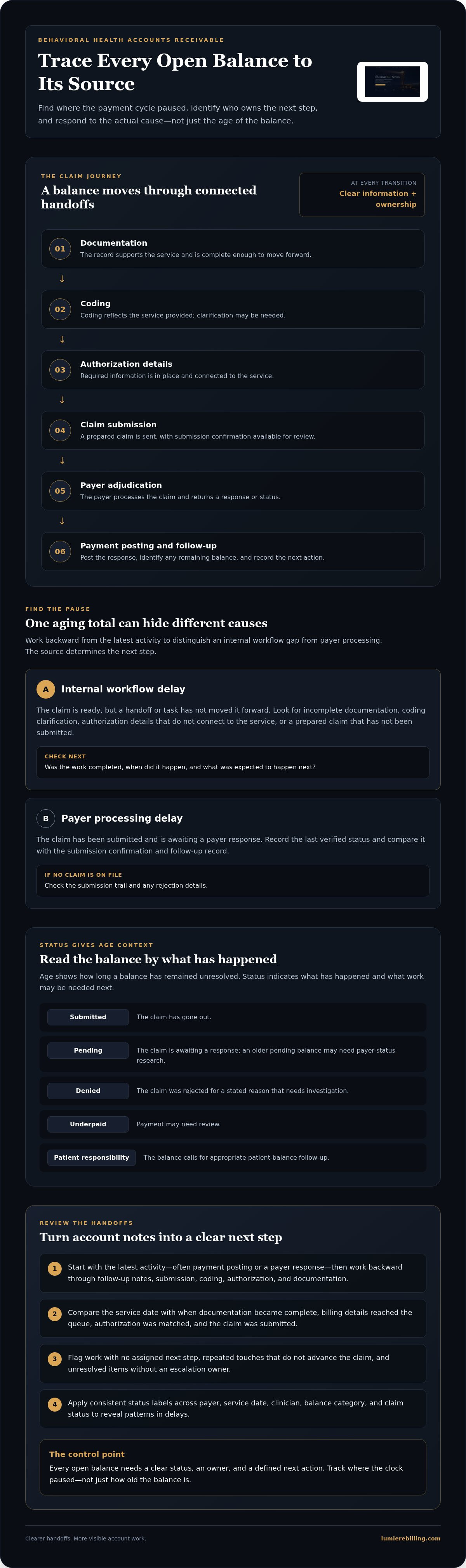
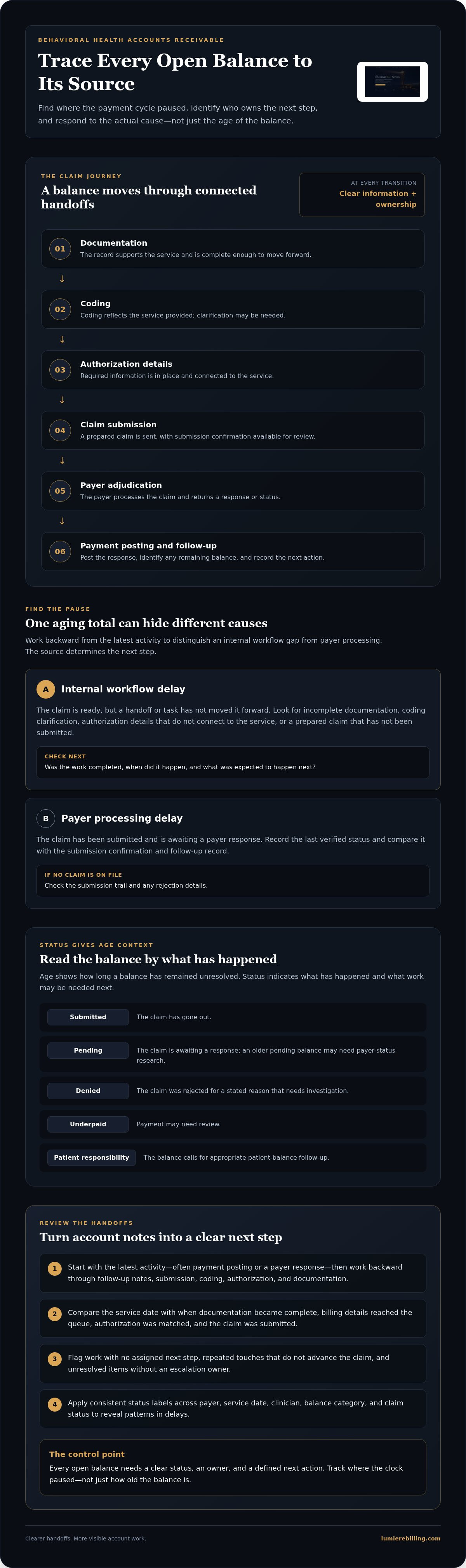
Behavioral health accounts receivable (AR) is the unpaid balance owed by payers and patients after services have been delivered. It represents completed work, but the route from a session to a posted payment can involve several handoffs. A claim may wait for documentation, coding, authorization details, submission, payer adjudication, payment posting, or follow-up. A small gap at any point can leave the balance open without making the cause clear.
AR speed measures how consistently and quickly open balances move toward resolution; it is not the same as total collections, which measures how much revenue is ultimately received. The goal of accelerating accounts receivable behavioral health processes is to remove avoidable waiting and rework, not rush inaccurate claims or put undue pressure on patients. The basic definition of AR and its role in business are summarized in this Accounts Receivable Overview.
Think of a claim as moving through a sequence: the record supports the service, coding reflects what was provided, required authorization details are in place, and the claim is submitted. The payer then adjudicates it. Once payment or another response arrives, the practice posts it, identifies any remaining balance, and follows up. Each transition needs clear information and ownership. If a claim is ready but no one submits it, that is an internal delay. If it has been submitted and is awaiting a payer response, the delay has a different source and calls for a different next step.
That distinction matters. A single aging total can make both situations look alike, even though one may need a corrected handoff and the other may need status research. Separating the sources of delay helps teams respond deliberately while preserving claim accuracy and respectful patient communication.
Where the behavioral health payment cycle can slow down
Documentation may be incomplete or not ready for coding; coding may need clarification; authorization information may not connect cleanly to the service; or a prepared claim may sit before submission. After submission, payer processing takes its own course, and practice follow-up depends on whether staff check the response and act on it.
For an illustrative claim journey, imagine a session record that needs a missing detail before coding. The claim waits internally, then goes out after correction. It remains pending with the payer; later, a response requires staff review and posting. This is not an industry benchmark. It shows why identifying where the clock paused is more useful than treating the entire wait as one undifferentiated delay.
Why an open balance needs a status, not just an age
Age shows how long a balance has remained unresolved. Status indicates what has happened and what work may be needed next. A submitted claim has gone out; a pending claim is awaiting a response; a denied claim has been rejected for a stated reason; an underpaid claim may need payment review; and a patient-responsibility balance calls for appropriate patient-balance follow-up.
Use labels that reflect the practice’s billing system and actual workflow, rather than applying a generic list without context. For example, an older pending balance may need payer-status research, while a newer denial may need prompt investigation. Without status, age alone can’t distinguish claims waiting on an external response from balances that need internal action. Clear definitions make the work easier to prioritize.
Trace Each Behavioral Health AR Delay to Its Source
An unpaid balance is the end point of a process, not an explanation. To find the cause, start with the latest activity, often payment posting or a payer response, then work backward through follow-up notes, claim submission, coding, authorization, and documentation. At each step, ask: what was completed, when did it happen, and what was expected to happen next?
A consistent status taxonomy, applied across payer, service date, clinician, balance category, and claim status, turns scattered account notes into comparable patterns. Those patterns can show whether delays cluster around a payer, service line, handoff, or follow-up task. This helps a practice distinguish external processing time from internal rework and address the right cause without sacrificing claim accuracy or respectful patient communication.
Audit handoffs from documentation through claim submission
Review a sample of open balances and compare the service date with the dates when documentation became complete, billing details reached the queue, authorization information was matched to the service, and the claim was submitted. Look for gaps between these milestones. A note may be finished but not routed; authorization may exist but be difficult to connect to the claim.
Then examine ownership. Identify work with no assigned next step, repeated touches that don’t advance the claim, and items that remain unresolved without an escalation owner. If several claims for one clinician pause at the same handoff, investigate that workflow rather than treating each balance as an isolated exception. Keep access to records and billing information aligned with your practice’s privacy and security processes; HHS provides information on HIPAA and Healthcare Regulations.
Separate payer processing from preventable rework
For each claim, compare the payer-reported status with your submission confirmation and follow-up record. If the payer shows no claim on file, check the submission trail and any rejection details. If it’s pending, record the last verified status and the next review point. If a response requests information or a correction, identify what’s needed, who owns it, and whether the revised claim or response was sent.
Recurring requests, corrected submissions, and unanswered payer responses can point to different failure points. Group them by payer and cause, then check whether the same issue appears across clinicians or service dates. This turns a stack of account notes into evidence for a targeted workflow fix. For error-specific examples, see Behavioral Health Billing Errors to Avoid.
Patient-responsibility balances need their own follow-up path. Track whether the balance has been accurately identified and whether communication is pending, rather than mixing patient follow-up with payer work. Clear records support steady, respectful communication and help prevent repeated outreach without an understanding of what has already happened.
When the cause is hard to see across handoffs, a behavioral health billing audit can help surface workflow gaps and inform practical improvements. The aim is not to chase every balance in the same way. It’s to make the source of delay visible, assign the appropriate next action, and keep the claim moving accurately.
Prioritize Behavioral Health AR by Age, Status, and Next Action
Age is a useful signal, but it shouldn’t determine follow-up on its own. A newly submitted claim and an older balance may need very different attention: one may simply be awaiting payer adjudication, while the other could have an unresolved denial, a missing response, or a filing deadline approaching. To accelerate accounts receivable behavioral health workflows, prioritize by what can still be done, what has already happened, and who can move the balance forward.
Build a work queue with one row for each open balance. Include the balance status, responsible owner, next action, and review date. Add the last action, payer or patient status, service date, and balance category so staff can understand the history without reconstructing it from scattered notes.
- Status and context: Record whether the balance is submitted, pending, denied, underpaid, or assigned to patient responsibility, along with the payer or patient context.
- Ownership and next step: Name one accountable owner and describe the next action, such as checking claim receipt, researching a denial, or completing patient follow-up.
- Last action and review date: Note the most recent contact or correction and set a date to revisit unresolved work.
Build an AR work queue that assigns ownership
One balance, one accountable owner, one documented next step. That structure prevents tasks from disappearing between teams or receiving repeated attention without progress. Set escalation rules for payer inquiries that remain unanswered and claims nearing the applicable timely filing limit. Use the payer’s terms and the claim’s history to set review dates; don’t apply one universal aging cutoff to every account.
Priority should reflect recoverability and context, not just the dollar amount. A claim with a correctable issue and a clear route to resubmission may warrant action before a larger balance awaiting a payer response. Consider payer status, filing considerations, balance type, and available information. CMS publishes program guidance through its CMS Billing and Reimbursement Guidelines; apply relevant payer requirements to the claims in your queue rather than assuming one rule fits all.
Read aging patterns without mistaking age for cause
Review aging by payer, service type, provider, and balance responsibility when your data allows. A cluster of older claims for one payer may point to a response or processing pattern; balances concentrated around a service type or provider may call for a closer look at internal handoffs. Patient-responsibility balances need a distinct view so they aren’t confused with unpaid payer claims.
Interpret those patterns alongside claim status and recorded actions. A balance can be old because the payer is still adjudicating, internal work stalled, or patient follow-up remains open. Those causes call for different owners and next steps. For broader context on how these activities connect across the revenue cycle, consult the Behavioral Health Revenue Cycle Management: 2026 Guide.
Review the queue on a consistent schedule and adjust priorities as statuses change, responses arrive, or filing considerations become more urgent. The aim is a visible, workable sequence of actions, not a rigid ranking by age alone.
Use a Repeatable Workflow to Move Behavioral Health AR Forward
A reliable AR process turns each open balance into a short, trackable sequence of work. A complete AR follow-up cycle reviews a balance, verifies its status, takes and records the appropriate action, then sets the next review date or closes the item. That loop keeps claims moving without sacrificing accuracy or creating unnecessary pressure for patients.
Use the same core steps for every balance, while tailoring the action to its status and history:
- Review the queue. Select balances due for review, including items flagged for denial action, payer response, correction, or patient follow-up.
- Verify the current status. Check the claim record and available payer information before acting. Confirm whether the claim is pending, denied, paid, or awaiting a practice response.
- Take the appropriate action. Correct and resubmit when the claim needs correction, research a payer issue when its status is unclear, or route a confirmed patient balance to the appropriate communication process.
- Document the outcome. Record what was checked, what changed, and any reference number, correspondence, or response that supports the next step.
- Schedule follow-up or close the item. Set a review date if work remains open. Close it only when the balance is resolved or routed to the next defined process.
Defined administrative handoffs protect clinician time. Billing questions that need clinical input should go through a clear request identifying the missing information and where it belongs, rather than interrupting clinicians with repeated or vague queries. Once the response is received, the billing owner can complete the claim task and update the record.
Standardize follow-up without using one script for every balance
Consistency means using the same documentation discipline, not sending identical messages for every account. Match follow-up to payer status, claim history, and confirmed patient responsibility. Record call references, portal updates, correspondence, and promised follow-up dates so another team member can understand what happened. For patient balances, use clear, respectful communication that explains the balance and the appropriate next step without implying blame.
Measure whether the workflow is improving
Track AR aging distribution, time spent in each status, follow-up completion, and payment-posting timeliness. Define each measure before reviewing it: specify when the status clock starts and what counts as a completed follow-up. Compare equivalent periods and consistent categories so a change reflects workflow performance rather than different reporting methods.
Then look for movement, not just totals. If follow-up completion improves but balances remain in the same status, the next action may not be resolving the underlying issue. If time between payer response and posting grows, review that handoff. Related analysis in Identifying Revenue Leakage in Your Practice can help connect workflow observations with broader revenue-cycle patterns.
A repeatable process can help practices accelerate accounts receivable behavioral health work while keeping claim handling accurate and patient interactions considerate. Lumiere Billing’s behavioral health-focused revenue cycle management and free billing audit can help identify workflow gaps and inform practical improvements. The audit can help assess where clearer ownership and follow-up may help.
When Behavioral Health AR Needs Specialist RCM Support
A consistent queue helps, but process rules alone can’t solve every capacity or expertise gap. Specialist revenue cycle management (RCM) support may be useful when balances repeatedly lose ownership, follow-up competes with other administrative demands, or teams can’t see whether delays begin with verification, authorization, claims, denials, or posting.
Look for recurring signals rather than one difficult claim: unresolved work carries forward without a clear owner; the same payer issues resurface; posting lags behind received responses; or staff spend time reconstructing claim history before they can act. These patterns can point to a need for added capacity, stronger controls, or more focused oversight. The goal is a better-managed process, not a promised collection increase or fixed AR timeline.
What specialist support can bring to AR operations
Behavioral health billing has connected stages. Insurance verification and prior authorization inform the claims process; denial prevention and follow-up address issues that arise after submission; payment posting clarifies what remains open. Coordinating these functions can give each balance a more continuous path instead of leaving it between separate tasks or teams.
Specialist RCM support can pair coordinated follow-up with denial prevention and practice-level analytics. Analytics may help teams examine where balances cluster and which handoffs merit review, while consistent ownership keeps unresolved work visible. Lumiere Billing focuses exclusively on behavioral health RCM, with support spanning insurance verification through payment posting. For a broader discussion of operating models, see Outsource Mental Health Billing: A Strategic Guide.
For clinicians, well-defined administrative handoffs can reduce interruptions caused by unclear or repeated billing questions. Requests for needed documentation can be routed with context, while billing staff retain responsibility for tracking the claim and its next step. That division helps keep operational follow-up from drifting into clinical time.
Turn an AR review into clear next steps
Start an AR review with four views: aging, work ownership, payer patterns, and unresolved handoffs. For each pattern, identify what the record shows, what remains unknown, and which process step should be reviewed. A cluster of stalled claims may call for a workflow adjustment; a payer-specific pattern may call for targeted status review. Findings should guide priorities, not serve as a guarantee of collections.
A free billing audit can help surface these opportunities and connect observations to practical workflow improvements. Lumiere Billing brings behavioral health revenue cycle expertise to that review, with the aim of making the process clearer and more accountable.
Make Your Next AR Improvement Visible
Choose one recurring point of friction and turn it into a measurable workflow question: where does work pause, who owns the next step, and what evidence will show whether the handoff improved? That focus gives your team a practical starting point without asking staff to overhaul every process at once. To accelerate accounts receivable behavioral health operations, start with a clear diagnosis, then refine the workflow based on what the records reveal.
Lumiere Billing focuses exclusively on behavioral health revenue cycle management. Its free billing audit is designed to help practices surface workflow opportunities and shape practical next steps, without promising a particular collection result. A clearer view can support more confident decisions about AR ownership and help protect time for patient care.
Ready to identify where your process can move forward? Request a free behavioral health billing audit. A focused review can be the first step toward a more visible, accountable AR workflow. Your team can make progress one well-defined action at a time.
Frequently Asked Questions
How quickly should a behavioral health practice follow up on an unpaid claim?
Follow up according to the payer’s stated processing expectations and the claim’s filing deadlines, rather than applying one interval to every claim. First confirm that the payer received it and check whether a response is pending or additional information is needed. If a filing deadline is approaching, prioritize review accordingly. Record the status check and next review date so the claim doesn’t disappear from view.
What does a high days-in-AR figure mean for a behavioral health practice?
A high days-in-AR figure means a larger portion of revenue remains unpaid for longer, but the total alone doesn’t explain why. Compare it with the practice’s prior periods and examine which balances are driving it. For example, a change may reflect a buildup of pending payer claims, unresolved denials, or patient balances. Break the figure down by status and payer before deciding which operational issue to address.
Should a practice write off old behavioral health accounts receivable?
Don’t write off a balance solely because it’s old. First determine whether payment is still reasonably pursuable by reviewing the claim history, payer response, applicable contract terms, and any remaining correction or appeal options. For patient balances, follow the practice’s established financial policies. Document the reason for any write-off and route it through the appropriate approval and accounting process so unresolved work isn’t mistaken for a deliberate adjustment.
Can patient billing statements help accelerate behavioral health collections?
Yes, clear and accurate statements can help patients understand what they owe and why. Send them after the payer has processed the claim and the patient-responsibility amount has been reconciled, so the statement doesn’t confuse an unpaid insurer balance with a patient balance. Include enough detail to identify the service and explain how to raise a billing question. Consistent, respectful communication supports follow-through without pressuring patients.
How can a small behavioral health practice manage AR with limited staff?
To accelerate accounts receivable behavioral health work with a small team, make the queue usable before trying to add more tasks. Assign a primary owner and backup, group claims by the type of action needed, and reserve recurring time to review unresolved items. Use a shared record of the last action and next step to reduce repeated investigation. If limited capacity leaves work consistently unowned, specialist RCM support can provide focused operational oversight.
Does faster AR mean submitting behavioral health claims before documentation is complete?
No. Faster AR depends on claims moving accurately, not on sending them before the record is ready. Incomplete or inconsistent documentation can lead to payer questions, corrections, or denials that create more work and delay resolution. If required information is missing, identify the specific gap and route it through the practice’s administrative process. Submit once the necessary billing details are complete and aligned with the service being reported.
Frequently Asked Questions
Follow up according to the payer’s stated processing expectations and the claim’s filing deadlines, rather than applying one interval to every claim. First confirm that the payer received it and check whether a response is pending or additional information is needed. If a filing deadline is approaching, prioritize review accordingly. Record the status check and next review date so the claim doesn’t disappear from view.
A high days-in-AR figure means a larger portion of revenue remains unpaid for longer, but the total alone doesn’t explain why. Compare it with the practice’s prior periods and examine which balances are driving it. For example, a change may reflect a buildup of pending payer claims, unresolved denials, or patient balances. Break the figure down by status and payer before deciding which operational issue to address.
Don’t write off a balance solely because it’s old. First determine whether payment is still reasonably pursuable by reviewing the claim history, payer response, applicable contract terms, and any remaining correction or appeal options. For patient balances, follow the practice’s established financial policies. Document the reason for any write-off and route it through the appropriate approval and accounting process so unresolved work isn’t mistaken for a deliberate adjustment.
Yes, clear and accurate statements can help patients understand what they owe and why. Send them after the payer has processed the claim and the patient-responsibility amount has been reconciled, so the statement doesn’t confuse an unpaid insurer balance with a patient balance. Include enough detail to identify the service and explain how to raise a billing question. Consistent, respectful communication supports follow-through without pressuring patients.
To accelerate accounts receivable behavioral health work with a small team, make the queue usable before trying to add more tasks. Assign a primary owner and backup, group claims by the type of action needed, and reserve recurring time to review unresolved items. Use a shared record of the last action and next step to reduce repeated investigation. If limited capacity leaves work consistently unowned, specialist RCM support can provide focused operational oversight.
No. Faster AR depends on claims moving accurately, not on sending them before the record is ready. Incomplete or inconsistent documentation can lead to payer questions, corrections, or denials that create more work and delay resolution. If required information is missing, identify the specific gap and route it through the practice’s administrative process. Submit once the necessary billing details are complete and aligned with the service being reported.
Free billing audit
Find out what your billing is really costing you
We'll review your claims, denials and collections and show you exactly where revenue is leaking. Free, no obligation, no contract.
Schedule a Free Billing Audit