How Do I Fight Timely Filing Denials for Therapy Claims?

A therapy claim may have been submitted on time, yet the payer’s records don’t clearly show when it was received. Knowing how to fight timely filing denials for therapy starts with tracing the claim’s path, not simply disputing the denial. A missing acknowledgment, conflicting status updates, or a plan-specific deadline can leave a practice unsure what happened.
Before correcting, resubmitting, or appealing, establish why the payer denied the claim and what the applicable plan requires. A transmission attempt, a clearinghouse acceptance, and payer receipt are different events, so match each one to its record. The right response depends on the denial and the evidence available.
This article explains how to investigate a timely filing denial, assemble dated evidence, and prepare a focused response. It also covers when to distinguish an appeal from a corrected claim and how to track submissions and follow-up. Clear records help you address the specific denial and spot workflow gaps that could affect future claims.
Key Takeaways
- Start with the denial notice and compare payer status records with clearinghouse transmissions to identify where the claim trail broke down.
- Build a dated timeline using the original claim, acknowledgments, portal history, and relevant correspondence.
- Match your response to the evidence and the payer’s instructions, distinguishing an appeal from a corrected claim.
- Track each response through the payer’s final determination so unresolved claims don’t disappear from follow-up.
- Review denial patterns by payer, rendering provider, service date, and submission outcome to identify workflow gaps and improve claim tracking.
What does a timely filing denial mean for a therapy claim?
A timely filing denial means the payer determined it received a claim after the submission limit that applies to the plan. The applicable limit can vary by payer, plan, provider contract, and claim circumstances. A claim sent before a deadline may still be denied if the payer’s records don’t show receipt within its required window.
This is a process denial, not necessarily a judgment about the therapy. It differs from a coding denial, which concerns claim information; an eligibility denial, which concerns coverage on the date of service; an authorization denial, which concerns required approval; or a medical necessity denial, which concerns whether the service meets the plan’s criteria. Identify the denial category before choosing a response. The remedy for a late-filing determination may differ from the steps for correcting a billing error.
Which date starts the payer’s timely filing clock?
The payer’s policy or provider contract determines which date starts the filing clock. It may be the date of service or another event defined by the payer, depending on the plan and claim circumstances. Don’t apply one payer’s deadline or counting rule to another payer, even when the claims are similar. Find the specific plan language, note the triggering event and counting rule, and compare them with the claim’s dates.
Why can a therapy claim receive a late-filing denial?
A claim can be submitted late if it sits in a practice work queue, goes to the wrong payer, or remains unresolved after a rejection. A transmission attempt and payer receipt aren’t necessarily the same event. A sent timestamp alone may not show that the claim reached the right destination or entered the payer’s system. Review what happened after transmission as well.
Common process points to investigate include:
- Delayed submission: The claim remained in a work queue or wasn’t released promptly.
- Inaccurate routing: The claim went to the wrong payer or submission destination.
- Unresolved rejection: An error stopped the claim from moving forward, but it wasn’t corrected and resubmitted in time.
- Missing follow-up: No one confirmed whether the payer received or processed the submission.
These causes differ from errors in coding, eligibility, authorization, or medical necessity, although a claim can involve more than one issue. If the notice points to incorrect claim information rather than late receipt, investigate that billing issue separately. Pinpointing the denial category helps determine whether timing, claim content, or both need attention.
What should you check before disputing a therapy CO-29 denial?
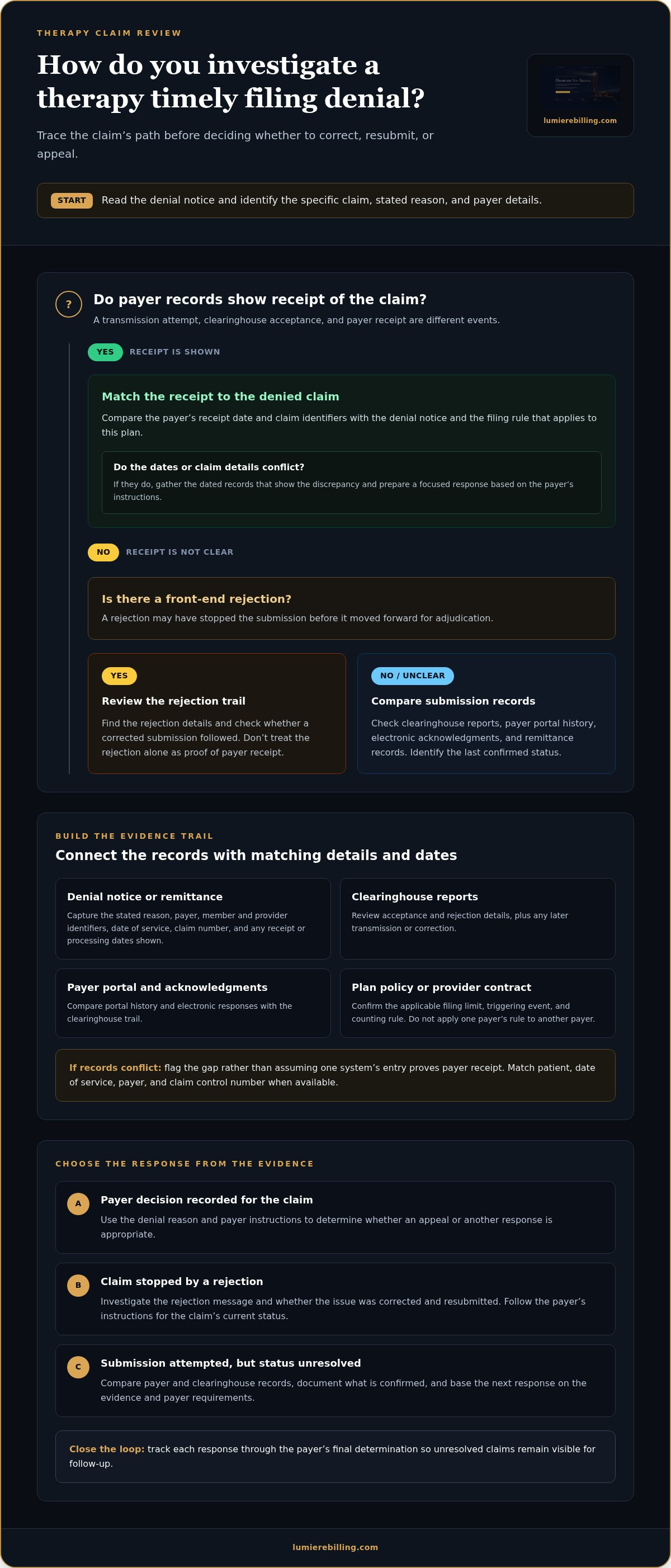
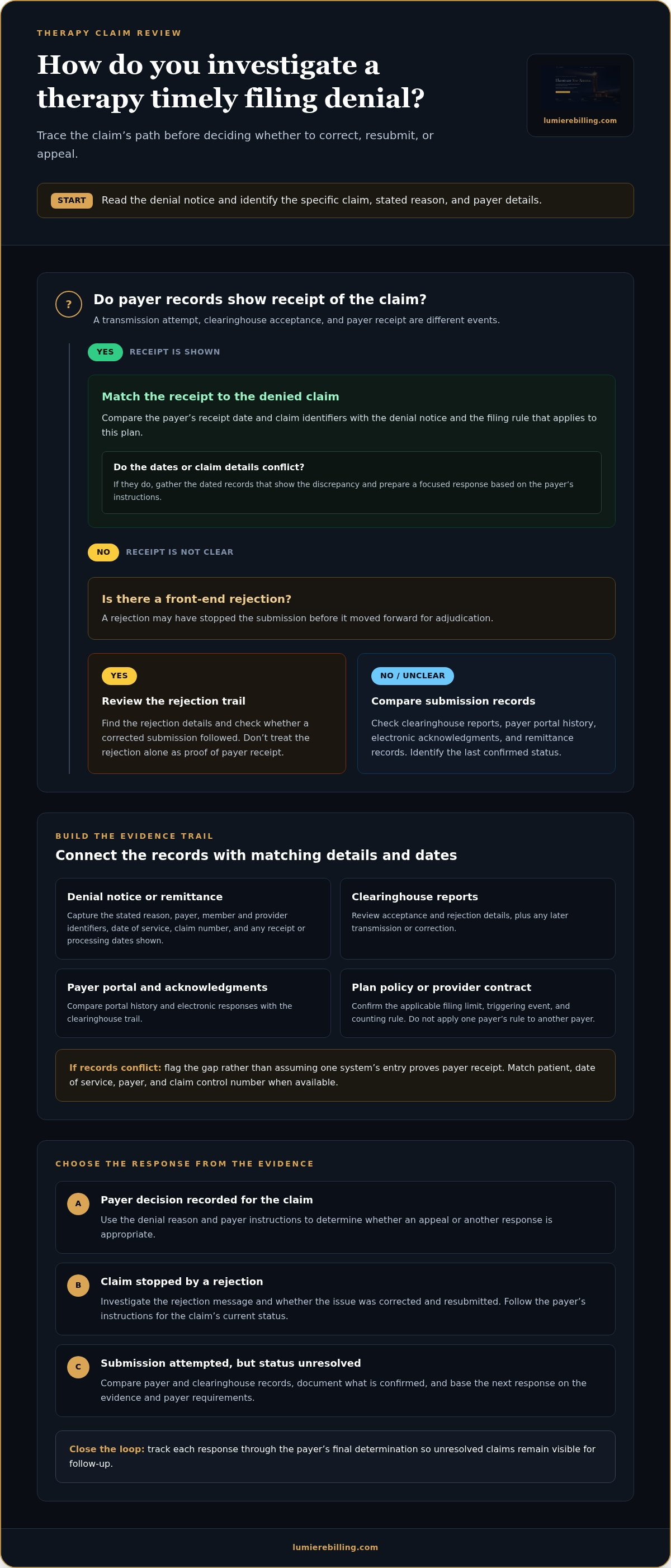
Before challenging a CO-29 timely filing denial, establish what happened to the specific claim. Start with the remittance advice or denial notice. Record the stated reason, payer, member and provider identifiers, date of service, claim number, and any receipt or processing dates shown. These details help you match the payer’s decision to the right submission trail instead of relying on a general account note.
Determine whether the payer received a processable claim. That tells you whether you’re investigating a denial after receipt, resolving a front-end rejection, or tracing a submission with an unclear status. A transmission timestamp by itself doesn’t answer that question.
Claim status | What it may indicate | What to examine next
Payer receipt shown | The payer’s records show that a claim entered its system. | Match the claim identifiers and receipt date to the denial and applicable filing rule.
Front-end rejection | A submission issue may have stopped the claim before adjudication. | Find the rejection details and determine whether a corrected submission followed.
Submission unresolved | Records show an attempt, but no clear payer receipt or rejection. | Compare clearinghouse and payer records, then identify the last confirmed status.
How do you distinguish rejection from denial?
A rejection generally means a problem prevented the submission from moving forward for adjudication. Review the rejection message and any later transmission before treating it as proof that the payer received the claim. A denial, by contrast, is a payer decision recorded for the claim, and its stated reason guides the next step. Adjustment information on the remittance can help interpret that decision. Consult a CARC and RARC explainer if the codes need decoding.
Which records establish the claim’s status?
Review clearinghouse acceptance and rejection reports, payer portal history, electronic acknowledgments, and remittance records. Match dates and identifiers across them, including the patient, date of service, payer, and claim control number when available. Look for a continuous trail: submission, response, any correction, and the payer’s eventual status. If records conflict, flag the gap rather than assuming an entry in one system proves payer receipt.
A typical practice might find that its clearinghouse record shows a file was transmitted while the payer portal shows no corresponding claim. That mismatch calls for more investigation, not an automatic conclusion that the claim was timely or late. An adjudicated denial may require a different response from a rejected or unconfirmed submission. To fight a timely filing denial, connect each status to dated evidence before choosing the next step.
Consistent claim-status review makes submission and follow-up gaps easier to identify. Behavioral health revenue cycle oversight can help organize those records and processes.
How do you build evidence for a timely filing appeal?
A strong filing-limit appeal presents a documented sequence, not a stack of unrelated screenshots. Build a timeline from the date of service through the original submission, acknowledgments, any rejection, correction or resubmission, and the denial. Include the date and source for each event. If a date is uncertain or records conflict, mark the gap rather than presenting an assumption as fact.
Connect each assertion in the appeal to a dated, claim-level record. Match every item to the patient, service date, payer, claim number or another available claim identifier, and the submission event it supports. This lets the reviewer follow the evidence without having to guess which claim a report describes.
- Date of service: Confirm the service date on the claim and identify the filing rule that applies to the plan.
- Original submission: Record when and where the claim was sent, along with the version submitted.
- Payer or clearinghouse response: Attach the relevant acceptance, rejection, or acknowledgment and note its date.
- Correction or resubmission: Show what changed, when the revised claim was sent, and what response followed.
- Denial: Record the notice date and the reason the payer gave for its decision.
What belongs in the appeal packet?
Keep the packet focused on the disputed determination. Include the denial notice, claim details, applicable payer filing policy or contract language, and records supporting the submission and receipt timeline. Add corrected-claim or resubmission history if it explains a gap or shows what happened after a rejection. Use the payer’s designated submission channel and protect patient information in the documents you send.
Choose records that answer a specific question. A clearinghouse report may document a transmission or response; a payer acknowledgment or portal history may show activity in the payer’s system. Include the relevant record in full, not a cropped excerpt that omits its date, status, or claim identifiers. Label attachments so each one can be matched to an entry in the timeline.
How should the appeal explain the timeline?
Open by identifying the denial reason and the determination you’re challenging. Then list the material events in chronological order, citing the attached record for each date. Explain any rejection, correction, or delay plainly. Don’t imply that an initial transmission proves payer receipt unless the evidence supports that. Close by requesting reconsideration under the applicable payer policy and stating what the records show, without predicting the outcome.
This evidence-first approach makes how to fight timely filing denials for therapy more precise: address the filing decision with claim-specific documentation, not unrelated clinical or coding arguments. Before submitting, check that the attachments support the same dates and claim identifiers stated in the appeal. A clear, consistent packet gives the payer a traceable basis for review.
How do you submit and track a therapy timely filing appeal?
A complete appeal can stall if it goes to the wrong destination or no one tracks the response. Treat submission and follow-up as one process. Before sending anything, check the current payer policy for the appeal deadline, required form, submission channel, and plan-specific instructions. Don’t assume the appeal route is the same as the corrected-claim route.
What steps should the billing team follow?
Use a consistent sequence and record each handoff. This helps the team distinguish an appeal from a corrected claim and track the status until the payer responds.
- Confirm the denial. Match the notice to the claim and verify the stated reason before selecting a response.
- Check the payer’s current instructions. Confirm the applicable policy, appeal deadline, required forms, supporting-document requirements, and permitted submission channel.
- Select the correct route. Follow appeal instructions when disputing a denial. Use corrected-claim instructions when the payer directs a claim correction. Don’t submit a corrected claim instead of an appeal unless the payer’s process calls for it.
- Prepare and submit the packet. Include the appeal, indexed supporting records, and any required form. Keep a complete copy of what was sent.
- Capture confirmation. Record the submission date, channel, confirmation or reference details, and staff member responsible for follow-up.
- Monitor and close the loop. Set a follow-up date, check for payer updates, and record the response and final determination.
Make the case log detailed enough for another team member to take over without reconstructing the history. Record the claim identifiers, denial date, appeal deadline, action taken, submission confirmation, assigned owner, next follow-up, and payer response. If the payer requests more information, log the request and response as separate events. A submitted appeal isn’t a resolved appeal.
What if the payer upholds the denial?
Read the written determination closely. Identify whether it describes another review option and the conditions or deadline for that step. Compare the notice with the applicable plan terms and current payer policy before deciding whether another submission is available. Don’t assume further review is automatic or that the same channel and requirements still apply.
Record the outcome even if no additional review is available. Note the payer’s explanation and any process gap the team can address, such as an unassigned rejection queue or a missing receipt check. This turns the determination into useful operational information without treating further action as guaranteed reimbursement.
A traceable appeal log can help behavioral health practices see where submission and follow-up handoffs need attention. Revenue cycle support for claims and denial oversight can help make those steps more visible.
How can a therapy billing workflow prevent repeat timely filing denials?
Prevention starts with making each claim’s status visible before a filing window closes. A submission schedule alone won’t catch a claim sitting in a rejection queue or one without a confirmed payer response. Assign ownership, reconcile submission records, and define what happens when a claim stalls. The goal is a traceable workflow that surfaces gaps early, not a promise that every denial can be avoided.
Which controls make filing issues visible sooner?
Assign a staff owner to each work queue, including unsubmitted claims, clearinghouse rejections, and claims without a payer acknowledgment. Set a routine for reviewing those queues and an escalation path for unresolved items. Reconcile outgoing claims against clearinghouse responses and payer acknowledgments so an attempted transmission isn’t mistaken for a completed submission. Use payer-specific filing rules to prioritize follow-up.
- Claim ownership: Make responsibility for each queue and its next action visible to the team.
- Submission cadence: Release claims consistently, with timing informed by applicable payer limits and the practice’s workflow.
- Rejection follow-through: Track rejected claims through correction and resubmission instead of letting them disappear into a general work list.
- Unresolved acknowledgments: Flag claims without a clear payer response for investigation and escalation.
Review timely filing denials by payer, rendering provider, date of service, and submission outcome. These views can reveal whether a pattern relates to a plan’s requirements, a handoff, or a recurring rejection type. Analytics can also help identify aging claims and gaps between transmission and acknowledgment. Use the findings to refine queue ownership, staff instructions, and follow-up routines, then monitor whether the same issue returns.
How can specialized billing support help?
For behavioral health practices, specialized revenue cycle oversight can connect claims submission, denial prevention, and follow-up in a more visible process. Analytics help examine where claims stall and which workflow patterns need attention. That supports a disciplined approach to fighting timely filing denials while strengthening prevention. Use the evidence to guide process changes; no review can guarantee a particular reimbursement outcome.
Lumiere Billing provides revenue cycle management for behavioral health practices, including claims submission, denial prevention, and analytics. A free billing audit can help assess your claims process and identify opportunities to improve visibility and follow-through. Learn about Lumiere Billing’s revenue cycle services.
Make the next claim easier to trace
Choose a recent timely filing denial and test how clearly your practice can trace the claim from submission through payer response. Where does ownership become unclear? Which handoff leaves the status unresolved? Turn what you find into a practical workflow adjustment, then make that control part of routine operations. Documented changes can make future claim activity easier to see and manage.
The lasting value of learning how to fight timely filing denials for therapy is not just responding to a disputed claim. It’s strengthening the process that supports the next one. Consistent oversight helps your team act with greater clarity, even when payer records or requirements are complex.
Ready to review your behavioral health billing workflow? Request a free billing audit to identify opportunities to improve claim visibility and follow-through.
Frequently Asked Questions
Can I appeal a therapy timely filing denial if I submitted the claim before the deadline?
Yes. If the payer appears to have applied the wrong receipt date or filing rule, you may be able to challenge the determination through the plan’s review process. Submission before the deadline alone may not resolve the dispute if the payer’s records show a later receipt. Check the denial notice for the available review route and time limit, then focus the dispute on the determination you believe is incorrect.
Does correcting a therapy claim restart the timely filing deadline?
Not automatically. A corrected claim may have its own submission rules, but that doesn’t necessarily restart the initial filing period. Hypothetically, if a practice corrects a rendering-provider identifier after receiving a remittance, it should follow the payer’s corrected-claim instructions and applicable deadline rather than assume the correction creates a new initial filing window. Keep the original and corrected claim versions distinct in the billing record.
What proof can show a therapy claim was submitted on time?
System-generated records created during submission are generally more useful than a staff member’s later recollection. Preserve the original electronic transaction files and acknowledgments in a retrievable format, along with payer correspondence. Internal notes can explain what staff did, but may not independently establish when the payer received a claim. Keep source records intact so their dates and status details are available for review.
What happens if a clearinghouse rejects a therapy claim before the payer receives it?
A clearinghouse rejection usually means the submission needs attention before it can proceed through the payer’s claim process. It isn’t necessarily a payer adjudication or a formal denial, so an appeal may be the wrong route. Hypothetically, if a rejected claim remains in a work queue, the practice should address the stated issue and follow the payer’s rules for any later submission. Don’t assume the original attempt establishes timely receipt.
Are Medicare timely filing rules the same as commercial plan rules?
No. Medicare Part A and Part B fee-for-service claims generally have a 12-month filing limit from the date of service under CMS rules. Commercial plans set requirements through their own policies and contracts, while Medicare Advantage is administered by private plans. Confirm the exact product and applicable instructions before using a deadline. Don’t apply an Original Medicare rule to a commercial or Medicare Advantage claim by default.
How long do I have to appeal a CO-29 denial for therapy?
The time limit depends on the payer and plan, so check the denial notice and current policy promptly. For Medicare fee-for-service, a standard CO-29 timely filing denial generally doesn’t follow the usual redetermination process; limited reopening circumstances may apply under CMS rules. Commercial plans have their own review timelines and procedures. Record the notice date and verify which route applies before preparing a response, since using the wrong process can affect review rights.
Can a therapy practice bill the patient for a timely filing denial?
If the remittance assigns the adjustment as a contractual obligation, the provider generally can’t shift that amount to the patient. Don’t treat the denial as patient responsibility solely because the claim wasn’t paid. Review the adjustment information, provider agreement, and applicable plan terms before changing the account balance or sending a statement. The remittance and contract govern how the amount must be handled, so keep the determination with the patient’s billing record.
Frequently Asked Questions
The payer’s policy or provider contract determines which date starts the filing clock. It may be the date of service or another event defined by the payer, depending on the plan and claim circumstances. Don’t apply one payer’s deadline or counting rule to another payer, even when the claims are similar. Find the specific plan language, note the triggering event and counting rule, and compare them with the claim’s dates.
A claim can be submitted late if it sits in a practice work queue, goes to the wrong payer, or remains unresolved after a rejection. A transmission attempt and payer receipt aren’t necessarily the same event. A sent timestamp alone may not show that the claim reached the right destination or entered the payer’s system. Review what happened after transmission as well. Common process points to investigate include: These causes differ from errors in coding, eligibility, authorization, or medical necessity, although a claim can involve more than one issue. If the notice points to incorrect claim information rather than late receipt, investigate that billing issue separately. Pinpointing the denial category helps determine whether timing, claim content, or both need attention. Before challenging a CO-29 timely filing denial, establish what happened to the specific claim. Start with the remittance advice or denial notice. Record the stated reason, payer, member and provider identifiers, date of service, claim number, and any receipt or processing dates shown. These details help you match the payer’s decision to the right submission trail instead of relying on a general account note. Determine whether the payer received a processable claim. That tells you whether you’re investigating a denial after receipt, resolving a front-end rejection, or tracing a submission with an unclear status. A transmission timestamp by itself doesn’t answer that question. Claim status | What it may indicate | What to examine next Payer receipt shown | The payer’s records show that a claim entered its system. | Match the claim identifiers and receipt date to the denial and applicable filing rule. Front-end rejection | A submission issue may have stopped the claim before adjudication. | Find the rejection details and determine whether a corrected submission followed. Submission unresolved | Records show an attempt, but no clear payer receipt or rejection. | Compare clearinghouse and payer records, then identify the last confirmed status.
A rejection generally means a problem prevented the submission from moving forward for adjudication. Review the rejection message and any later transmission before treating it as proof that the payer received the claim. A denial, by contrast, is a payer decision recorded for the claim, and its stated reason guides the next step. Adjustment information on the remittance can help interpret that decision. Consult a CARC and RARC explainer if the codes need decoding.
Review clearinghouse acceptance and rejection reports, payer portal history, electronic acknowledgments, and remittance records. Match dates and identifiers across them, including the patient, date of service, payer, and claim control number when available. Look for a continuous trail: submission, response, any correction, and the payer’s eventual status. If records conflict, flag the gap rather than assuming an entry in one system proves payer receipt. A typical practice might find that its clearinghouse record shows a file was transmitted while the payer portal shows no corresponding claim. That mismatch calls for more investigation, not an automatic conclusion that the claim was timely or late. An adjudicated denial may require a different response from a rejected or unconfirmed submission. To fight a timely filing denial, connect each status to dated evidence before choosing the next step. Consistent claim-status review makes submission and follow-up gaps easier to identify. Behavioral health revenue cycle oversight can help organize those records and processes. A strong filing-limit appeal presents a documented sequence, not a stack of unrelated screenshots. Build a timeline from the date of service through the original submission, acknowledgments, any rejection, correction or resubmission, and the denial. Include the date and source for each event. If a date is uncertain or records conflict, mark the gap rather than presenting an assumption as fact. Connect each assertion in the appeal to a dated, claim-level record. Match every item to the patient, service date, payer, claim number or another available claim identifier, and the submission event it supports. This lets the reviewer follow the evidence without having to guess which claim a report describes.
Keep the packet focused on the disputed determination. Include the denial notice, claim details, applicable payer filing policy or contract language, and records supporting the submission and receipt timeline. Add corrected-claim or resubmission history if it explains a gap or shows what happened after a rejection. Use the payer’s designated submission channel and protect patient information in the documents you send. Choose records that answer a specific question. A clearinghouse report may document a transmission or response; a payer acknowledgment or portal history may show activity in the payer’s system. Include the relevant record in full, not a cropped excerpt that omits its date, status, or claim identifiers. Label attachments so each one can be matched to an entry in the timeline.
Open by identifying the denial reason and the determination you’re challenging. Then list the material events in chronological order, citing the attached record for each date. Explain any rejection, correction, or delay plainly. Don’t imply that an initial transmission proves payer receipt unless the evidence supports that. Close by requesting reconsideration under the applicable payer policy and stating what the records show, without predicting the outcome. This evidence-first approach makes how to fight timely filing denials for therapy more precise: address the filing decision with claim-specific documentation, not unrelated clinical or coding arguments. Before submitting, check that the attachments support the same dates and claim identifiers stated in the appeal. A clear, consistent packet gives the payer a traceable basis for review. A complete appeal can stall if it goes to the wrong destination or no one tracks the response. Treat submission and follow-up as one process. Before sending anything, check the current payer policy for the appeal deadline, required form, submission channel, and plan-specific instructions. Don’t assume the appeal route is the same as the corrected-claim route.
Use a consistent sequence and record each handoff. This helps the team distinguish an appeal from a corrected claim and track the status until the payer responds. Make the case log detailed enough for another team member to take over without reconstructing the history. Record the claim identifiers, denial date, appeal deadline, action taken, submission confirmation, assigned owner, next follow-up, and payer response. If the payer requests more information, log the request and response as separate events. A submitted appeal isn’t a resolved appeal.
Read the written determination closely. Identify whether it describes another review option and the conditions or deadline for that step. Compare the notice with the applicable plan terms and current payer policy before deciding whether another submission is available. Don’t assume further review is automatic or that the same channel and requirements still apply. Record the outcome even if no additional review is available. Note the payer’s explanation and any process gap the team can address, such as an unassigned rejection queue or a missing receipt check. This turns the determination into useful operational information without treating further action as guaranteed reimbursement. A traceable appeal log can help behavioral health practices see where submission and follow-up handoffs need attention. Revenue cycle support for claims and denial oversight can help make those steps more visible. Prevention starts with making each claim’s status visible before a filing window closes. A submission schedule alone won’t catch a claim sitting in a rejection queue or one without a confirmed payer response. Assign ownership, reconcile submission records, and define what happens when a claim stalls. The goal is a traceable workflow that surfaces gaps early, not a promise that every denial can be avoided.
Assign a staff owner to each work queue, including unsubmitted claims, clearinghouse rejections, and claims without a payer acknowledgment. Set a routine for reviewing those queues and an escalation path for unresolved items. Reconcile outgoing claims against clearinghouse responses and payer acknowledgments so an attempted transmission isn’t mistaken for a completed submission. Use payer-specific filing rules to prioritize follow-up. Review timely filing denials by payer, rendering provider, date of service, and submission outcome. These views can reveal whether a pattern relates to a plan’s requirements, a handoff, or a recurring rejection type. Analytics can also help identify aging claims and gaps between transmission and acknowledgment. Use the findings to refine queue ownership, staff instructions, and follow-up routines, then monitor whether the same issue returns.
For behavioral health practices, specialized revenue cycle oversight can connect claims submission, denial prevention, and follow-up in a more visible process. Analytics help examine where claims stall and which workflow patterns need attention. That supports a disciplined approach to fighting timely filing denials while strengthening prevention. Use the evidence to guide process changes; no review can guarantee a particular reimbursement outcome. Lumiere Billing provides revenue cycle management for behavioral health practices, including claims submission, denial prevention, and analytics. A free billing audit can help assess your claims process and identify opportunities to improve visibility and follow-through. Learn about Lumiere Billing’s revenue cycle services. Choose a recent timely filing denial and test how clearly your practice can trace the claim from submission through payer response. Where does ownership become unclear? Which handoff leaves the status unresolved? Turn what you find into a practical workflow adjustment, then make that control part of routine operations. Documented changes can make future claim activity easier to see and manage. The lasting value of learning how to fight timely filing denials for therapy is not just responding to a disputed claim. It’s strengthening the process that supports the next one. Consistent oversight helps your team act with greater clarity, even when payer records or requirements are complex. Ready to review your behavioral health billing workflow? Request a free billing audit to identify opportunities to improve claim visibility and follow-through.
Yes. If the payer appears to have applied the wrong receipt date or filing rule, you may be able to challenge the determination through the plan’s review process. Submission before the deadline alone may not resolve the dispute if the payer’s records show a later receipt. Check the denial notice for the available review route and time limit, then focus the dispute on the determination you believe is incorrect.
Not automatically. A corrected claim may have its own submission rules, but that doesn’t necessarily restart the initial filing period. Hypothetically, if a practice corrects a rendering-provider identifier after receiving a remittance, it should follow the payer’s corrected-claim instructions and applicable deadline rather than assume the correction creates a new initial filing window. Keep the original and corrected claim versions distinct in the billing record.
System-generated records created during submission are generally more useful than a staff member’s later recollection. Preserve the original electronic transaction files and acknowledgments in a retrievable format, along with payer correspondence. Internal notes can explain what staff did, but may not independently establish when the payer received a claim. Keep source records intact so their dates and status details are available for review.
A clearinghouse rejection usually means the submission needs attention before it can proceed through the payer’s claim process. It isn’t necessarily a payer adjudication or a formal denial, so an appeal may be the wrong route. Hypothetically, if a rejected claim remains in a work queue, the practice should address the stated issue and follow the payer’s rules for any later submission. Don’t assume the original attempt establishes timely receipt.
No. Medicare Part A and Part B fee-for-service claims generally have a 12-month filing limit from the date of service under CMS rules. Commercial plans set requirements through their own policies and contracts, while Medicare Advantage is administered by private plans. Confirm the exact product and applicable instructions before using a deadline. Don’t apply an Original Medicare rule to a commercial or Medicare Advantage claim by default.
The time limit depends on the payer and plan, so check the denial notice and current policy promptly. For Medicare fee-for-service, a standard CO-29 timely filing denial generally doesn’t follow the usual redetermination process; limited reopening circumstances may apply under CMS rules. Commercial plans have their own review timelines and procedures. Record the notice date and verify which route applies before preparing a response, since using the wrong process can affect review rights.
If the remittance assigns the adjustment as a contractual obligation, the provider generally can’t shift that amount to the patient. Don’t treat the denial as patient responsibility solely because the claim wasn’t paid. Review the adjustment information, provider agreement, and applicable plan terms before changing the account balance or sending a statement. The remittance and contract govern how the amount must be handled, so keep the determination with the patient’s billing record.
Free billing audit
Find out what your billing is really costing you
We'll review your claims, denials and collections and show you exactly where revenue is leaking. Free, no obligation, no contract.
Schedule a Free Billing Audit