How Can I Reduce Stress as a Mental Health Practice Owner?

What if reducing mental health practice owner stress starts with fixing the work that keeps spilling beyond your workday? When billing questions, administrative tasks, and constant decisions follow you from clinical hours into personal time, simply trying harder won’t solve the underlying problem. The strain may be a sign that key workflows need clearer ownership and more predictable routines.
Running a practice is demanding, and financial uncertainty or processes that depend on you can make routine tasks feel hard to control. Make the workload more manageable by identifying recurring friction, setting boundaries around administrative work, and building systems that don’t require your attention at every step. This article covers common sources of practice-owner stress and practical ways to address them, including how specialized behavioral health billing support can reduce administrative demands and leave more room for clinical leadership.
Key Takeaways
- Identify which recurring clinical, administrative, financial, or leadership demands are driving mental health practice owner stress.
- Separate personal recovery habits from operational changes so each source of strain gets the right response.
- Use a simple weekly review to choose one bottleneck, assign ownership, and test a manageable change.
- Clearer billing workflows and financial visibility can make recurring tasks easier to track and manage.
- Specialized behavioral health billing support can reduce administrative demands while you retain oversight of your practice.
Why does running a mental health practice create recurring stress?
You may spend the day giving clients your attention, then switch straight into decisions about staffing, scheduling, claims, or cash flow. That shift can be difficult: clinical care calls for focus and presence, while ownership brings a steady stream of responsibilities that compete for both. The pressure doesn’t necessarily mean you’re managing poorly. It may mean important work is arriving through too many channels or repeatedly landing with you.
Mental health practice owner stress is the strain created by recurring clinical, administrative, financial, or leadership demands. It can show up in observable work patterns: unfinished notes or administrative tasks accumulating, frequent interruptions, difficulty choosing what to address next, or work regularly extending into personal time. Naming the pattern helps you examine the operating pressure behind it instead of treating every difficult week as an individual failing.
Which parts of practice ownership are consuming your attention?
For a clearer picture, sort the demands competing for your attention into four areas. Then note which ones interrupt focused clinical or leadership time:
- Clinical work: sessions, documentation, and care-related coordination.
- Administration: scheduling, messages, records, and recurring follow-up.
- Finances: reviewing revenue, resolving billing questions, and tracking outstanding items.
- People management: staff questions, delegation, training, and decisions about responsibilities.
Mark each item as urgent, scheduled, or repeatable. An urgent issue may need your attention now. A task that returns every week may need a reliable time slot, a clear owner, or a documented process instead.
When should you look beyond a busy week?
A demanding week may be temporary. Look for repetition: administration routinely carrying into evenings, familiar issues resurfacing without a clear next step, or decisions piling up because everyone waits for your input. Notice whether concentration, decision-making, or your ability to disconnect changes during these periods. These observations are useful signals about workload design, not a diagnosis.
To distinguish a short surge from recurring operational pressure, track what remains unfinished and why. For a typical practice, a hypothetical review might show that one payer follow-up task appears on the owner’s list every week, while an unexpected staffing issue happened only once. The repeated task points to a workflow to examine; the isolated disruption may need only a one-time response.
Keep the review factual. For a week, jot down each interruption, its category, whether it was genuinely time-sensitive, and whether it has happened before. Look for clusters: the same question reaching you from different people, routine work with no assigned owner, or financial information that takes several steps to piece together. This makes mental health practice owner stress easier to assess operationally. This article offers business guidance, not a clinical assessment. If distress is affecting your wellbeing, consider seeking appropriate professional support.
How can billing and operational friction add to practice-owner stress?
Billing pressure often comes from the work around a claim as much as from the claim itself. Staff may need to confirm that information was verified, find out who submitted a claim, follow up on its status, or determine whether a payment was posted. If each answer requires searching separate records or asking several people, small questions repeatedly pull the owner away from other responsibilities. Financial uncertainty can add to the strain, though it isn’t the explanation for every owner’s stress.
Revenue cycle management is the connected work that follows a service from insurance verification through claim submission, follow-up, and payment posting. Treating those steps as one process helps reveal where information or responsibility gets lost. Visibility doesn’t guarantee a particular financial result, but it can help owners make more informed decisions about what needs attention.
Where can administrative friction appear in a practice?
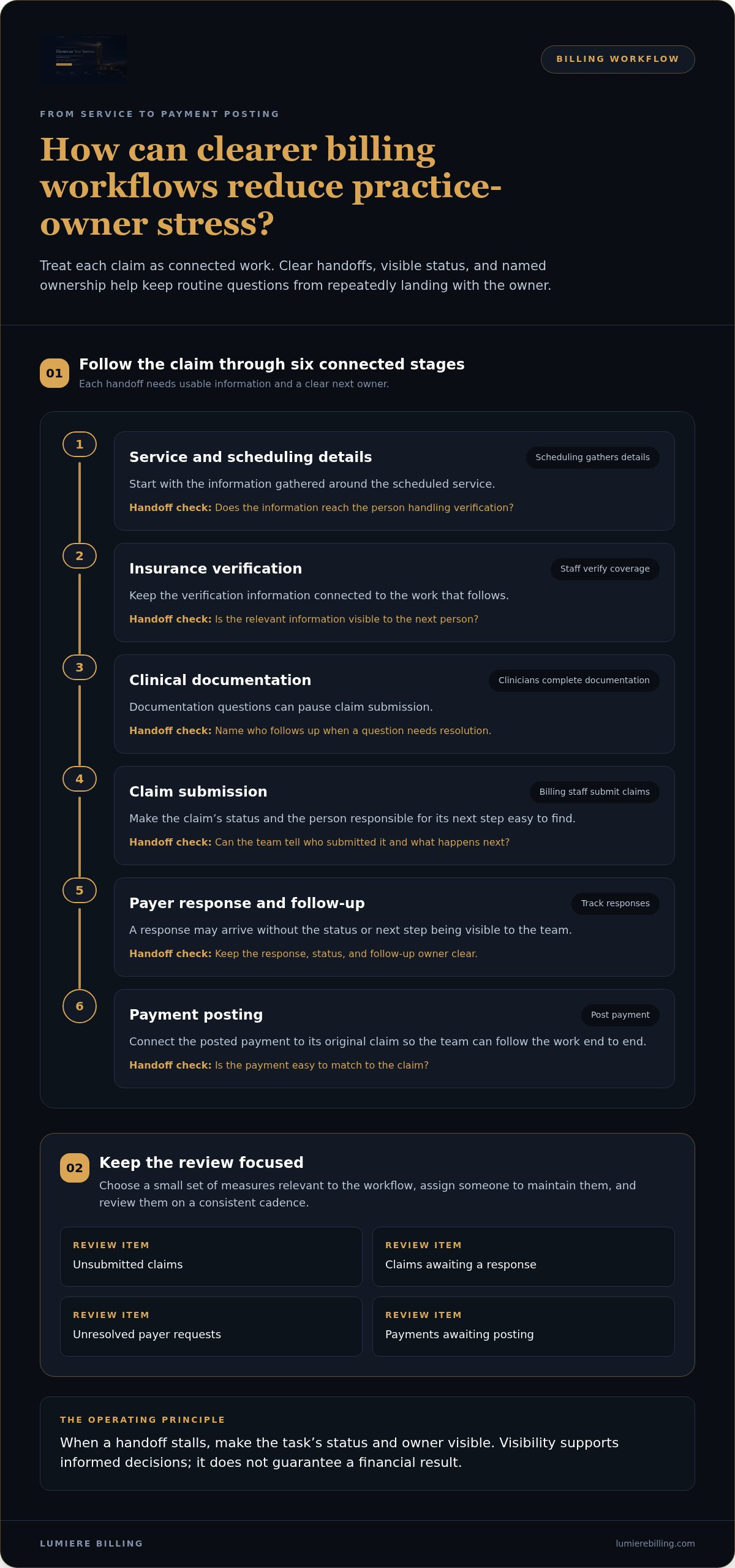
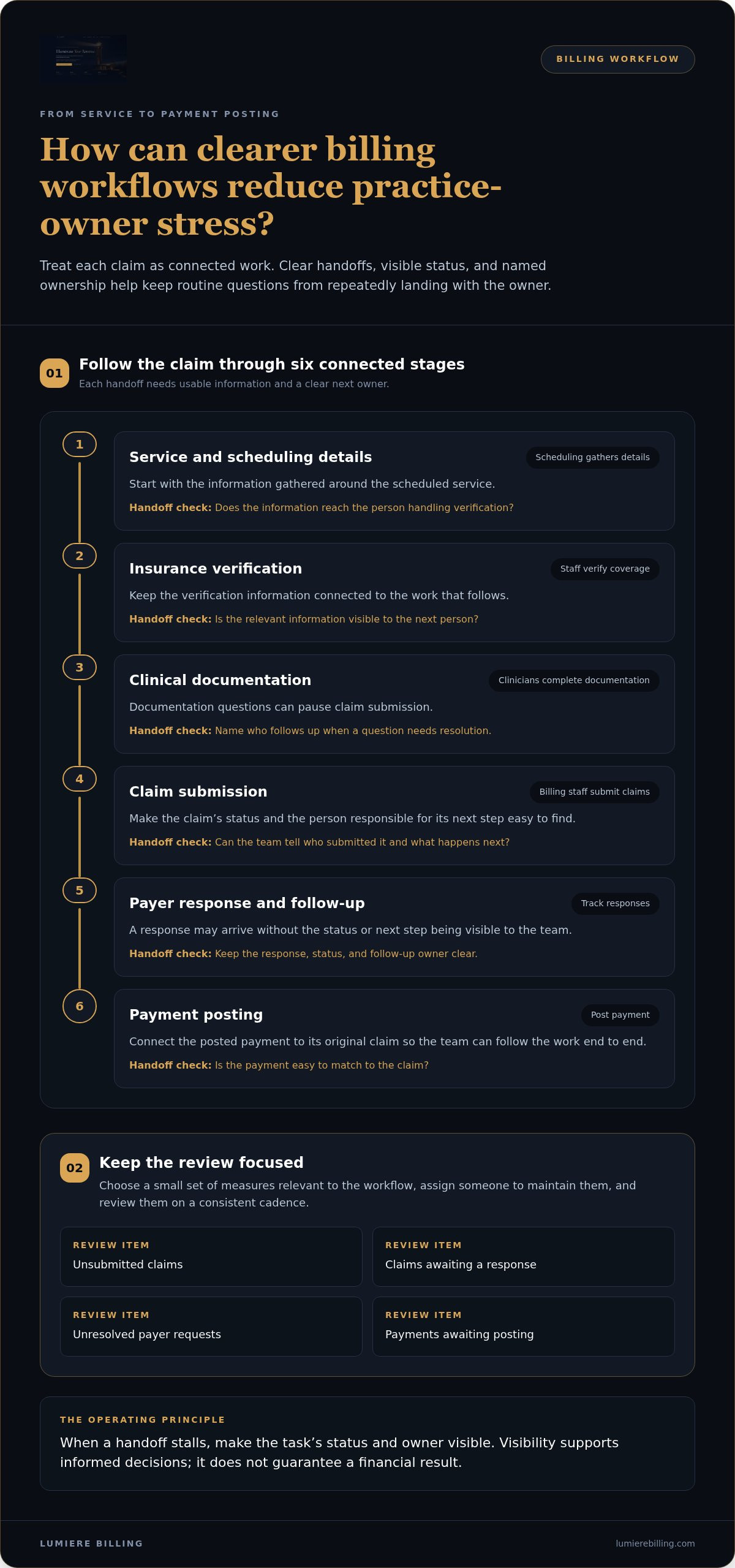
A claim-related task can pass through several hands: scheduling gathers details, staff verify coverage, clinicians complete documentation, billing staff submit claims, and someone tracks responses and posts payments. Each handoff needs clear information and ownership. If no one knows who follows up, a task may sit untouched. If two people assume the other hasn’t acted, they may duplicate the work.
- Scheduling information may not reach the person handling verification.
- A documentation question may pause claim submission without a named follow-up owner.
- A payer response may arrive, but its status or next step may not be visible to the team.
- A posted payment may not be easy to connect to the original claim.
These are hypothetical workflow examples, not evidence that every practice has the same gaps. Ask where a handoff tends to stall and whether the next person can see both the task’s status and its owner.
How can clearer billing visibility support decisions?
A regular review of claim status and accounts receivable can help distinguish items that need follow-up from those still moving through the process. Keep the review focused: choose a small set of measures relevant to your workflow, assign someone to maintain them, and use a consistent cadence. For example, a practice might review unsubmitted claims, claims awaiting a response, unresolved payer requests, and payments awaiting posting. The goal is a usable view, not a dashboard full of numbers.
When a measure changes, ask what action it points to. A growing queue of claims awaiting follow-up may call for clearer task ownership; repeated delays at verification may call for attention earlier in the workflow. The behavioral health revenue cycle management guide explains how these steps connect. Lumiere Billing manages behavioral health billing workflows, from insurance verification to payment posting, and can take on defined billing tasks so owners have more time for practice leadership. Learn about behavioral health billing support.
Do self-care and better systems address the same kind of stress?
They address different parts of the problem. Rest, time away from work, and supportive routines can help you recover from demanding responsibilities. But if the same task keeps interrupting your day or following you home, recovery alone won’t change the process creating the pressure. Mental health practice owner stress may call for personal recovery, operational adjustments, or both.
Recovery helps restore your capacity; a better process addresses a repeated source of pressure. Neither replaces the other. Longer hours and constant availability can seem like the only way to keep everything moving, but they can also make you the default point of contact for every decision. Clearer boundaries and task ownership offer another way to keep work visible without requiring you to stay perpetually on call.
Personal recovery habits
- Taking breaks and protecting time away from work.
- Building transitions between clinical, administrative, and personal responsibilities.
- Noticing when you need support or time to reset.
Workflow improvements
- Assigning an owner and next step to recurring tasks.
- Setting protected blocks for administrative work.
- Creating a consistent way to record status and follow-up.
What can boundaries change, and what can they not change?
Protected administrative blocks can reduce constant task-switching, while defined availability clarifies when routine questions should reach you. A short transition between clinical work and business responsibilities can also help you shift attention deliberately. These boundaries are easier to maintain when each task has a clear owner and escalation path. They won’t remove staffing, financial, or clinical pressures, but they can make responsibilities and response expectations more visible.
When does a recurring task need a better process?
Repeated rework, unclear handoffs, and follow-up that regularly becomes overdue are signals to examine the workflow, not simply add more effort. Trace one task from start to finish: who begins it, what information moves with it, where it waits, and who takes the next action. Start with one process before changing several systems. If billing rework is the recurring example, this overview of behavioral health billing errors can help you spot where the process may need closer attention.
For a hypothetical example, imagine a routine billing question returning to the owner because no one is sure who should resolve it. A boundary that says “send this to me less often” won’t settle the ownership gap. Mapping the task can show where responsibility becomes unclear and help the practice define a repeatable next step. Lumiere Billing provides behavioral health revenue cycle support for defined billing workflows, giving owners more room for clinical leadership while they retain practice oversight. Learn about behavioral health billing support.
How can you reduce practice-owner stress with a weekly plan?
A useful weekly plan doesn’t try to solve every operational problem at once. It creates a reliable moment to see what’s building, choose one manageable change, and decide who will carry it forward. That rhythm can make mental health practice owner stress easier to address through deliberate action rather than constant reaction.
Capture the pressure, choose one bottleneck, assign ownership, and review what changed. Keep the first adjustment small enough to test during a normal workweek. For example, clarify who tracks one category of billing follow-up before revising multiple workflows or adding new tools.
- Capture: Write down open operational tasks, recurring interruptions, upcoming deadlines, and unresolved billing follow-up.
- Choose: Select one priority by weighing urgency, impact, and whether you can act on it now.
- Assign: Name the responsible person, the next action, and when the task should be completed or reviewed.
- Test: Try one specific change in the existing workflow, such as setting a regular time to review outstanding follow-up.
- Review: At the next check-in, note what moved, what stalled, and whether the adjustment needs refinement.
What should a short weekly operations review include?
Keep the review focused on open tasks, approaching deadlines, and unresolved billing items. Choose a priority based on what needs attention, what could have the greatest operational impact, and where you can make a useful decision. Record the owner and next review point for each action. A short, consistent review can bring scattered work into view without turning the meeting into a second full-time job.
How can you delegate without losing visibility?
Before handing off a task, document what needs to happen, the expected completion point, and when an issue should be escalated. Agree on one consistent check-in so staff can report progress without repeated interruptions. Review exceptions and patterns, not every routine step. If a task repeatedly returns incomplete, clarify the instructions or handoff before assuming that more owner oversight is the answer.
Protect time for three distinct responsibilities: clinical leadership, administration, and personal recovery. Put those blocks on the calendar as real commitments, while recognizing that urgent clinical or staffing needs may still require attention. The plan is a guide for allocating focus, not a promise that every week will run perfectly. In a hypothetical practice, the owner might assign one recurring follow-up task to a clear owner, then use the next review to see whether the handoff is working.
If billing visibility is the bottleneck, Lumiere Billing’s free billing audit can help examine where the revenue-cycle workflow needs attention.
How can specialized billing support help a mental health practice owner?
When recurring billing work competes with clinical leadership, specialized support can give defined parts of the revenue cycle a clear owner. The practice owner still sets priorities, oversees operations, and makes decisions; a specialist can handle agreed-upon billing tasks. This can reduce administrative demands and improve visibility into workflow status, but it doesn’t guarantee a particular financial result or remove every source of mental health practice owner stress.
Lumiere Billing specializes in revenue cycle management for behavioral health providers. Its services include insurance verification, prior authorization, claims submission, denial prevention, and analytics. The focus is revenue-cycle operations, not proprietary EHR software. Start by identifying where work is stalling and which tasks you want managed.
Which recurring billing tasks could be handled by a specialist?
Start with the work that repeatedly returns to the owner or interrupts other responsibilities. Lumiere Billing can manage defined tasks such as:
- Verifying insurance information and coordinating prior authorization workflows.
- Preparing and submitting claims, then tracking follow-up.
- Supporting denial prevention by examining recurring process issues.
- Using analytics to make workflow activity and outstanding items easier to review.
Analytics can help owners see patterns and focus management attention. Credentialing and practice advisory services can also address enrollment or broader operational questions. Define who handles each task and what information remains visible to the owner.
What is a practical next step for examining billing strain?
Before changing the workflow, make a short inventory of unresolved claims, repeated rework, and unclear handoffs. Note where each item stands, who currently owns it, and what next action is missing. This gives a billing review something concrete to examine and helps distinguish a defined operational need from a general feeling that “billing is taking too much time.”
A focused review of billing workflows can identify areas for closer attention. It can bring the process into focus, while decisions about practice operations remain with you. A typical practice might use its list of unresolved items to guide that review, without assuming every issue has the same cause or solution.
To examine your billing workflow, explore behavioral health revenue-cycle support.
Make room for the work only you can do
You don’t need to redesign your entire practice to begin easing mental health practice owner stress. Choose one recurring pressure to address next: clarify who owns a task, set a time to review it, or identify where a billing workflow needs a closer look. A small, deliberate change gives you a clearer basis for deciding what to adjust next.
Some operational demands are easier to manage with specialized support. Lumiere Billing focuses exclusively on behavioral health provider revenue cycle management, with related services in credentialing, analytics, and practice advisory. This support can organize defined back-office responsibilities while you retain oversight of your practice. It’s a practical option when billing administration is taking attention away from clinical leadership.
To examine your billing workflows, request a free billing audit. Start with one pressure point, take the next manageable step, and give yourself room to lead with greater clarity.
Frequently Asked Questions
Can running a mental health practice contribute to burnout?
Yes, sustained demands from clinical care and business responsibilities can contribute to feeling depleted, especially when recovery time is repeatedly displaced. That doesn’t mean every stressful stretch is burnout, or that this article can diagnose what you’re experiencing. Pay attention to whether exhaustion or reduced capacity persists and affects your daily life. If you’re concerned about your wellbeing, consider discussing it with a qualified health professional.
How can I tell whether billing is contributing to my practice stress?
Look for concrete signs that billing tasks are taking attention away from other responsibilities: time spent investigating the same unresolved item, repeated corrections before a claim can move forward, or difficulty explaining the status of outstanding work. For a short period, note how often billing interrupts your day and what triggered each interruption. If a recurring billing issue is a major source of pressure, examining its pattern can clarify whether it needs process changes or additional support.
What happens if I keep handling every practice task myself?
If every decision and follow-up depends on you, routine work can become a bottleneck. Staff may wait for your approval, and your attention may be divided between immediate questions and longer-term leadership needs. The practice can also become more dependent on your availability to keep tasks moving. Start by identifying one low-risk, repeatable responsibility that someone else could own, then define which decisions still need your review.
Can outsourcing billing reduce mental health practice owner stress?
It can reduce the amount of billing administration you personally manage, but the effect depends on the tasks assigned and how responsibilities are coordinated. Before delegating, clarify what the billing specialist handles, what information you’ll receive, and which exceptions require your decision. You remain responsible for practice oversight. Outsourcing can support clearer operations, but it can’t guarantee financial results or resolve every source of stress.
How often should a mental health practice owner review operational stressors?
A brief weekly check can help surface emerging issues, while a more detailed monthly review may reveal patterns that are easy to miss in the daily flow. Consider reviewing outstanding decisions, recurring interruptions, and responsibilities that repeatedly return to you. Add a focused review after a staffing change or workflow adjustment, when ownership or handoffs may need clarification. Choose a cadence you can maintain consistently.
Is self-care enough to manage stress as a practice owner?
Self-care can support your wellbeing, but it may not change an operational problem that keeps recurring. For example, time away can provide recovery, yet a task with no clear owner may still be waiting when you return. Use both approaches: protect personal time and identify repeated work that needs clearer instructions, ownership, or follow-up. If stress persists or affects your health, seek appropriate professional support.
Frequently Asked Questions
For a clearer picture, sort the demands competing for your attention into four areas. Then note which ones interrupt focused clinical or leadership time: Mark each item as urgent, scheduled, or repeatable. An urgent issue may need your attention now. A task that returns every week may need a reliable time slot, a clear owner, or a documented process instead.
A demanding week may be temporary. Look for repetition: administration routinely carrying into evenings, familiar issues resurfacing without a clear next step, or decisions piling up because everyone waits for your input. Notice whether concentration, decision-making, or your ability to disconnect changes during these periods. These observations are useful signals about workload design, not a diagnosis. To distinguish a short surge from recurring operational pressure, track what remains unfinished and why. For a typical practice, a hypothetical review might show that one payer follow-up task appears on the owner’s list every week, while an unexpected staffing issue happened only once. The repeated task points to a workflow to examine; the isolated disruption may need only a one-time response. Keep the review factual. For a week, jot down each interruption, its category, whether it was genuinely time-sensitive, and whether it has happened before. Look for clusters: the same question reaching you from different people, routine work with no assigned owner, or financial information that takes several steps to piece together. This makes mental health practice owner stress easier to assess operationally. This article offers business guidance, not a clinical assessment. If distress is affecting your wellbeing, consider seeking appropriate professional support. Billing pressure often comes from the work around a claim as much as from the claim itself. Staff may need to confirm that information was verified, find out who submitted a claim, follow up on its status, or determine whether a payment was posted. If each answer requires searching separate records or asking several people, small questions repeatedly pull the owner away from other responsibilities. Financial uncertainty can add to the strain, though it isn’t the explanation for every owner’s stress. Revenue cycle management is the connected work that follows a service from insurance verification through claim submission, follow-up, and payment posting. Treating those steps as one process helps reveal where information or responsibility gets lost. Visibility doesn’t guarantee a particular financial result, but it can help owners make more informed decisions about what needs attention.
A claim-related task can pass through several hands: scheduling gathers details, staff verify coverage, clinicians complete documentation, billing staff submit claims, and someone tracks responses and posts payments. Each handoff needs clear information and ownership. If no one knows who follows up, a task may sit untouched. If two people assume the other hasn’t acted, they may duplicate the work. These are hypothetical workflow examples, not evidence that every practice has the same gaps. Ask where a handoff tends to stall and whether the next person can see both the task’s status and its owner.
A regular review of claim status and accounts receivable can help distinguish items that need follow-up from those still moving through the process. Keep the review focused: choose a small set of measures relevant to your workflow, assign someone to maintain them, and use a consistent cadence. For example, a practice might review unsubmitted claims, claims awaiting a response, unresolved payer requests, and payments awaiting posting. The goal is a usable view, not a dashboard full of numbers. When a measure changes, ask what action it points to. A growing queue of claims awaiting follow-up may call for clearer task ownership; repeated delays at verification may call for attention earlier in the workflow. The behavioral health revenue cycle management guide explains how these steps connect. Lumiere Billing manages behavioral health billing workflows, from insurance verification to payment posting, and can take on defined billing tasks so owners have more time for practice leadership. Learn about behavioral health billing support. They address different parts of the problem. Rest, time away from work, and supportive routines can help you recover from demanding responsibilities. But if the same task keeps interrupting your day or following you home, recovery alone won’t change the process creating the pressure. Mental health practice owner stress may call for personal recovery, operational adjustments, or both. Recovery helps restore your capacity; a better process addresses a repeated source of pressure. Neither replaces the other. Longer hours and constant availability can seem like the only way to keep everything moving, but they can also make you the default point of contact for every decision. Clearer boundaries and task ownership offer another way to keep work visible without requiring you to stay perpetually on call. Personal recovery habits Workflow improvements
Protected administrative blocks can reduce constant task-switching, while defined availability clarifies when routine questions should reach you. A short transition between clinical work and business responsibilities can also help you shift attention deliberately. These boundaries are easier to maintain when each task has a clear owner and escalation path. They won’t remove staffing, financial, or clinical pressures, but they can make responsibilities and response expectations more visible.
Repeated rework, unclear handoffs, and follow-up that regularly becomes overdue are signals to examine the workflow, not simply add more effort. Trace one task from start to finish: who begins it, what information moves with it, where it waits, and who takes the next action. Start with one process before changing several systems. If billing rework is the recurring example, this overview of behavioral health billing errors can help you spot where the process may need closer attention. For a hypothetical example, imagine a routine billing question returning to the owner because no one is sure who should resolve it. A boundary that says “send this to me less often” won’t settle the ownership gap. Mapping the task can show where responsibility becomes unclear and help the practice define a repeatable next step. Lumiere Billing provides behavioral health revenue cycle support for defined billing workflows, giving owners more room for clinical leadership while they retain practice oversight. Learn about behavioral health billing support. A useful weekly plan doesn’t try to solve every operational problem at once. It creates a reliable moment to see what’s building, choose one manageable change, and decide who will carry it forward. That rhythm can make mental health practice owner stress easier to address through deliberate action rather than constant reaction. Capture the pressure, choose one bottleneck, assign ownership, and review what changed. Keep the first adjustment small enough to test during a normal workweek. For example, clarify who tracks one category of billing follow-up before revising multiple workflows or adding new tools.
Keep the review focused on open tasks, approaching deadlines, and unresolved billing items. Choose a priority based on what needs attention, what could have the greatest operational impact, and where you can make a useful decision. Record the owner and next review point for each action. A short, consistent review can bring scattered work into view without turning the meeting into a second full-time job.
Before handing off a task, document what needs to happen, the expected completion point, and when an issue should be escalated. Agree on one consistent check-in so staff can report progress without repeated interruptions. Review exceptions and patterns, not every routine step. If a task repeatedly returns incomplete, clarify the instructions or handoff before assuming that more owner oversight is the answer. Protect time for three distinct responsibilities: clinical leadership, administration, and personal recovery. Put those blocks on the calendar as real commitments, while recognizing that urgent clinical or staffing needs may still require attention. The plan is a guide for allocating focus, not a promise that every week will run perfectly. In a hypothetical practice, the owner might assign one recurring follow-up task to a clear owner, then use the next review to see whether the handoff is working. If billing visibility is the bottleneck, Lumiere Billing’s free billing audit can help examine where the revenue-cycle workflow needs attention. When recurring billing work competes with clinical leadership, specialized support can give defined parts of the revenue cycle a clear owner. The practice owner still sets priorities, oversees operations, and makes decisions; a specialist can handle agreed-upon billing tasks. This can reduce administrative demands and improve visibility into workflow status, but it doesn’t guarantee a particular financial result or remove every source of mental health practice owner stress. Lumiere Billing specializes in revenue cycle management for behavioral health providers. Its services include insurance verification, prior authorization, claims submission, denial prevention, and analytics. The focus is revenue-cycle operations, not proprietary EHR software. Start by identifying where work is stalling and which tasks you want managed.
Start with the work that repeatedly returns to the owner or interrupts other responsibilities. Lumiere Billing can manage defined tasks such as: Analytics can help owners see patterns and focus management attention. Credentialing and practice advisory services can also address enrollment or broader operational questions. Define who handles each task and what information remains visible to the owner.
Before changing the workflow, make a short inventory of unresolved claims, repeated rework, and unclear handoffs. Note where each item stands, who currently owns it, and what next action is missing. This gives a billing review something concrete to examine and helps distinguish a defined operational need from a general feeling that “billing is taking too much time.” A focused review of billing workflows can identify areas for closer attention. It can bring the process into focus, while decisions about practice operations remain with you. A typical practice might use its list of unresolved items to guide that review, without assuming every issue has the same cause or solution. To examine your billing workflow, explore behavioral health revenue-cycle support. You don’t need to redesign your entire practice to begin easing mental health practice owner stress. Choose one recurring pressure to address next: clarify who owns a task, set a time to review it, or identify where a billing workflow needs a closer look. A small, deliberate change gives you a clearer basis for deciding what to adjust next. Some operational demands are easier to manage with specialized support. Lumiere Billing focuses exclusively on behavioral health provider revenue cycle management, with related services in credentialing, analytics, and practice advisory. This support can organize defined back-office responsibilities while you retain oversight of your practice. It’s a practical option when billing administration is taking attention away from clinical leadership. To examine your billing workflows, request a free billing audit. Start with one pressure point, take the next manageable step, and give yourself room to lead with greater clarity.
Yes, sustained demands from clinical care and business responsibilities can contribute to feeling depleted, especially when recovery time is repeatedly displaced. That doesn’t mean every stressful stretch is burnout, or that this article can diagnose what you’re experiencing. Pay attention to whether exhaustion or reduced capacity persists and affects your daily life. If you’re concerned about your wellbeing, consider discussing it with a qualified health professional.
Look for concrete signs that billing tasks are taking attention away from other responsibilities: time spent investigating the same unresolved item, repeated corrections before a claim can move forward, or difficulty explaining the status of outstanding work. For a short period, note how often billing interrupts your day and what triggered each interruption. If a recurring billing issue is a major source of pressure, examining its pattern can clarify whether it needs process changes or additional support.
If every decision and follow-up depends on you, routine work can become a bottleneck. Staff may wait for your approval, and your attention may be divided between immediate questions and longer-term leadership needs. The practice can also become more dependent on your availability to keep tasks moving. Start by identifying one low-risk, repeatable responsibility that someone else could own, then define which decisions still need your review.
It can reduce the amount of billing administration you personally manage, but the effect depends on the tasks assigned and how responsibilities are coordinated. Before delegating, clarify what the billing specialist handles, what information you’ll receive, and which exceptions require your decision. You remain responsible for practice oversight. Outsourcing can support clearer operations, but it can’t guarantee financial results or resolve every source of stress.
A brief weekly check can help surface emerging issues, while a more detailed monthly review may reveal patterns that are easy to miss in the daily flow. Consider reviewing outstanding decisions, recurring interruptions, and responsibilities that repeatedly return to you. Add a focused review after a staffing change or workflow adjustment, when ownership or handoffs may need clarification. Choose a cadence you can maintain consistently.
Self-care can support your wellbeing, but it may not change an operational problem that keeps recurring. For example, time away can provide recovery, yet a task with no clear owner may still be waiting when you return. Use both approaches: protect personal time and identify repeated work that needs clearer instructions, ownership, or follow-up. If stress persists or affects your health, seek appropriate professional support.
Free billing audit
Find out what your billing is really costing you
We'll review your claims, denials and collections and show you exactly where revenue is leaking. Free, no obligation, no contract.
Schedule a Free Billing Audit