Expert Behavioral Health Billing Assistance: What Practices Should Expect

A claim rarely fails at just one point. An outdated eligibility detail, an authorization gap, or a delayed follow-up can leave revenue unresolved and staff chasing answers. Expert behavioral health billing assistance connects those steps, making each claim’s path more visible and accountable.
That matters when billing competes with patient care and practice operations. Insurance requirements, authorizations, claim submission, denial follow-up, and payment tracking are linked tasks. A gap early in the process can create extra work later. Without clear reporting, it’s harder to see what’s unresolved, what action is needed, and who is responsible for moving it forward.
This article explains what specialist billing support can cover, how to assess its effectiveness, and what communication, reporting, and follow-through a practice should expect. You’ll also see how a focused partner can work as an extension of your team, connecting front-end checks with claims, denials, and revenue visibility. The goal isn’t simply to process paperwork. It’s to bring the full revenue cycle into focus so your practice can make informed decisions and keep attention where it belongs: on patient care.
Key Takeaways
- Expert behavioral health billing assistance should coordinate the full billing cycle, not stop at submitting claims.
- Eligibility checks, authorization, claims, and payment posting depend on connected information. Accurate intake can help prevent downstream issues.
- Assess billing support by its specialty focus, workflow scope, communication, reporting, and clear ownership of open items.
- Prepare for a smoother handoff by organizing payer information, current workflows, unresolved billing questions, and practice contacts.
- Lumiere Billing connects behavioral-health-focused revenue cycle support across verification, authorization, claims, denial prevention, and analytics.
What expert behavioral health billing assistance should cover
Expert behavioral health billing assistance is coordinated revenue cycle support tailored to behavioral health practices. It connects insurance checks, authorization tracking, claim submission, payment posting, follow-up, denial prevention, and reporting. It’s more than sending claims. Each step should inform the next, so the practice can see what needs attention and where an issue began.
This work sits within the broader revenue cycle management process, which follows the financial side of care from appointment through payment. The goal is to connect billing operations with the services clinicians provide, rather than treat claims as isolated paperwork. Billing assistance also differs from general medical billing, which may not be tailored to behavioral health workflows, and from patient resource directories, which help people find community support rather than manage provider claims.
Which billing responsibilities can a specialist support?
Specialist support can begin before a session. Insurance verification helps clarify coverage details and identify information that may need attention. Prior authorization workflows track whether a payer requires approval for a service and whether the relevant approval details are on hand. These front-end checks give the practice a chance to address discrepancies before a claim is prepared.
After care is delivered, billing support can submit claims, post payments by recording how the payer adjudicated them, and follow up on unpaid or underpaid claims. Denial prevention and analytics add ongoing oversight. Teams can review recurring issues, identify where a process needs attention, and track whether corrections are reflected in later claims.
Why behavioral health billing requires specialty focus
Behavioral health claims depend on payer-specific requirements and documentation that align with the service provided. A mismatch between information gathered at intake, authorization details, and the claim can create extra work or delay resolution. Specialist workflows keep those details connected rather than relying on separate handoffs without a clear owner.
Coordination matters, too. Administrative processes should support clinical operations without adding avoidable interruptions for clinicians. For example, a billing team needs a clear process for routing documentation questions to the right practice contact, while keeping claim status and follow-up visible to the people responsible for next steps.
That’s the distinction to look for: not simply whether claims go out, but whether the practice can trace the work from coverage checks through payment and see what remains unresolved. Focused behavioral health support brings those moving parts into one accountable process.
How expert billing assistance connects each stage of the revenue cycle
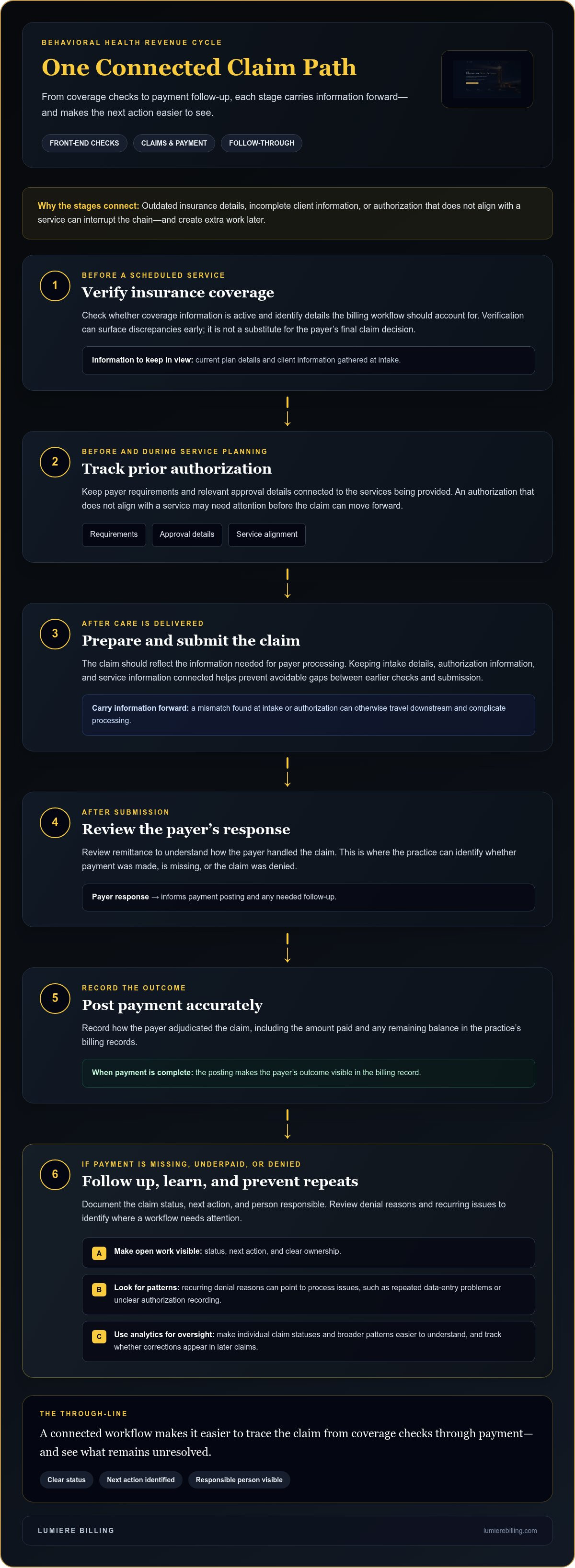
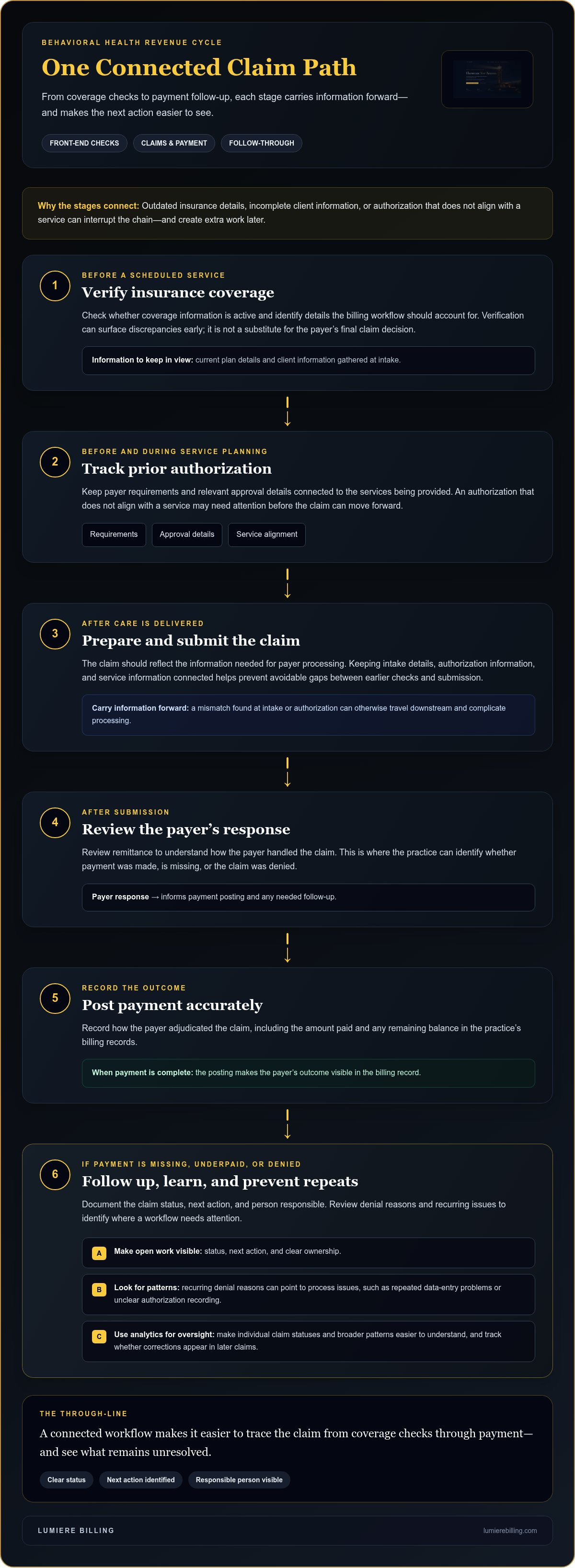
A behavioral health claim follows a sequence: confirm coverage, track any required authorization, prepare and submit the claim, review the payer’s response, and post the payment accurately. Each step depends on information gathered earlier. If a client’s insurance details are outdated or service information doesn’t match the authorization, the issue can travel downstream and complicate processing.
That’s why expert behavioral health billing assistance treats the workflow as connected, not as a set of disconnected tasks. For a broader overview of how these stages fit together, see this behavioral health revenue cycle management guide.
Front-end checks: verification and prior authorization
Before a scheduled service, insurance verification can clarify whether coverage information is active and what details the practice should account for in its billing workflow. It isn’t a substitute for the payer’s final claim decision, but it can surface discrepancies early. Authorization tracking is also ongoing: staff need to keep relevant requirements and approval details connected to the services being provided.
Missing or outdated information can interrupt the chain. A changed plan, incomplete client details, or an authorization that doesn’t align with the service may require correction before a claim can move forward. Clear intake processes help capture and route those details before they become back-end follow-up work.
Back-end oversight: claims, denials, and payment posting
Once a service is delivered, the claim should reflect the information needed for payer processing. After submission, remittance review shows how the payer handled the claim. Accurate payment posting records the amount paid and any remaining balance in the practice’s billing records. If payment is missing or the claim is denied, follow-up should document the status, next action, and person responsible.
Denials are not only items to resolve one by one. Reviewing their reasons can reveal recurring workflow issues and help teams prioritize prevention, such as correcting a repeated data-entry problem or clarifying how authorization details are recorded. Analytics should make individual claim statuses and broader patterns easier to understand, not bury them in reports that leave staff guessing.
For practices reviewing how these steps work together, Lumiere Billing’s behavioral health revenue cycle support connects verification, authorization, claims, denial prevention, and analytics.
How to assess billing expertise, visibility, and accountability
Strong billing support makes the work easier to see and follow. A practice should be able to understand what’s being handled, what needs its attention, and who owns the next step. Use this framework to assess whether a partner offers specialized, accountable support rather than claim processing without clear oversight.
| Area to assess | What effective support looks like |
|---|---|
| Specialty focus | Understands behavioral health workflows and payer-facing requirements, not just general billing processes. |
| Workflow scope | Addresses prevention, submission, payment review, denial resolution, and ongoing follow-up. |
| Communication | Shares understandable updates and provides a clear path for questions or escalations. |
| Reporting | Shows claim status, outstanding work, follow-up actions, and useful patterns. |
| Ownership | Makes clear who is responsible for each open item and what happens next. |
What signals genuine behavioral health billing expertise?
Look for familiarity with behavioral health workflows and the administrative tasks that support them. Broad healthcare experience alone doesn’t establish specialty expertise. A stronger signal is a connected approach that addresses issues before submission and follows through when a claim needs attention. Submission should be one step in the process, not the finish line.
Process risks can be subtle. This guide to behavioral health billing errors to avoid offers examples of gaps practices can watch for.
What reporting and communication should practices expect?
Useful reporting should answer practical questions: Which claims remain unresolved? What follow-up has occurred? Is an action needed from the practice, and who is handling it? Claim-level updates make ownership visible, while regular summaries help leaders see outstanding work without monitoring every task.
Escalation paths matter when an issue needs clinical or administrative input. The billing team should identify the question, direct it to the appropriate practice contact, and record the next step. Reports should support decisions, not simply present a large volume of metrics without context. That’s how expert behavioral health billing assistance can keep leaders informed without turning oversight into micromanagement.
Practices seeking a clearer view of their current workflows can explore Lumiere Billing’s behavioral health billing support.
How a practice can prepare for expert billing support
A smoother handoff starts with a clear picture of how billing work moves through your practice today. You don’t need to redesign every workflow first. Gather the information that shows what’s working, where questions recur, and which claims still need attention. Accurate records and named practice contacts help a billing partner understand the current process and route questions without unnecessary interruptions.
Before work begins, agree on what updates your team needs, how often they should arrive, and which communication channels to use. This gives staff visibility while allowing operational tasks to be delegated. Expert behavioral health billing assistance works best when both sides understand their responsibilities and know how to move an issue forward.
What practice information helps clarify the billing picture?
Organize payer details, provider information, workflow notes, and available claim-status records. Flag recurring denials, authorization questions, and unresolved balances so they can be reviewed as patterns, not just isolated items. Note where information is gathered and who currently handles each step. Keep patient-identifiable information out of public examples, and use appropriate secure processes for sharing practice records.
How to make the working relationship clear
Define who handles routine billing tasks, who answers practice-specific questions, how urgent issues are escalated, and what reporting cadence leaders can use. Agree on claim-level status updates and summaries of outstanding work. Clear boundaries let staff stay informed without duplicating follow-up or micromanaging each task.
A practical preparation sequence can keep the handoff focused:
- Map the workflow. Note how information moves from intake through billing and payment review.
- Gather open questions. List unresolved claims, recurring process concerns, and payer or authorization issues for review.
- Name key contacts. Identify the practice contacts for billing questions, operational decisions, and escalations.
- Set visibility expectations. Decide which claim details and summary trends will help your team make decisions.
A billing audit can help surface workflow gaps and organize questions before next steps are set. Lumiere Billing offers a free billing audit to examine billing workflows and bring areas for review into focus.
How Lumiere Billing provides specialist behavioral health billing assistance
Lumiere Billing focuses exclusively on revenue cycle management for behavioral health providers. That specialty focus shapes how the work is organized: front-end insurance details, payer requirements, claims, follow-up, and revenue visibility are treated as connected parts of the practice’s billing operation. The team works as an extension of the practice, supporting its administrative workflows so clinicians can keep their attention on patient care.
This is expert behavioral health billing assistance built around behavioral health operations, not a general billing model applied without context. Support spans insurance verification, prior authorization, claims submission, denial prevention, and analytics. The aim is to give practices a clearer view of what’s moving, what needs attention, and where an operational question may be affecting the revenue cycle.
What Lumiere Billing brings into the workflow
At the front end, verification and authorization work connects coverage details and payer requirements to billing activity. Claims submission carries that information forward, while denial prevention and analytics provide ongoing oversight. Rather than treating each task as a separate handoff, this scope links the steps and makes outstanding work easier to track.
Credentialing and enrollment provide related support for payer participation workflows. Practice advisory offers operational guidance on billing processes and practice needs. Together, these capabilities help organize administrative responsibilities while keeping the practice’s focus on care delivery.
Explore a billing audit as a practical next step
Before changing a workflow, it helps to understand how it currently functions. A billing audit can surface questions for closer review, such as where information enters the process, how open claims are tracked, or which billing tasks may need clearer ownership. It offers a structured starting point for discussing the practice’s revenue cycle without presuming what the review will find.
For practices ready to examine their billing workflows, Lumiere Billing offers a free billing audit. It’s a practical way to bring current processes into focus and identify useful questions for the next conversation.
Bring Your Revenue Cycle Into Clearer Focus
Effective billing support is more than claim submission. It connects front-end information, payer requirements, follow-up, and reporting, with clear ownership at every stage. When practices can see what’s resolved, what remains open, and where staff input is needed, they can delegate billing work without losing oversight.
Expert behavioral health billing assistance should reflect the needs of behavioral health providers. Lumiere Billing specializes exclusively in behavioral health revenue cycle management, supporting verification, authorization, claims, denial prevention, and analytics. Its team works as an extension of the practice, helping clinicians keep more focus on patient care while billing operations stay visible.
A useful next step is to examine your current workflows and identify questions that deserve closer review. Explore Lumiere Billing’s free billing audit to start bringing those processes into focus. With a clearer view of your revenue cycle, your practice can make informed decisions and keep attention where it matters most.
Frequently Asked Questions
What does expert behavioral health billing assistance include?
Expert behavioral health billing assistance can cover connected revenue cycle tasks, from insurance verification and prior authorization through claim submission, payment posting, denial follow-up, and analytics. The scope can reflect a practice’s needs, but effective support makes responsibilities and claim status visible. It should help staff understand what’s been completed, what remains unresolved, and whether the next step belongs to the billing team or the practice.
How is behavioral health billing different from general medical billing?
Behavioral health billing requires workflows attentive to behavioral health services and the payer requirements that apply to them. Coverage checks, authorization details, service information, and supporting documentation need to align as a claim moves through the process. General healthcare billing experience alone doesn’t demonstrate that specialty knowledge. A focused billing approach connects administrative steps with behavioral health practice operations rather than applying a broad process without considering the context.
Can a billing company help prevent behavioral health claim denials?
Yes. A billing company can help reduce preventable issues by checking information before submission, tracking authorization details, reviewing claims for errors, and analyzing denial patterns. For example, repeated denials tied to missing or inconsistent information can signal a workflow that needs attention. Prevention can’t ensure every claim will be paid, since payer decisions and other factors affect outcomes, but consistent review and documented follow-up help practices respond more deliberately.
How can a practice tell whether its billing support is effective?
Effective support gives practice leaders a clear view of claim status, unresolved work, follow-up actions, and recurring issues. Updates should explain what needs attention and who owns the next step, not just present totals without context. Practices can also assess whether workflows cover prevention and resolution, not only claim submission. Clear communication and useful reporting help leaders stay informed without having to monitor every billing task themselves.
Should a behavioral health practice outsource billing or keep it in-house?
The right model depends on the practice’s staffing, workflow complexity, and need for specialty knowledge and reporting. An in-house team may offer close day-to-day coordination, while an external partner can provide focused revenue cycle support as an extension of the practice. Compare how each approach handles verification, authorizations, claims, follow-up, and visibility. The key is clear accountability, whether tasks are managed internally, externally, or across both teams.
What information should a practice prepare before getting billing assistance?
Start with payer details, provider information, workflow notes, and available claim-status records. Flag recurring denials, authorization questions, unresolved balances, and areas where staff aren’t sure who owns follow-up. Identify practice contacts for routine questions and escalations, then define the reporting and communication your team needs. Share records through appropriate secure processes, and don’t use patient-identifiable information in public examples or materials.
What is a behavioral health billing audit?
A behavioral health billing audit is a review of billing workflows and available records to identify questions or areas that may need closer examination. It can help a practice look at how information moves through verification, authorizations, claims, follow-up, and reporting. An audit doesn’t guarantee a particular finding or financial result. Lumiere Billing offers a free billing audit as a practical starting point for reviewing current billing processes.
Frequently Asked Questions
Specialist support can begin before a session. Insurance verification helps clarify coverage details and identify information that may need attention. Prior authorization workflows track whether a payer requires approval for a service and whether the relevant approval details are on hand. These front-end checks give the practice a chance to address discrepancies before a claim is prepared. After care is delivered, billing support can submit claims, post payments by recording how the payer adjudicated them, and follow up on unpaid or underpaid claims. Denial prevention and analytics add ongoing oversight. Teams can review recurring issues, identify where a process needs attention, and track whether corrections are reflected in later claims.
Look for familiarity with behavioral health workflows and the administrative tasks that support them. Broad healthcare experience alone doesn’t establish specialty expertise. A stronger signal is a connected approach that addresses issues before submission and follows through when a claim needs attention. Submission should be one step in the process, not the finish line. Process risks can be subtle. This guide to behavioral health billing errors to avoid offers examples of gaps practices can watch for.
Useful reporting should answer practical questions: Which claims remain unresolved? What follow-up has occurred? Is an action needed from the practice, and who is handling it? Claim-level updates make ownership visible, while regular summaries help leaders see outstanding work without monitoring every task. Escalation paths matter when an issue needs clinical or administrative input. The billing team should identify the question, direct it to the appropriate practice contact, and record the next step. Reports should support decisions, not simply present a large volume of metrics without context. That’s how expert behavioral health billing assistance can keep leaders informed without turning oversight into micromanagement. Practices seeking a clearer view of their current workflows can explore Lumiere Billing’s behavioral health billing support. A smoother handoff starts with a clear picture of how billing work moves through your practice today. You don’t need to redesign every workflow first. Gather the information that shows what’s working, where questions recur, and which claims still need attention. Accurate records and named practice contacts help a billing partner understand the current process and route questions without unnecessary interruptions. Before work begins, agree on what updates your team needs, how often they should arrive, and which communication channels to use. This gives staff visibility while allowing operational tasks to be delegated. Expert behavioral health billing assistance works best when both sides understand their responsibilities and know how to move an issue forward.
Organize payer details, provider information, workflow notes, and available claim-status records. Flag recurring denials, authorization questions, and unresolved balances so they can be reviewed as patterns, not just isolated items. Note where information is gathered and who currently handles each step. Keep patient-identifiable information out of public examples, and use appropriate secure processes for sharing practice records.
Expert behavioral health billing assistance can cover connected revenue cycle tasks, from insurance verification and prior authorization through claim submission, payment posting, denial follow-up, and analytics. The scope can reflect a practice’s needs, but effective support makes responsibilities and claim status visible. It should help staff understand what’s been completed, what remains unresolved, and whether the next step belongs to the billing team or the practice.
Behavioral health billing requires workflows attentive to behavioral health services and the payer requirements that apply to them. Coverage checks, authorization details, service information, and supporting documentation need to align as a claim moves through the process. General healthcare billing experience alone doesn’t demonstrate that specialty knowledge. A focused billing approach connects administrative steps with behavioral health practice operations rather than applying a broad process without considering the context.
Yes. A billing company can help reduce preventable issues by checking information before submission, tracking authorization details, reviewing claims for errors, and analyzing denial patterns. For example, repeated denials tied to missing or inconsistent information can signal a workflow that needs attention. Prevention can’t ensure every claim will be paid, since payer decisions and other factors affect outcomes, but consistent review and documented follow-up help practices respond more deliberately.
Effective support gives practice leaders a clear view of claim status, unresolved work, follow-up actions, and recurring issues. Updates should explain what needs attention and who owns the next step, not just present totals without context. Practices can also assess whether workflows cover prevention and resolution, not only claim submission. Clear communication and useful reporting help leaders stay informed without having to monitor every billing task themselves.
The right model depends on the practice’s staffing, workflow complexity, and need for specialty knowledge and reporting. An in-house team may offer close day-to-day coordination, while an external partner can provide focused revenue cycle support as an extension of the practice. Compare how each approach handles verification, authorizations, claims, follow-up, and visibility. The key is clear accountability, whether tasks are managed internally, externally, or across both teams.
Start with payer details, provider information, workflow notes, and available claim-status records. Flag recurring denials, authorization questions, unresolved balances, and areas where staff aren’t sure who owns follow-up. Identify practice contacts for routine questions and escalations, then define the reporting and communication your team needs. Share records through appropriate secure processes, and don’t use patient-identifiable information in public examples or materials.
A behavioral health billing audit is a review of billing workflows and available records to identify questions or areas that may need closer examination. It can help a practice look at how information moves through verification, authorizations, claims, follow-up, and reporting. An audit doesn’t guarantee a particular finding or financial result. Lumiere Billing offers a free billing audit as a practical starting point for reviewing current billing processes.
Free billing audit
Find out what your billing is really costing you
We'll review your claims, denials and collections and show you exactly where revenue is leaking. Free, no obligation, no contract.
Schedule a Free Billing Audit