Effective Behavioral Health Billing Strategies: A 2026 Practice Guide

Billing problems rarely begin at the claim. They often start earlier, when intake, authorization, documentation, and follow-up operate as disconnected tasks. Effective behavioral health billing strategies connect these steps into one coordinated process, helping practices improve collections while keeping clinicians focused on patient care.
If preventable claim issues keep delaying reimbursement, look beyond quick fixes. Unclear ownership and limited visibility make it difficult to see where claims stall or revenue slips away. A repeatable workflow can catch gaps earlier and give your team clearer priorities.
This 2026 practice guide explains how to strengthen front-end accuracy, organize claims and denial follow-up, and use performance data to guide billing work. It also covers when specialist revenue cycle support can extend your team’s capacity, giving clinicians more time for care and practice leaders a clearer view of financial operations.
Key Takeaways
- Map the billing journey from intake through payment follow-up to spot handoff gaps before they cause recurring rework.
- Assign administrative, clinical, and billing responsibilities clearly, without making clinicians responsible for billing operations.
- Use effective behavioral health billing strategies to organize claims, denials, aging receivables, and unresolved exceptions into a practical scorecard.
- Establish practice-specific performance baselines before setting targets, then use data patterns to choose the next improvement.
- Connect workflow reviews with specialist revenue cycle support to strengthen oversight and protect more time for patient care.
Effective behavioral health billing strategies start with finding workflow gaps
A claim that needs correction is a visible problem, but its cause may be less obvious. A payer detail might not have been confirmed at intake, an authorization update may not have reached the billing team, or no one may own follow-up after submission. Small handoff failures can compound into delays, duplicate work, and balances that remain unresolved.
Effective behavioral health billing strategies treat billing as a connected operating process, not a series of isolated claim fixes. Correcting one claim addresses that instance. Adding a preventive control can help the team catch the same type of issue earlier. The goal is better financial visibility, not more administrative work for clinicians.
Where behavioral health billing workflows commonly lose visibility
Trace a claim from scheduling and intake through documentation, submission, payment posting, and follow-up. At each handoff, ask what information moves forward, who checks it, and where exceptions are recorded. For example, when a claim is returned for missing information, the workflow should identify who gathers the correction, who resubmits the claim, and who confirms the outcome.
Visibility often breaks when responsibility is assumed rather than assigned. A clinician may need to clarify a documentation detail, while an administrative or billing team member owns payer follow-up. Connect those roles without making clinical staff responsible for running claims operations. A foundational overview of the behavioral health billing workflow can help frame the revenue cycle, but each practice should examine its own handoffs and identify where information or ownership gets lost.
Look for patterns before deciding on a cause. Similar delays can stem from different points in the process, while repeated issues may point to a control that needs attention. Review exceptions by stage, type, and owner to distinguish a one-time correction from a recurring workflow gap.
What a connected billing strategy should accomplish
A connected strategy carries accurate patient and payer information into claim preparation, then follows each claim through payment posting and resolution. It makes exceptions visible, assigns an owner, and records follow-up outcomes so unresolved work does not disappear between teams.
An effective behavioral health billing strategy is a repeatable set of controls linking intake, documentation, claims, payment, and follow-up, with clear ownership at each handoff. In practice, that means fixing the immediate issue and asking what routine check could prevent it from happening again. Defined administrative and revenue cycle processes let clinicians focus on care while practice leaders see where work is stalling.
Build a behavioral health billing workflow that prevents avoidable rework
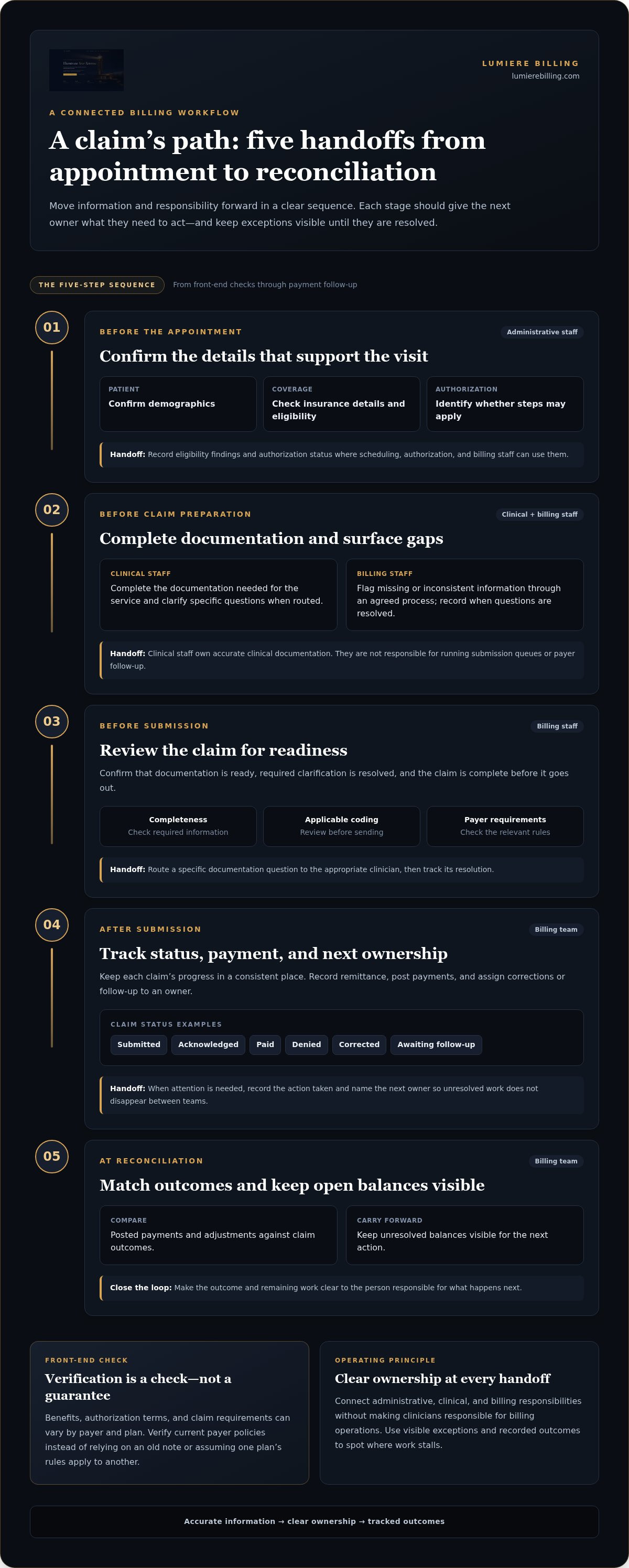
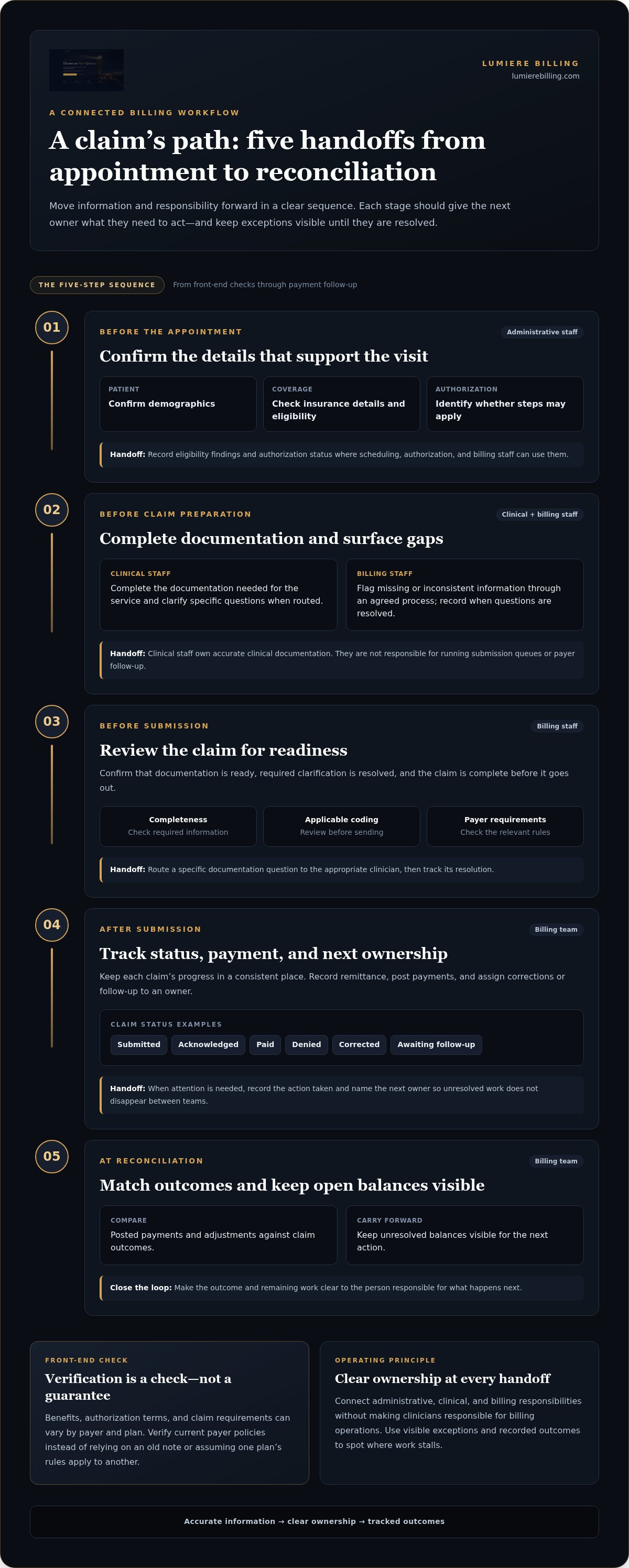
A reliable workflow moves information and responsibility forward in a defined order. Each step should give the next person what they need to act, rather than leaving them to reconstruct what happened. Effective behavioral health billing strategies account for handoffs from appointment setup through payment reconciliation while keeping clinical work distinct from billing operations.
A practical sequence looks like this:
- Before the appointment: Administrative staff confirm demographic and insurance details, check eligibility, and identify whether authorization steps may apply.
- Before claim preparation: Clinical staff complete the documentation needed for the service. Billing staff flag missing or inconsistent information through an agreed process.
- Before submission: Billing staff review the claim for completeness, applicable coding, and payer-specific requirements.
- After submission: The billing team tracks claim status, records remittance, posts payments, and assigns corrections or follow-up to an owner.
- At reconciliation: Compare posted payments and adjustments with claim outcomes, then keep unresolved balances visible for the next action.
Create reliable front-end checks before the appointment
Start with details that can change between visits: patient demographics, payer information, and coverage status. Record eligibility findings where the staff responsible for scheduling, authorization, and billing can use them. If authorization is required, make its status and relevant details visible to the appropriate team members before billing the service.
Verification is a check, not a guarantee of coverage or payment. Benefits, authorization terms, and claim requirements can vary by payer and plan. Maintain a process for verifying current payer policies instead of relying on an old note or assuming one plan’s rules apply to another.
Close the loop from documentation to payment
Before a claim goes out, billing staff need a clear way to confirm that documentation is ready and any required clarification has been resolved. Clinical staff own accurate clinical documentation. They should not be expected to manage submission queues or payer follow-up. Billing staff can route a specific documentation question to the appropriate clinician and record when it is resolved.
Track each claim’s progress in a consistent place, using statuses such as submitted, acknowledged, paid, denied, corrected, or awaiting follow-up. When a claim needs attention, record the action taken and the next owner. Questions involving documentation sufficiency, coding choices, authorization, or filing time limits must be checked against current payer policies and applicable requirements. A related guide to behavioral health billing errors to avoid can help teams turn recurring mistakes into prevention checks.
When a practice needs a closer look at its handoffs, a behavioral health billing audit can help identify where workflow controls need attention.
Coordinate clinical and billing teams without adding unnecessary workload
Clinicians need clear documentation expectations, not ownership of billing operations. A workable division of responsibility lets clinicians focus on accurate clinical records while administrative and billing staff manage intake details, claim edits, payer follow-up, and status tracking. The handoffs matter most: each role should know what information to pass on, who receives it, and where an unresolved issue goes.
Set clear handoffs between practice roles
Use a simple responsibility map to make ownership visible. For example:
- Administrative team: Collect and update patient and insurance information, then route eligibility or authorization findings to the appropriate team member.
- Clinical team: Complete the documentation required for the service and respond to specific requests for clarification.
- Billing team: Review claim readiness, manage claim edits and submission, track status, and handle payer follow-up.
- Practice leader or designated owner: Resolve escalated exceptions that need a decision across teams or a workflow change.
Define the minimum information each handoff needs. A billing request to a clinician should identify the claim or service, state the precise documentation question, and explain the next step once it is clarified. Avoid broad requests that leave clinicians guessing. Assign an owner and an escalation route for unresolved exceptions, so claims do not sit in a shared queue without accountability.
Preserve oversight when billing tasks are delegated
Automation can flag missing fields, route routine tasks, or surface claim status. It cannot reliably resolve every exception or replace review of context-sensitive documentation and payer instructions. Manual review can catch nuanced issues, but without consistent queues and tracking, it may create delays or uneven follow-up. Use automation to support repeatable checks, and assign a person to review exceptions and confirm their resolution.
Delegating billing work can add administrative capacity, but it should not make the process less visible to practice leadership. Set a regular communication cadence to review open issues, decisions needed, recurring patterns, and completed follow-up. Reports should show what remains unresolved and who owns the next action, not only how many claims were processed.
Practices considering external support can also review a guide on outsourcing mental health billing as they assess how responsibilities and oversight should work. Effective behavioral health billing strategies keep clinical input focused, billing ownership explicit, and leadership informed. The right structure creates capacity without giving up accountability.
Use behavioral health billing metrics to prioritize the next improvement
Billing data is useful when it guides a decision. A compact scorecard can show where work is accumulating, which exceptions need attention, and whether a process change appears to be helping. Keep measures consistent over time, and do not treat any single number as a diagnosis.
Start with four views:
- Claim status: Track claims by stage, such as submitted, awaiting payer response, paid, or requiring action.
- Denials: Record denial reasons consistently so the team can identify recurring categories.
- Aging receivables: Review outstanding balances by age and assign follow-up based on practice priorities.
- Unresolved exceptions: List open issues with an owner, next action, and status.
Define what counts in each measure before comparing periods. For example, agree on how the team classifies an unresolved exception and when a claim moves from awaiting response to follow-up. Without shared definitions, a scorecard can create noise instead of clarity.
Choose measures that point to an operational decision
Pair each measure with an owner, a review frequency, and a next step. A billing lead might review open claim statuses regularly and route exceptions that need action. A practice leader can review recurring themes and decide whether a workflow adjustment is needed. Establish a baseline using consistent records, then set targets that fit your practice rather than relying on unsupported industry benchmarks.
Turn recurring patterns into controlled improvements
Use trend reviews to decide what to investigate, not to assume the cause. A rise in unresolved claims could reflect a handoff issue, payer response patterns, or another process problem. Compare the trend with exception details, identify a plausible point of failure, and prioritize issues by their frequency and operational impact within your practice.
Make one process change at a time, such as adding a review step or clarifying who owns a follow-up queue. Check the same measure afterward to see whether the pattern changes. Keep the adjustment only if it addresses the problem without creating unnecessary work. For a broader view of how these activities fit together, read the guide to behavioral health revenue cycle management.
Clear measures can reveal where a closer workflow review would help. A free behavioral health billing audit can help identify potential gaps and areas for improvement.
Put effective behavioral health billing strategies into practice with specialist support
A billing strategy becomes useful when a practice can maintain it consistently. Start by mapping the revenue cycle, assigning an owner to each handoff, reviewing recurring patterns, and refining the controls that address them. If internal capacity is limited or claims sit without a clear follow-up owner, specialist revenue cycle management support can bring structure and focused oversight to the work.
When specialist billing support can strengthen the process
Behavioral health billing involves connected tasks, not separate fixes. Insurance verification and authorization findings inform claim preparation. Denial prevention and follow-up address issues that arise after submission, while analytics make patterns visible. Specialist support can coordinate these revenue cycle workflows as an extension of the practice team, allowing clinicians to focus on patient care instead of claim queues.
Delegation should still leave practice leaders with a clear view of work in progress. Defined responsibilities, regular reporting, and an escalation path help keep open questions visible and decisions accountable. The aim is not to promise a particular financial result. It is to create a more disciplined process for managing billing activity and identifying where attention is needed.
Start with a focused review of the current billing cycle
A billing audit can give a practice a structured starting point by examining how information and claims move through its current workflow. Bring forward the questions already causing friction, such as where follow-up ownership becomes unclear, which exceptions keep recurring, or what information is difficult to track. Available billing records and process notes can help focus the review on practical priorities.
From there, the practice can identify a manageable next step, clarify who owns it, and decide how to monitor whether the workflow is functioning as intended. Lumiere Billing specializes exclusively in behavioral health revenue cycle management, with support spanning verification, authorization, claims, denial prevention, payment posting, and analytics. This specialized oversight works alongside the practice team without shifting billing operations onto clinicians.
A focused review of your current billing process can surface workflow questions and help identify practical priorities for your practice. Request your free billing audit.
Make your next billing improvement a focused one
Effective behavioral health billing strategies work best as a connected process, with clear handoffs, defined ownership, and regular review of where claims or exceptions stall. Use practice-specific metrics to choose improvements, then refine one control at a time. Clinicians need clear documentation expectations, while billing operations need accountable owners and follow-through.
For practices that need added capacity or a clearer view of the revenue cycle, specialist support can connect insurance verification, authorization, claims, denial prevention, and analytics. Lumiere Billing focuses exclusively on behavioral health providers, bringing that specialized perspective to the practice team without shifting billing operations onto clinicians.
Start with a practical review of your current workflow and the questions your team is already working to resolve. Request your free behavioral health billing audit to identify priorities for the next step. With clearer ownership and better visibility, your team can build a more reliable billing process and protect more time for patient care.
Frequently Asked Questions
What are effective behavioral health billing strategies?
Effective behavioral health billing strategies connect accurate intake, insurance verification, authorization tracking, complete documentation, timely claims, payment posting, and consistent follow-up. Assign an owner at each handoff, then review recurring exceptions to find workflow patterns instead of treating every claim issue as isolated. The process should reflect your services, payer contracts, and current payer requirements, which can vary and should be verified regularly.
How can a behavioral health practice reduce billing rework?
Map how information moves from scheduling through payment, then standardize what staff collect and pass along at each step. Clarify who handles documentation questions, claim corrections, and follow-up, and route exceptions to an accountable owner. If the same correction keeps recurring, look for a process gap rather than fixing claims one by one. Verify current payer requirements before changing documentation, authorization, or submission workflows.
Which billing metrics should a behavioral health practice monitor?
Monitor claim status, denial patterns, accounts receivable aging, unresolved exceptions, and payment posting progress. Define each measure consistently so you can compare results over time, then establish a baseline using your practice’s own data. Assign an owner to investigate meaningful changes and recommend a next step. A metric can point to a question, but it rarely explains the cause on its own, so review the underlying workflow too.
How often should a practice review its behavioral health billing performance?
Set a recurring review schedule that fits your claim volume, staffing, and ability to act on findings. Routine operational checks can flag open exceptions, while periodic trend reviews can reveal repeated workflow issues. Consistency matters more than choosing a universal schedule. Record decisions, assign follow-up owners, and adjust the cadence when operational changes affect billing. Each review should lead to a clear action or a documented reason to keep monitoring.
Can outsourcing behavioral health billing improve a practice workflow?
Outsourcing can add specialized billing capacity and coordinate work such as insurance verification, claims submission, denial prevention, and analytics. Its value depends on clear responsibilities, timely communication, and appropriate practice oversight. Define how staff and billing specialists will share issue details, reports, and decisions so open items remain visible. Delegated support can manage revenue cycle workflows, while practice leaders retain oversight and clinicians focus on patient care.
What should a behavioral health billing audit review?
A focused billing audit can review workflow handoffs, insurance verification, authorization processes, claim submission patterns, payment posting, follow-up, and available performance reports. Use the review to surface questions and prioritize improvements, not to assume every issue has the same cause. Bring process concerns and relevant billing information to help guide the discussion. Verify payer-specific rules and compliance-related conclusions against current authoritative guidance.
How can a practice keep clinicians focused on patient care while improving billing?
Give clinicians clear documentation expectations and keep billing administration with designated operational staff or specialist support. If clarification is needed, send a concise request that identifies the specific information required and routes it to the appropriate clinician. Assign payer follow-up and claim tracking elsewhere, with a defined escalation path for unresolved issues. Regular communication helps practice leaders maintain visibility without making clinicians responsible for billing operations.
Frequently Asked Questions
Effective behavioral health billing strategies connect accurate intake, insurance verification, authorization tracking, complete documentation, timely claims, payment posting, and consistent follow-up. Assign an owner at each handoff, then review recurring exceptions to find workflow patterns instead of treating every claim issue as isolated. The process should reflect your services, payer contracts, and current payer requirements, which can vary and should be verified regularly.
Map how information moves from scheduling through payment, then standardize what staff collect and pass along at each step. Clarify who handles documentation questions, claim corrections, and follow-up, and route exceptions to an accountable owner. If the same correction keeps recurring, look for a process gap rather than fixing claims one by one. Verify current payer requirements before changing documentation, authorization, or submission workflows.
Monitor claim status, denial patterns, accounts receivable aging, unresolved exceptions, and payment posting progress. Define each measure consistently so you can compare results over time, then establish a baseline using your practice’s own data. Assign an owner to investigate meaningful changes and recommend a next step. A metric can point to a question, but it rarely explains the cause on its own, so review the underlying workflow too.
Set a recurring review schedule that fits your claim volume, staffing, and ability to act on findings. Routine operational checks can flag open exceptions, while periodic trend reviews can reveal repeated workflow issues. Consistency matters more than choosing a universal schedule. Record decisions, assign follow-up owners, and adjust the cadence when operational changes affect billing. Each review should lead to a clear action or a documented reason to keep monitoring.
Outsourcing can add specialized billing capacity and coordinate work such as insurance verification, claims submission, denial prevention, and analytics. Its value depends on clear responsibilities, timely communication, and appropriate practice oversight. Define how staff and billing specialists will share issue details, reports, and decisions so open items remain visible. Delegated support can manage revenue cycle workflows, while practice leaders retain oversight and clinicians focus on patient care.
A focused billing audit can review workflow handoffs, insurance verification, authorization processes, claim submission patterns, payment posting, follow-up, and available performance reports. Use the review to surface questions and prioritize improvements, not to assume every issue has the same cause. Bring process concerns and relevant billing information to help guide the discussion. Verify payer-specific rules and compliance-related conclusions against current authoritative guidance.
Give clinicians clear documentation expectations and keep billing administration with designated operational staff or specialist support. If clarification is needed, send a concise request that identifies the specific information required and routes it to the appropriate clinician. Assign payer follow-up and claim tracking elsewhere, with a defined escalation path for unresolved issues. Regular communication helps practice leaders maintain visibility without making clinicians responsible for billing operations.
Free billing audit
Find out what your billing is really costing you
We'll review your claims, denials and collections and show you exactly where revenue is leaking. Free, no obligation, no contract.
Schedule a Free Billing Audit