2026 Guide: Choosing a Behavioral Health Billing Company

For growing behavioral health practices, the line between clinical excellence and financial stability is razor-thin. Administrative bottlenecks, rising claim denial rates, and the sheer complexity of payer rules can divert focus from what truly matters: patient care. The solution isn't just hiring a billing service; it's engaging a strategic partner who understands the unique financial language of behavioral health. Discover how a specialized behavioral health billing partner can eliminate claim denials, optimize revenue through advanced analytics, and allow your clinicians to focus entirely on patient care.
The Critical Difference: Specialized vs. Generalist Billing Companies
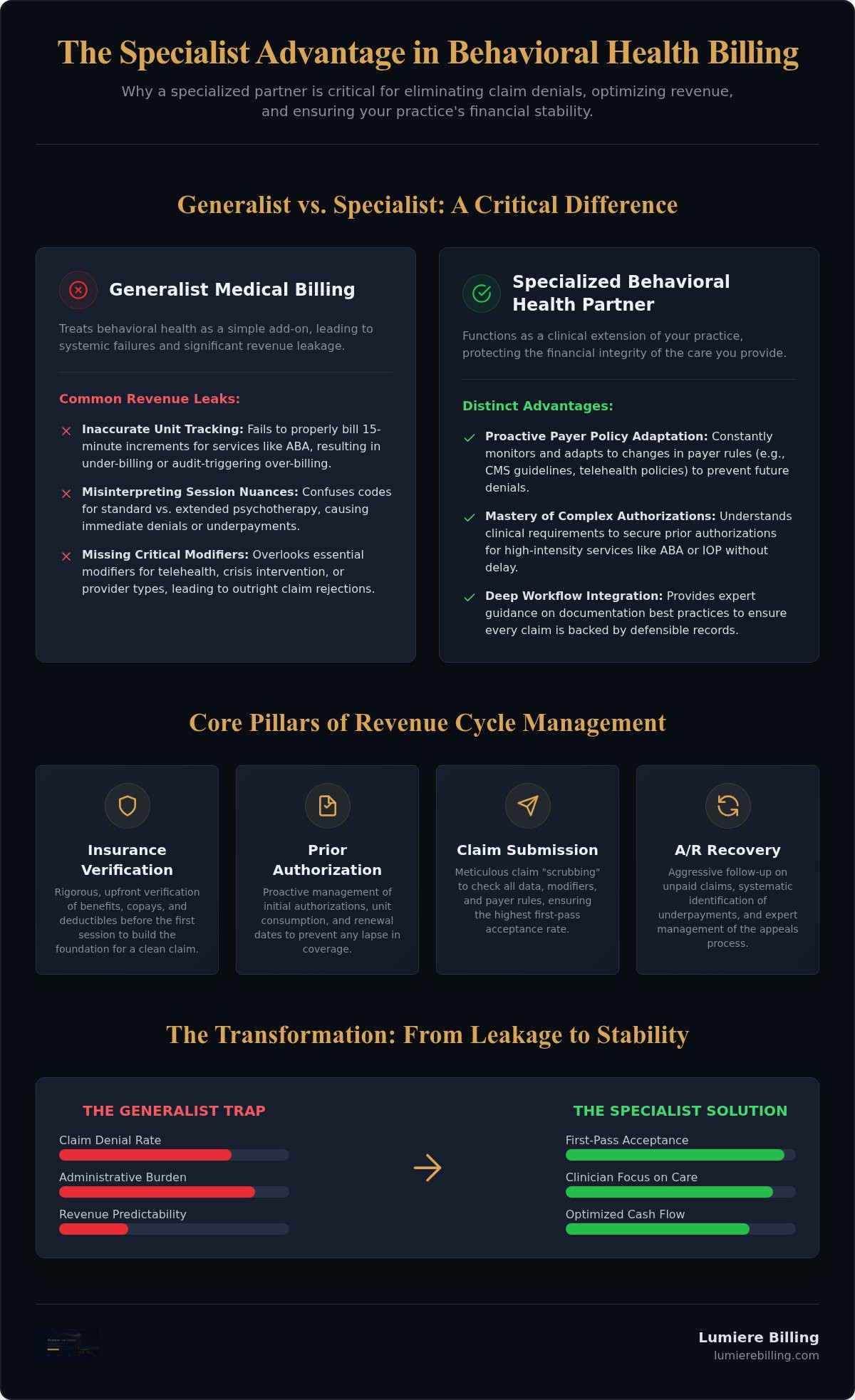
Choosing a billing partner is one of the most critical financial decisions a practice will make. Yet, many organizations default to generalist medical billing firms, assuming that a claim is just a claim. This is a costly mistake. General medical billing operates on a transaction-based model suited for procedures and office visits, a framework that fundamentally misunderstands the time-based, documentation-intensive nature of behavioral healthcare.
Generalist firms often treat behavioral health as a simple add-on to their primary care or surgical billing services. They lack the dedicated expertise to navigate the labyrinth of state-specific Medicaid policies, diverse payer rules for psychotherapy, and the unique challenges of ABA services. This gap in knowledge directly translates to higher denial rates, delayed payments, and significant revenue leakage.
A specialized behavioral health billing company, in contrast, functions as a clinical extension of your practice. They don't just submit claims; they protect the financial integrity of the care you provide. Their teams are fluent in the nuances of behavioral health coding, documentation requirements, and prior authorization strategies, leading to higher first-pass claim acceptance and a healthier revenue cycle.
Why 'Generalist' Billing Often Leads to Revenue Leakage
When a billing company doesn't live and breathe behavioral health, blind spots emerge that directly impact your bottom line. These aren't minor errors; they are systemic failures that compound over time, silently draining practice revenue.
- Inaccurate Unit Tracking: Generalist software and processes often fail to accurately track the 15-minute billing increments common in ABA therapy. This leads to under-billing for services rendered or over-billing that triggers audits and clawbacks.
- Misinterpreting Session Nuances: A lack of specialized knowledge leads to confusion between codes for standard and extended psychotherapy sessions. Incorrectly applying these results in immediate denials or underpayments that are rarely caught by non-specialist teams.
- Missing Critical Modifiers: Behavioral health claims require a host of specific modifiers to communicate the context of care—telehealth, crisis intervention, or services rendered by different types of licensed professionals. Generalist billers frequently miss these, causing claims to be rejected outright.
The Value of an Exclusive Behavioral Health Focus
Partnering with a firm that focuses exclusively on behavioral health transforms billing from a reactive administrative task into a proactive revenue strategy. This specialization provides three distinct advantages that generalists cannot match.
- Proactive Payer Policy Adaptation: Payers constantly update their policies for behavioral health services. A dedicated firm monitors these changes—from telehealth reimbursement shifts in the 2026 CMS guidelines to new authorization requirements from commercial insurers—and adjusts billing protocols immediately to prevent future denials.
- Mastery of Complex Authorizations: Securing and managing prior authorizations is a major bottleneck. A specialized team understands the clinical information payers need to approve care, especially for high-intensity services like ABA or IOP, ensuring treatment can begin without delay.
- Deep Workflow Integration: A true specialist understands the day-to-day realities of a clinician's workflow. They can provide guidance on documentation best practices that not only support clinical quality but also ensure every claim is backed by ironclad, defensible records.
Core Pillars of Behavioral Health Revenue Cycle Management (RCM)
Effective Revenue Cycle Management (RCM) is more than just submitting claims; it's a comprehensive, multi-stage process designed to maximize collections and ensure financial predictability. While some firms tout AI and automation as a silver bullet, sustainable success requires a blend of advanced technology and deep human expertise. A premier behavioral health billing company builds its service on four core pillars.
- Insurance Verification: The RCM process begins before the patient’s first session. Rigorous, upfront verification of benefits, copays, deductibles, and authorization requirements is the foundation of a clean claim cycle.
- Prior Authorization Management: This is the number one cause of treatment delays and lost revenue. Proactive management involves not just obtaining initial authorizations but tracking unit consumption and renewal dates to prevent any lapse in coverage.
- Claims Submission and Denial Prevention: Every claim is meticulously "scrubbed" for accuracy before submission. This includes checking for correct patient data, valid authorizations, appropriate modifiers, and compliance with payer-specific rules to achieve the highest possible first-pass acceptance rate.
- Accounts Receivable (AR) Recovery: The work isn't over when a claim is submitted. This pillar involves aggressive follow-up on unpaid claims, systematic identification of underpayments, and expert management of the appeals process for any denied claims.
Mastering Insurance Verification and Prior Authorization
The most effective way to manage denials is to prevent them from ever happening. This proactive stance begins with meticulous front-end processes that leave no room for error. A lapse at this stage guarantees revenue loss down the line.
- Verifying Benefits Before the First Session: Confirming active coverage is not enough. A specialist team digs deeper to verify specific benefits for outpatient behavioral health, telehealth services, and any relevant plan exclusions. This prevents the tragedy of providing unbillable care.
- Real-Time Authorization Tracking: For services like ABA, tracking authorized units against rendered services is critical. Sophisticated systems monitor this in real-time to alert clinical staff before limits are exceeded, ensuring every minute of therapy is compensable.
- Mitigating the 'Silent Denial' Risk: A "silent denial" occurs when a valid authorization exists, but it doesn't actually cover the specific service provided. This often happens with mismatched service locations or provider types. Only a specialist team knows to verify these finer details, protecting the practice from unexpected write-offs.
Aggressive Denial Management and Appeals
Even with the best prevention strategies, some denials are inevitable. How a billing partner responds is what separates an administrative vendor from a true revenue partner. An effective denial management strategy is swift, systematic, and clinically informed.
- Systemic Denial Categorization: Each denial is categorized to identify trends. Is one specific payer consistently rejecting claims for a certain service? Is a new clinician making a recurring documentation error? This data transforms individual denials into actionable intelligence for practice-wide improvement.
- The 48-Hour Rule: The longer a denied claim sits in AR, the lower its chance of being paid. Elite RCM teams operate on a strict timeline, working to correct and resubmit or appeal most denials within 48 hours of receipt.
- Crafting Clinical Appeals: When a denial requires an appeal, a generic response is insufficient. A specialized partner works with your clinical team to craft compelling, evidence-based appeals that articulate medical necessity in language that payers understand and respect.
Strategic Growth Through Credentialing and Analytics
For an ambitious behavioral health group, billing is not just about collecting on past services; it's about enabling future growth. Two often-overlooked functions—provider credentialing and practice analytics—are the engines that power sustainable expansion. Treating credentialing as mere paperwork or ignoring the story your data tells is a barrier to scaling.
A strategic RCM partner integrates these functions directly into your revenue strategy. Credentialing becomes a tool for market expansion, ensuring new clinicians can begin generating revenue immediately. Analytics becomes your practice's command center, providing the visibility needed to make confident decisions about hiring, expansion, and service line development.
Eliminating the Credentialing Bottleneck
Credentialing is the critical gateway to revenue. Delays in getting a new provider paneled with insurers mean lost income and frustrated clinicians. A dedicated credentialing team transforms this administrative hurdle into a streamlined process.
- Proactive Payer Contracting: The process begins with strategic payer contracting to ensure your practice is in-network with the key insurers in your market. This ensures a steady flow of patient referrals.
- Meticulous Roster Management: For large group practices, managing CAQH profiles, re-attestations, and payer rosters is a full-time job. A specialized service handles this maintenance seamlessly, preventing providers from being dropped from insurance panels due to administrative oversight.
- Preventing Revenue Holds: A well-managed credentialing process minimizes the "hold" period on a new provider's revenue. By submitting applications correctly the first time and following up relentlessly, a good partner can reduce the time from hire to first payment by weeks or even months.
Leveraging Analytics for Practice Visibility
You cannot manage what you cannot measure. A world-class behavioral health billing company provides more than just basic reports; they deliver actionable intelligence through transparent, easy-to-understand dashboards.
- KPIs That Actually Matter: Forget vanity metrics. Your focus should be on core financial health indicators: Days in AR, Clean Claim Rate (CCR), and Net Collection Ratio (NCR). These KPIs provide a true picture of your RCM performance.
- Spotting Payer-Specific Trends: Sophisticated analytics can quickly identify if a specific insurance company has suddenly started denying a particular service or systematically underpaying claims. This allows for immediate intervention before a small problem becomes a major financial drain.
- Identifying Revenue Leakage: Granular data can pinpoint revenue leakage at the clinician, location, or service-line level. This visibility helps practice managers identify needs for targeted training or make strategic decisions about which services are most profitable.
The ABA Specialist: Solving the Unit Tracking Puzzle
If behavioral health billing is complex, Applied Behavior Analysis (ABA) billing is the final exam. Its reliance on 15-minute time units, complex modifier usage, and stringent authorization requirements makes it a minefield for generalist billers. In fact, mishandling ABA billing is one of the fastest ways for a practice to face audits, clawbacks, and catastrophic revenue loss.
A true specialist behavioral health billing company must demonstrate profound mastery of ABA's unique RCM challenges. This includes reconciling rendered units against authorized units to prevent unbillable overages and managing the distinct billing requirements for services provided by RBTs versus BCBAs. This level of detail is non-negotiable for any practice offering ABA services.
Unit Tracking and Reconciliation Strategies
The core challenge in ABA billing is ensuring that every unit billed is both clinically justified and contractually authorized. This requires a system of checks and balances that connects the clinical, administrative, and billing functions of the practice.
- Real-Time Unit Consumption Tracking: The billing system must provide real-time visibility into how many authorized units have been used for each client. This prevents clinicians from inadvertently providing services that insurance will not cover.
- Automated EHR Reconciliation: A specialist partner automates the process of reconciling clinical session notes in the EHR with the units submitted for billing. This crucial step catches discrepancies before the claim is even created, dramatically reducing denial rates.
- Managing Service Splits: Billing correctly for different ABA services, such as direct therapy versus parent training, requires specific expertise. A dedicated ABA billing team ensures these services are coded and billed separately according to each payer's unique rules.
Navigating ABA-Specific Denials
Denials for ABA claims are often more complex than those in traditional psychotherapy. They frequently center on clinical documentation and perceived medical necessity, requiring a more sophisticated appeals strategy.
- Common Rejection Reasons in 2026: As payers refine their ABA policies, common denial reasons include mismatched location codes, incorrect rendering provider credentials, and failure to re-authorize in a timely manner. A specialist is already prepared for these evolving challenges.
- Addressing 'Medical Necessity' Denials: This is the most challenging type of denial. A successful appeal requires a deep understanding of how to use data from treatment plans and progress notes to build a compelling clinical case that justifies the level of care provided.
- Strategies for Multi-Disciplinary Clinics: For practices offering ABA alongside Speech, Occupational, or Physical Therapy, billing becomes even more complex. An expert partner understands how to manage concurrent billing and avoid payer edits that prohibit paying for multiple therapies on the same day.
Why Partnering with Lumiere Billing is the Logical Next Step
Making the decision to outsource your revenue cycle management is a commitment to the financial health and future of your practice. At Lumiere Billing, we don't see ourselves as a vendor; we operate as a direct extension of your clinical team, a dedicated partner invested in your success. Our exclusive focus on behavioral health means we understand your challenges, speak your language, and are singularly focused on protecting the revenue you work so hard to earn.
- An Extension of Your Clinical Team: We integrate with your practice to provide seamless support, acting as your dedicated financial advocates so your clinicians can focus on patient outcomes.
- A Transparent, Aligned Fee Model: Our percentage-based fee model ensures our incentives are perfectly aligned with yours. We only succeed when you do, eliminating the conflicts of interest found in other billing arrangements.
- Solutions That Scale With You: We provide customized RCM solutions that grow with your practice, from solo practitioners needing foundational support to large, multi-site groups requiring sophisticated analytics and enterprise-level management.
- Start with a No-Risk Audit: We believe in proving our value upfront. Our process begins with a Free Billing Audit to analyze your current RCM health and identify immediate opportunities for revenue recovery and process improvement.
A Partnership Built on Transparency and Results
Too many billing services operate as a "black box," leaving practice owners in the dark about their financial performance. We are built on a foundation of transparency, collaboration, and measurable results.
- Eliminating the 'Black Box': You get 24/7 access to our reporting dashboards, giving you complete visibility into every stage of your revenue cycle. No more guessing about the status of your claims or your practice's financial health.
- Strategic Collaboration: We schedule regular strategy calls to review performance, discuss payer trends, and align on growth goals. This is a partnership, not a transaction.
- Direct Expert Access: When you have a question, you won't be routed to a generic call center. You will have direct access to the team of behavioral health billing experts who manage your account.
The Path Forward: From Audit to Optimization
Transitioning your billing can feel daunting, but our structured process is designed to be seamless and immediately impactful. It all starts with understanding where you are today.
- Your Free Billing Audit: In this complimentary, no-obligation analysis, our experts will perform a deep dive into your recent billing data to identify issues like denial patterns, underpayments, and compliance risks. We'll provide you with a clear report of findings and a strategic plan for improvement.
- Seamless Onboarding: If you choose to partner with us, our dedicated onboarding team will manage the entire transition, ensuring there is no disruption to your cash flow. We handle the credentialing transfers, system integration, and workflow training.
- Take the First Step: Stop letting claim denials and administrative burdens dictate your practice's potential. Take control of your financial future and empower your team to focus on patient care.
Schedule your Free Billing Audit with Lumiere Billing
Frequently Asked Questions (FAQs)
- What is a behavioral health billing company and why do I need one?
- A behavioral health billing company is a specialized firm that manages the entire revenue cycle for mental health and ABA practices. Unlike general medical billers, they have deep expertise in the unique codes, modifiers, payer rules, and authorization processes specific to behavioral healthcare. You need one to reduce claim denials, accelerate payments, ensure compliance, and free up your clinical staff to focus on patient care rather than administrative tasks.
- How do behavioral health billing services differ from general medical billing?
- The primary difference is specialization. Behavioral health billing is time-based, not procedure-based, and relies heavily on complex prior authorizations and specific documentation to prove medical necessity. General billers often lack the systems to track therapy units correctly or the expertise to appeal clinically complex denials, leading to significant revenue loss for practices.
- What are the common service codes used in behavioral health billing?
- While specific codes are used to denote services, it's more important to understand the categories they represent. These include diagnostic assessments, individual and group psychotherapy sessions of varying lengths, family therapy, crisis intervention, and specialized services like ABA. A professional billing company ensures the correct codes and modifiers are used based on the clinical documentation, provider type, and payer contract.
- How does a billing company help reduce claim denials for mental health?
- A specialized company reduces denials through a proactive, multi-step process. This includes rigorous upfront insurance verification, securing and tracking prior authorizations, "scrubbing" every claim for errors before submission, and using analytics to spot negative payer trends early. For any denials that do occur, they manage a rapid, clinically-informed appeals process.
- What is the typical cost for outsourcing behavioral health billing?
- Most specialized behavioral health billing companies operate on a percentage-based fee model, typically charging a percentage of the total revenue they successfully collect for the practice. This model aligns the billing company's incentives with the practice's success. Rates vary based on practice size, claim volume, and complexity, but the goal is always for the service to generate a return on investment through increased collections and reduced administrative costs.
- How does ABA billing differ from standard mental health billing?
- ABA billing is significantly more complex. It is based on 15-minute units, requires meticulous tracking of rendered versus authorized units to prevent clawbacks, and involves a different set of codes and modifiers for services delivered by different provider types (e.g., RBTs and BCBAs). It demands a level of specialization that even many behavioral health billers do not possess.
- Can a billing company help with provider credentialing and enrollment?
- Yes, a comprehensive RCM partner should offer provider credentialing and enrollment services. This is a critical function for growing practices. They manage the entire process, from initial payer applications and contract negotiations to ongoing maintenance of provider profiles (like CAQH), ensuring new clinicians can start seeing insured clients and generating revenue as quickly as possible.
- What should I look for in a behavioral health billing audit?
- A thorough billing audit should go beyond surface-level denial rates. It should analyze the root causes of denials, identify underpayments by comparing payments to contracted rates, assess the accuracy of coding and modifier usage, and evaluate the efficiency of your accounts receivable follow-up process. The audit should provide a clear, actionable report on specific areas of revenue leakage and a strategic plan to fix them.